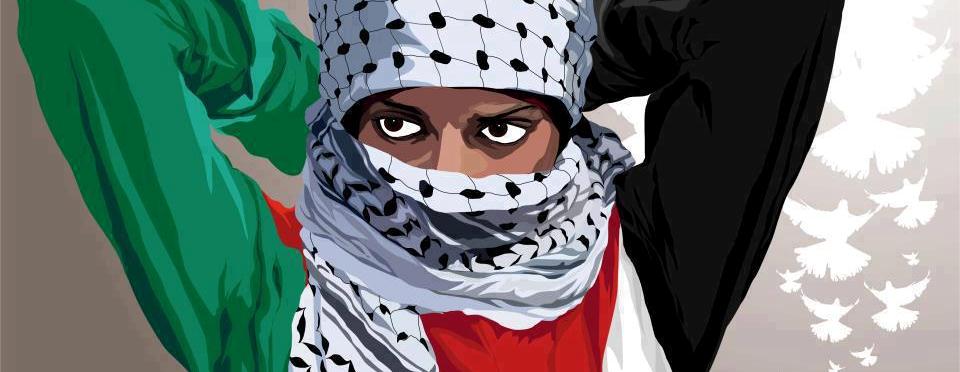
What was supposed to be a wedding ended up a funeral

Samer and his mother
“Samer will get engaged!” My friend Loai said with a big laugh. “Oh my God! Really? When?” I burst out with an endless list of questions and exclamations in my head.
Samer Abu Seir is an ex-detainee who was released in Shalit’s prisoner exchange and deported from Jerusalem to the Gaza Strip. Getting married should not be surprising for a single man at the age of 46. However, Samer is one of the few released prisoners who was cautiously considering getting married especially after he spent more time in the Israel jails than he spent outside. I remember when I first met him and asked him how long he had been detained and he answered me sarcastically, “Nothing! It was only a matter of 24 years passed like a blink of an eye.”
He always thought that he needed time to keep up with the updates of the outside world that occurred without him noticing. He always felt that he needed to be accustomed to seeing the blue sky, the green trees, the crowded buildings, walking on Gaza’s beach and feeling its breeze smoothly hitting his cheeks, instead of being under that dark-gray ugly ceiling, in a narrow jail, and between the same four surrounding walls where neither sunshine nor air could sneak in.
“What was the reason behind this sudden decision?” I asked. “His 83-year-old mother is in a grave situation,” Loai replied. “He rushed this just to make her happy, so if she dies, she can rest in peace.”
Samer has grown up fatherless. He lost his father when he was a little child when he was away in Jordan. His widow mother had raised him along with his other two brothers and two sisters by herself. He thinks the whole world of her. She is a symbol of motherhood who had raised her children on the noble values of love, dignity, and sacrifice for Palestine. She believed that there is always a price for everything you fight for, and she has instilled these beliefs in her children. Samer and his family have paid the price in many ways. The simplest example of pain that he has always endured was that his family never gathered for a meal. There was always at least a member missing.
Samer had always suffered the ban of family visits for long periods, especially during his detention in solitary confinement for 3 years and a half. These times were the most difficult that Samer lived inside prison as he constantly kept thinking about his mother and fantasizing how her wrinkles beautifully spread in her beautiful loving and peaceful face. The family visits were his only connection with the outside world. Once a family visit ended, he eagerly waited for the next one.
Moreover, Samer had always led unsettled life in prison as he was moved around to every one of Israel’s prisons. Samer’s constant thinking of his mother made it more painful for him to tolerate such inhumane practices of the Israeli Prison Service (IPS). Samer’s mother never let that or any of the humiliating actions she received from strip searches and insults hold her away from having 45-minute meeting with her son through a barrier between them.
Even after Samer was released, she didn’t stop suffering. She handled the pain of Samer’s 24 years of imprisonment without complaining, and then she kept suffering the pain of him being forcibly deported away from her. This is another violation of Article 49 of the Fourth Geneva Convention which prohibits deporting people within or outside the occupied territories.
While thinking about Samer’s motive to get married, I recalled his cute old mother who arrived to Gaza almost a week after the prisoners’ exchange, challenging her age and deteriorating health condition. Last November, I joined my family to a celebration of freedom where almost no one was taking seats, all people were happily performing Dabka, the folk dancing of Palestine, and waving Palestinian flags as revolutionary songs were playing loudly in the background.

Samer’s mother dancing celebrating her son’s freedom
There, my eyes fixed on an elderly woman wearing the Palestinian traditional dress. She could barely walk or stand but her happiness gathered all the strength inside her to dance slowly and erratically. My eyes were following her with joy and wondering who she was. I asked Dad about her. “She is Samer’s mother. Wherever you see her, she is dancing. When she gets out of the car, she dances. when someone visits her at home to congratulate her with her son’s freedom, she dances. Look how happy she is!” Dad answered smilingly. “She reminds me of your grandmother who was just like that when I was set free. All the Gaza Strip would hear of my freedom because of her. She’d be dancing and singing songs of freedom wherever she went.”
Samer was enthusiastically going to officially get engaged today’s evening and let his mother declare his engagement from Jerusalem through Skype. But destiny stood against his intentions of making his mother happy. Sadly, this morning he woke up on hearing the news of his mother’s death and what was to supposed to be a wedding turned out to be a funeral.
I am thankful that at least she lived long enough to celebrate her son’s freedom. This reminds me of another story I wrote last December of a mother of two former prisoners who have been deported from Hebron to Gaza, and who died a week after she arrived to Gaza and wrapped her two sons between her arms once again. Please say a prayer for Samer and his family.
My father’s memories of his release from Israel’s “graves for the living”
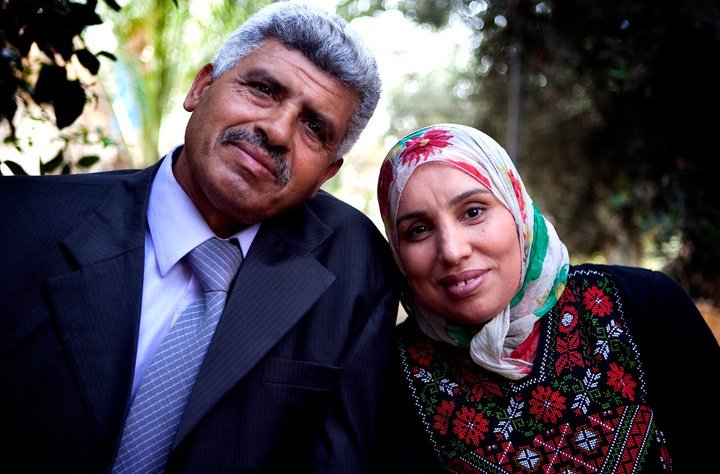
My amazing parents met after Dad’s release, fell in love, and got married. I’m proud I’m their daughter. ( Nathalie Beser)
Twenty-seven years ago, my father’s eyes saw the sun after being in the dark of Israeli prison for 13 years. On 20 May 1985, my father regained his freedom.
“I was sentenced for seven lifetimes plus 10 years and I thought that this prison, Nafha, would be my grave. Thank God I didn’t stay that long there, and I was set free to marry your mother and to bring you to this life,” my father told me, smiling. He considered the 13 years of misery as not that long. Yes, it’s not that long if compared with the life sentence to which he was bound if the deal to exchange Palestinian and Israeli prisoners didn’t happen.
No regret
I can’t recall that Dad ever showing any regret or sorrow for how the precious years of his youth were stolen from him. His prison experience is instead his song of life. He believes that it is his treasure, the reason behind his rich culture and beliefs, his strong character, his intimate friendships, and the reason why he values life. I’ve always been proud that I am my Dad’s daughter, and I’ll always be. He is a mix of experience and knowledge.
The story of the exchange deal all started when Ahmad Jibril of the Popular Front for the Liberation of Palestine captured three Israeli soldiers (Yosef Grof, Nissim Salem, Hezi Shai) in revenge for thousands of Palestinian prisoners kidnapped by Israel without any apparent reason. After a long process of negotiations, both sides struck a deal that Israel would release 1,250 prisoners in return for the three Israelis that Jibril held captive. My father was included in the deal, and fortunately, he was set free. Among the prisoners released were the Japanese freedom fighter Kozo Okamoto who had been sentenced to life imprisonment, and Ahmed Yassin, the leader of Hamas who was sentenced to 13 years imprisonment in 1983.
History repeats itself
History repeats itself. On 18 October last year, we experienced a similar historical event with a swap deal involving the Israeli soldier Gilad Shalit, who was arrested by the resistance in Gaza while he was on top of his war machine (an Israeli tank). Just like what happened with Shalit, the capture of three Israelis caused uproar in the Israeli public opinion and international media at that time, but the thousands of Palestinian prisoners behind Israeli bars were not noticed, except for by the resistance fighters that have always forced Israel to meet some demands regarding the Palestinian prisoners.
When I deeply think about these events and the way the international media reacts, I get angry at how unjust this world is. Why did the world make a big deal of Shalit and the three soldiers when they were attested by the “terrorist” Palestinians while thousands of Palestinian political prisoners are left behind in Israeli jails enduring all forms of violations and torture and the world chooses to look away?
My father told the story with tears struggling to fall. He was staring at a picture stuck on the wall of his room; a painting that my father drew during his imprisonment of flowers blooming among barbed wires. “I cannot forget the moment when the leader of the prison started calling off the names to be released,” he said.
Mixed emotions
Among the prisoners was Omar al-Qassim, a leading member of the Democratic Front for the Liberation of Palestine. Al-Qassim was asked to read the list of the names loudly. He was so excited at the beginning hoping that his freedom would be restored. Every time he said a name, a scream of happiness convulsed the walls of prison. Suddenly, his face’s features started to change. He became reluctant to speak because he noticed that his name wasn’t among the names. This was another incident of psychological torture that the prison’s manager committed against him. But he left him no chance to make fun of him. He withdrew himself silently and went to his prison to continue with his resistance. Sadly, he died in a horrible narrow cell after 22 years of resistance, pride and glory.
The tears of happiness and sadness mixed together. The freed prisoners were happy to regain their freedom but they were upset at leaving the other prisoners in that dirty place where the sun never shines. “We were like a big family sharing everything together. We all handled the same issues that we were united to fight for,” my father said. “Although I am free now, my soul will always be with my friends who are still suffering in there.”
My father has always said that “prisoners are the living martyrs.” He also described Israeli jails as “graves for the living.” Let’s unite and use all the means available to help 4,653 Palestinian political prisoner have fewer years of suffering. We share this responsibility as we can’t leave them as prey for those criminal jailers. Their freedom will be a triumph for humanity.
Note: Read this in Italian here. Many thanks for Emanuele Qalitry for translating it!
On Deported Palestinian’s Day, a deported man describes his life as “never settled”

An old photo of the photo besieged insid the Church of Nativity in 2002
On May 10, 39 Palestinians from Bethlehem completed eleven years of deportation from their precious homes. On the very same day, eleven years ago, they were expelled from the Church of Nativity after a siege by the Israeli Occupation Forces that lasted for 39 days: 26 men went to Gaza, 13 to Europe. Since that tragedy, which marked another form of ethnic cleansing, this day has been called ”Deported Palestinian’s Day”.
Since the last swap deal in October, hundreds of Palestinians have joined this category, as 203 ex-detainees were convicted to indefinite deportation. Moreover, ex-detainee Hana’ Shalabi was recently deported from Jenin to Gaza after hunger striking for 45 days to protest having been re-detained after midnight by a huge, aggressive force of Israeli soldiers, and held under administrative detention on February 16. Israel has intensively deported people from the West Bank to either the Gaza Strip or countries such as Turkey, Syria and Qatar. Israel offered administrative detainees Bilal Diab, Thaer Halahla, and Jafar Ez Al-Din Qadan, all on hunger strike for over two months, deportation to Gaza, but they refused this horrible offer and bravely insisted on continuing their battle of empty stomachs against Israel’s injustices and violations.

Mr. Fahmi Kanan and other Palestinians including deported ones from the church of Nativity marching on Deported Prisoner’s Day calling for ending their exile.
On May 10, hundreds of people from all generations marched to the sit-in tent for Palestinian political prisoners in Gaza to share the continued suffering of the deported Palestinians. The experience of exile, with all its pain, repeats itself hundreds of times in Palestine at the hands of Israel, as it openly violates the same Geneva Convention it ratified in 1951.
One of the people I am very proud to have met through the weekly protest for Palestinian detainees is a deportee from the Church of Nativity, Fahmi Kanan. Fahmi has been a good friend of mine, despite our difference in age: He is 43 years old, while I am only 20. He makes sure to attend every Gaza activity organized in solidarity with the Palestinian detainees and their families.
I remember very well Mr. Fahmi’s touching words when I first met him and asked him about the reason for his dedication to the detainees’ cause. “I have never lived a settled life,” he said. “First, I was born in a land under occupation. Secondly, I lived the hard life of detention inside Israel’s prisons five times, each under administrative detention. I was only a 17-year-old teenager when I was first detained. Thirdly, when I’m not detained, wherever I walk within the Palestinian territories, I’m ‘wanted’ and chased by the Israeli Occupation. Fourthly, I was one of the people besieged inside the Church of Nativity in 2002, then deported to Gaza. Our sufferings take different forms, but all of them result from one thing – Israel.”
Afterward, I learned that Mr. Fahmi is the spokesman for the people deported from the Church of Nativity. Having a shared passion for a just cause, Mr. Fahmi and I get along well. He always brings his kids with him to the protest for detainees. I’ve gotten to know him as a person, not merely as a political activist. I believe that children are reflections of their parents. In Mr. Fahmi’s case, his children are outstanding reflections. I always tell him, “If I ever have a child, I’d like to raise her or him the same way you did.” I see a bright future for Palestine through his kids who are, despite their young ages, very well-educated about Palestinian issues.
On the second day of Eid al-Adha last year, I saw him with all his kids in the weekly protest for detainees outside the International Committee of the Red Cross. When I asked him how his family in Bethlehem was doing, he replied, “I was on the phone with Dad this morning, greeting him for Eid. He is getting older. He fears that his death will be soon as he suffers from some health problems. My heart aches when he tells me that he wishes he could see his grandchildren before he dies.” I asked his 11-year-old son Nasr whether he was enjoying his Eid or not. He replied with a sad look on his face, “I feel like it is the same as any other day. All our relatives are in Bethlehem, and Eid without family is tasteless.” His words touched me very deeply.

Two of Mr. Fahmi’s cute kids, Nasr and Israa, and I in a park in southern Gaza during Al-Adha Eid last November.
When I shared with Mr. Fahmi what his son told me, he answered, “My kids were raised without their grandparents or relatives around. The times I was questioned about them are countless, especially during our traditional and religious feasts. But thankfully, they are smart enough to understand that this is one of the prices that Palestinian people pay for being merely Palestinian. And they are proud!”
Yesterday, Mr. Fahmi made a moving speech that showed the humanitarian aspect of a deported Palestinian’s suffering. “The hardest times in a deported person’s life are the times of need,” he said. “Today, we should remember Abdullah Dahoud, one of the 39 deported from the Church of Nativity. Sadly, he could not be among us today. He died of sorrow over his mother and sister, who passed away without him seeing them for one last time. When he was once asked about his fondest wish, he said, ‘I wish I could read a verse of Qura’n next to my mother’s grave.’”
Palestinians consider the United Nations a partner of the Israeli Occupation because of its silence. Security Council Resolution 607 “[c]alls upon Israel to refrain from deporting any Palestinian civilians from the occupied territories” and “[s]trongly requests Israel, the occupying Power, to abide by its obligation arising from the Convention.” But when it comes to reality, the UN chooses to take no action against Israel’s violations. We, the Palestinian people, don’t want resolutions, we want actions! We want real justice, not just words tossed into the air!
“Only one of my three sons is left and is locked behind Israel’s bars”
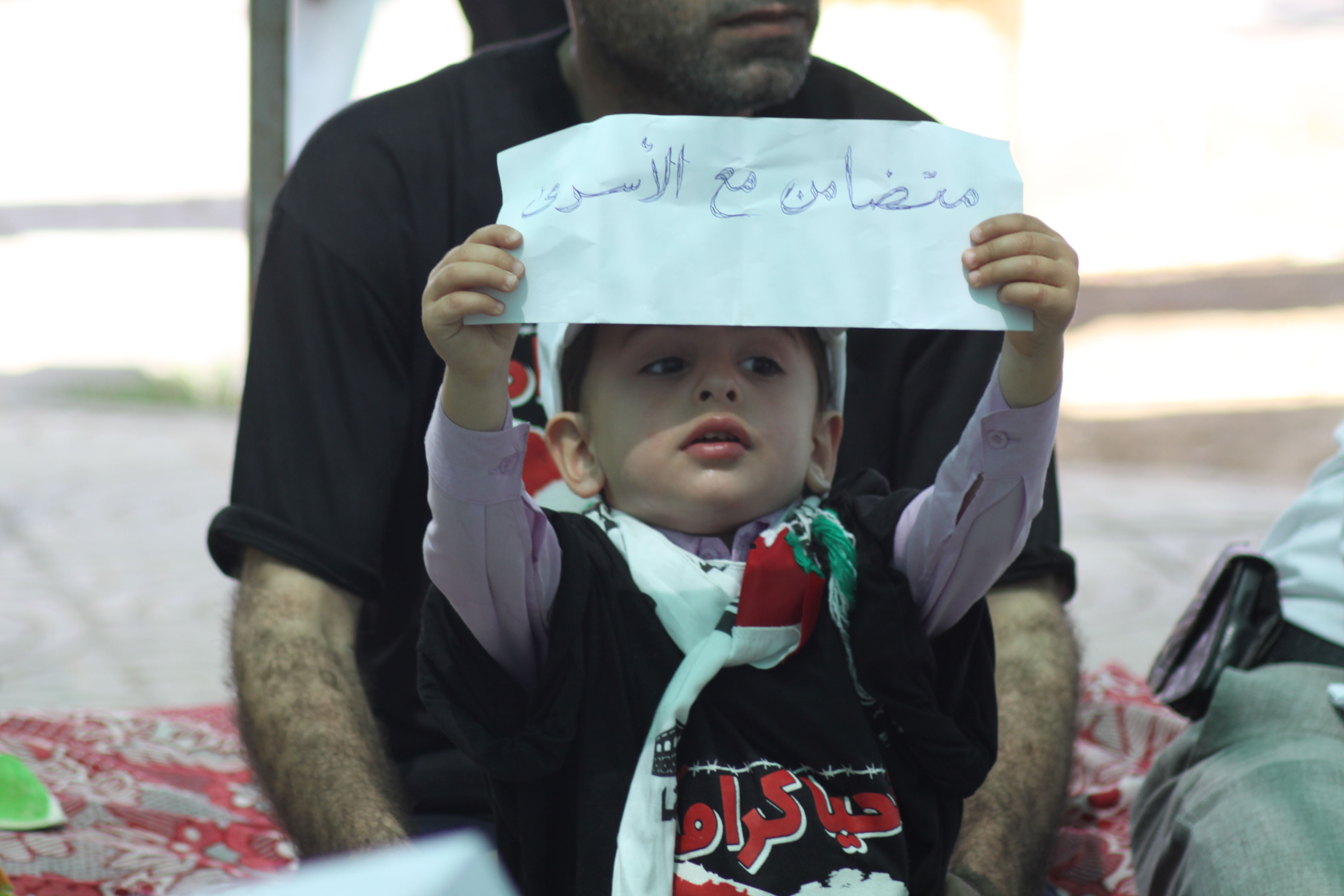
A hunger striker’s son in Gaza’s sit-in tent carrying a sign reading “I am in solidarity with Palestinian detainees”–By Mjd Abusalama
The sit-in tent for Palestinian political prisoners has been moved from the International Committee for the Red Cross to a central park near the statue of the Unknown Soldier in the middle of Gaza City. It is one of the few green places and thus one of the most lively places in Gaza, where people escape from their dark houses and seek fun and relief, or to simply waste their times observing others. However, the sit-in tent is now used differently, to send messages of solidarity with our Political prisoners who have been on a mass hunger strike since April 17, and to show anger with the Arab and international community and all human rights organizations, which keep calling for human rights, democracy and justice, but when it comes to our prisoners, they do nothing but watch them dying and remaining helpless.
The solidarity is taking many forms, such as lighting candles, making marches, creatively performing plays, songs, poetry and Dabka, joining a symbolic hunger strike. In Gaza’s sit-in tent, 50 men and 45 women have joined a symbolic hunger strike in solidarity with the detainees since May 2, including prisoner’s wives, parents, sisters and former prisoners. Those people have been protesting day and night. The tent is their shelter as long as the revolution of hunger is going inside Israeli prisons. Having been in the solidarity tent daily, even more than in my house, I’ve witnessed most of the cases among hunger strikers whose health conditions got deteriorating. Several cases were sent to hospital for low or high blood pressure and so many people fainted or emotionally collapsed. Ambulances and doctors never leave the tents anymore as if they have full time job at the tent.
While observing the hunger strikers getting paler as more days pass, I can’t help but think of our heroes, our prisoners behind Israel’s bars and compare. The strikers here have access to water and salt and they also have a small dish of yogurt and soup per day. But our prisoners have nothing but water and salt, ‘in case it’s not confiscated by the Israeli Prison Service (IPS).’ Strikers here can rest or sleep whenever they feel like it, but our prisoners keep being transferred between sections and prisons by the IPS attempting to exhaust them. Loai Odeh, a former prisoner who is also now on a hunger strike in solidarity, emphasizes that the IPS mercilessly prevents the strikers from resting, with these words he wrote recalling his experience of hunger strike during the campaign of disobedience. “Soldiers burst into strikers’ rooms aggressively as if they were confronting armed fighters on a battleground, not hunger strikers with feeble bodies that can barely stand. Knowing that strikers are intolerant of noise, soldiers break into their rooms with loud screams and initiate a hand search in a way that one feels that he’s being beaten rather than searched.”

Loai Odeh and Abu Hosny Al-Srafity in the sit-in tent
While making the daily tour to show support and admiration to the hunger strikers in the tent, I was surprised to see Abu Hosny Al-Srafity wearing the strikers’ t-shirt that distinguishes them from others, and which beautifully designed with the Palestinian flag with “we’ll live dignified” written on it. Abu Hosny is a 66-year old detainee’s father whom I met since I started going to the weekly protest in the ICRC for political prisoners. Whenever we meet, we greet each other and have a short and informal conversation, but never had a real one that would make me feel like knowing him intimately. Finally, I had this conversation with him after I said “You, too?” out of surprise reacting to seeing that t-shirt.
“Absolutely!” He powerfully confirmed. “We took this step because we consider ourselves as partners in this battle of dignity but our hunger strike remains symbolic at the end of the day. It equals nothing of our detainees’ enormous suffering under the Israeli oppressive regime. They aren’t only hungry for food, they are hungry for dignity, justice, and freedom.”
He refused to let his age be a barrier in front of standing with his son Ali who was detained for 10 years and still has six to go. Doctors keep pressuring him to break his hunger strike but he refuses saying that “my life isn’t any more precious than that of my son.”
Our conversation was still in the beginning. What came next was heartbreaking. I was amazed at his high spirit and his determination but this profound chat we had clarified to me where he got that strength from.
“Ali is the only son left.” He said. “Left?” I interrupted. Then he moved his below to take a photo he kept below and started explaining. “I had three sons. My oldest son Hosny and my youngest Mohammed were killed and the one in the middle is behind Israel’s bars.” I felt raged and asked how. “In 2004, I was sitting with my wife chatting alone about the terrifying sounds of warplanes that occupied Gaza’s sky. We knew an attack was coming. Then a loud expulsion was heard and shook the land below us. We were in indescribable panic. My wife prayed, “May Allah stand with the mothers of the targeted people.” Then she answered the phone that informed her about the assassination of her oldest son, having no idea she was praying for herself.”
It was very hard to keep control of my emotions after hearing that tragedy. I continued looking directly at his eyes that were full of sorrow and listened silently. “Wait. The next story is even more shocking.” He said. “I was on my way home from a family visit with my wife and my seven-year-old son Mohammed in 1994. We were close to the eastern line, near Naheloz settlement. While standing in the street and waving for cars to take us back home, we suddenly glanced an Israeli car and a jeep driving too fast toward us. We got confused and scared. They intentionally smashed my son under their wheels, hit my wife and badly injured her and kept driving fast toward the settlement. It was horrible. It all happened so quickly that I couldn’t rescue my son who froze out of fear in front of that heartless driver who killed him and didn’t bother to even look back.”
Abu Hosny stopped talking to see my reaction but I was too shocked to utter any word after hearing that horrible incidents. His voice narrating the stories of the murder of his two sons kept replaying in my ears, and my tears kept flowing and the features of shock didn’t leave my face. He saw me in that condition and softly tapped on my hand and said, “Don’t be sad, my daughter. As long as we’re living on these holy lands of Palestine, we’ll never get fed up giving any sacrifice. These unjust and unsecure lives we’re leading are the source of our inner strength and determination. If that wasn’t the case, you wouldn’t see me now hunger striking in solidarity with my son, the living martyr, with hope to celebrate his freedom soon.”
Let’s pray to all detainees’ families to celebrate the victory of their detained sons in their battle of empty stomachs against the armed merciless jailers and pray that this victory will result in allowing them to visit their sons after over 6 years of family visits’ ban. Let’s support our prayers with taking serious actions.
A morning in Gaza’s sit-in tent for Palestinian political prisoners
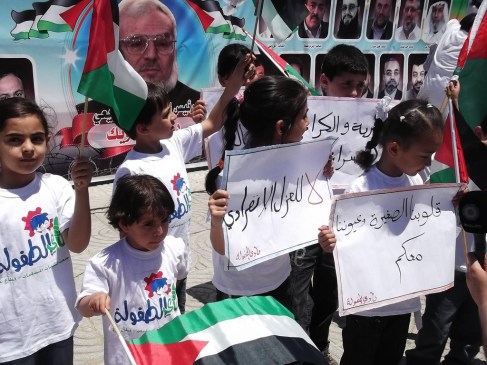
Kindergarten kids carry signs reading, “No to solitary confinement”, “Freedom and dignity for Palestinian political prisoners”, “Our little heart and minds are with you”– by Joe Catron
This morning was very eventful one in the Gaza sit-in tent. As I arrived around 10:00 am, more than a hundred kids, each about four years old, entered the tent. They looked very beautiful and innocent. They came from Gassan Kanafani’s kindergarten carrying signs like “I want to hug Dad,” “I want Dad to be free,” or “Freedom for Palestinian political prisoners.”
They didn’t fully understand why they were there, but their participation put smiles on the faces of the hunger strikers and the detainees’ families, who joined their soft voices while chanting along with them: “Free, free Palestine!” All generations united their voices to call for the victory of our political prisoners’ battle of dignity, which continues for the 23rd day.

Hassan Salama’s mother in Gaza’s sit-in tent
Soon after that, a 75-year-old woman entered the sit-in tent in a wheelchair, surrounded by a crowd of photographers and other people. I wondered who she was, then discovered that she was Hassan Salama’s mother. Despite her age and her medical condition, she insisted on visiting the tent to show solidarity with her son, who has been in solitary confinement for 13 years. She gave a revolutionary, emotional speech that inspired many listeners and made them cry, especially when she said, “My son is my sacrifice to Palestine.” She and all detainees’ mothers are symbols of the resistance.
We consider solitary confinement one of the most horrible crimes and among the most difficult punishments inflicted on our brave detainees by the Israeli Prison Service. Its main goal is to destroy the prisoner’s mind and devastate his psychological and physical health as quickly as possible. Ending this unjust policy is one of the most important demands our prisoners aim to achieve from this strike, as it constitutes a grave violation of their rights to personal liberty, bodily integrity, and dignity.
After that, hundreds of Palestinians marched in solidarity with the2002 deportees from the Church of Nativity in Bethlehem. May 10 marks the eleventh anniversary of their exile. They were promised that they would be allowed to return after two or three years of deportation, after 11 years, they’re still refugees in the Gaza Strip. Deportation is a terrible violation of Geneva Convention IV and a form of ethnic cleansing that Israel continues to use against Palestinian people. Recently, administrative detainee Hana’ Shalabi was deported to Gaza and promised she could return to Jenin after 3 years of exile, but who knows if she’ll ever be allowed back or forced into exile forever?
Hunger strike diaries: the fate of Palestinian political prisoners is “our shared responsibility”

Loai Odeh (in foreground) at a solidarity tent where supporters of Palestinian prisoners are on symbolic hunger strike. (Majd Abusalama)
Loai Odeh (in foreground) at a solidarity tent where supporters of Palestinian prisoners are on symbolic hunger strike.
Loai Odeh is a former political prisoner who was released from Israeli prison in theprisoner swap deal last year and forcibly transferred from Jerusalem to Gaza; before his release, Loai took part in the 22-day mass hunger strike launched at the end of September 2011 to protest cruel conditions and an escalating series of punitive measures against Palestinian prisoners.
Loai has published on Facebook very expressive, moving and informative diaries chronicling the experience of a hunger striker (see my translation of the first eight installements of Loai’s hunger strike diaries, pubilshed on 24 April). His last status update was on the 15th day of the hunger strike, just before he went on open hunger strike along with fifty other people on the 16th day of the mass hunger strike. They have taken the sit-in tent in Gaza as their shelter, which they say they will not leave unless our prisoners stop suffering. They couldn’t stand watching our prisoners going through slow death without doing anything in solidarity, so they have gone on a symbolic hunger strike that aims to draw attention locally and internationally to the prisoners’ just cause.
I took the initiative to translate the rest of Loai’s diaries from Arabic, hoping to inspire everyone who reads it, just like they inspired me.
On April 25, Loai wrote:
Today is the ninth day of heroism. Our strikers have already endured a long time of suffering and loss of weight. The provocative practices of the Israeli Prison Service (IPS) keep escalating. The searches get more intensive and violent. But we should keep in mind that “search” policy according to Israel’s oppressive administration involves different processes.
During ordinary days, the purpose of searches is to find the contraband that our prisoners managed to smuggle in to ease their difficult lives. However, during a hunger strike, the only purpose of a search is to tire our strikers physically and psychologically. Soldiers burst into strikers’ rooms aggressively as if they were confronting armed fighters on a battleground, not hunger strikers with feeble bodies that can barely stand. Knowing that strikers are intolerant of noise, soldiers break into their rooms with loud screams and initiate a hand search in a way that one feels that he’s being beaten rather than searched. Whoever refuses to undergo these “searches” gets beaten up and is plunged directly into solitary confinement. The prisoners are then left in a yard outside with no place to sit for hours while their rooms are turned into a complete mess. The contents of the rooms are heaped into a single pile, indiscriminate of who they belong to, disheartening the prisoners when they return and discover the pile that they are faced with sorting through and straightening out. Moreover, they tear off their mattresses’ cover sheets that take strikers a long time to put back or replace. Even during ordinary days these searches are tiring, so imagine how they are during hunger strikes. Jailers subject prisoners to these searches several times a day, leaving them for hours under the burning sun or in the cold night air while conducting the searches.
However, our heroes’ determination and their solid commitment help them to neglect the guards’ provocative and humiliating practices as they realize that challenging is a needed weapon to go on and win over the IPS’s oppression. Solidarity movements have to use all the means available to help them have fewer days of suffering.
On April 26, Loai wrote:
Today marks the tenth day of the hunger strike. Despite the multitude of searches and the pains of hunger, our heroes manage to maintain their smiles. They are stronger as they are armed with souls that can never be submissive, even during hunger. Their sense of humor stemming from their pain becomes their sweetest memories during imprisonment. Abstaining from food for a long time doesn’t mean that they stop thinking about it. Instead, strikers start thinking about which meals they like or dislike. Actually the meals that they don’t like come to their minds even more intensely than the meals they prefer as they regret not appreciating the blessings and satisfaction of those meals when they ate them in the past.
In fact, it does often happen that after hunger strikes, many strikers start eating foods that they have never liked. The talk about these unfavorable meals which suddenly become desirable creates a humorous atmosphere among them during their strikes. One of them acts as if he is the one whose responsibility is to cook for everyone. They start imagining the smell and taste of their favorite meals while making funny comments that uplift their spirits and make them stronger.
It’s important to know that these thoughts of food arouse their hunger and thus cause their stomachs significant pain, and the laughter gives them headaches. However, they do their best to keep smiling regardless of the heavy price they are paying, believing in the importance of keeping their spirits at ease. They are stronger than all of us because they have high spirits, armed with conviction that the smiles of Palestine’s children are worth their sacrifice.
On April 27, Loai wrote:
Today is the eleventh day of the battle, the hunger strike for the sake of dignity and freedom. Fear of an organ failure increases as the physical sores worsen. All strikers start to suffer from toothaches and backaches that worsen due to the lack of proper medical care.
During ordinary days, their demands to have dentist appointments take months to be granted. Even when one finally gets an appointment, he has his tooth pulled or receives a temporary and incorrect treatment. And then there is the waiting room, which is extremely hot in summer and freezing in winter, where a prisoner is left for hours to wait in before he is allowed in to see the dentist. The waiting room conditions make these rooms seem like rooms for torture, not for waiting, and thinking of these rooms makes prisoners avoid demanding medical appointments, except for the utmost necessity.
Tooth and back conditions intensively deteriorate during the hunger strike. Pain gets unbearable, causing them sleepless nights. Despite that strikers tend to sleep, to rest, to stretch their bodies. Their backaches are caused and exacerbated by their thin mattresses placed on iron beds, which aren’t flat, preventing them from sleeping or resting properly.
These pains make them more determined to accomplish their goals as they believe that their victory will improve the medical care they get. “Stop medical neglect” is on the top of slogans that our prisoners are demanding of the IPS with their empty stomachs. It’s the duty of everyone whose conscience is awakened to support our prisoners so that they can achieve a victory that guarantees their simplest humanitarian rights.
On April 28, Loai wrote:
Today is the twelfth day of the hunger strike. After twelve days of hunger, our prisoners are increasingly eager to hear news regarding their strike that may contribute at ending their suffering. Usually, not all prisoners join the strike all at once. However, as more days of hunger strike pass, strikers’ number increases.
I assume that most of you wonder why all prisoners don’t join the hunger strike with their comrades. For this question to be answered, we should keep in mind that the success of the hunger strike depends on three main factors.
The first factor is the internal preparation, including the process of selecting leaders and their framework — the strategy for negotiating with the IPS, and preparing the needed publications to prepare youth for the battle by making them aware of the side-effects and the psychological circumstances that they may go through during the hunger strike.
The second factor is the external political situation. The political situation must be suitable to start the strike as it’s not logical to start it while a war, during a major international event (the World Cup, for example), or any overshadowing political event which might prevent the politicians or supporters from paying full attention to the strike.
The third factor is the popular support and the foreign pressure needed to sustain the strike. Without this factor, Israel won’t feel pressured to meet our prisoners’ demands. The 1992 hunger strike was recognized as the most successful strike in the history of the Palestinian prisoners’ cause. The reason it was so successful was that all three factors were aligned, especially the popular uprising to support detainees.
Not all prisons join the strike because the first factor – good preparation – is so important. Poor relations with the prison leadership or coordination between prisons prevents them from adequate preparation. The IPS concentrates on adding more obstacles that negatively affect and weaken the ability to prepare, chiefly by transferring the leaders of the prisoners movement between prisons to prevent them from meeting and coordinating a strike.
It’s good that the unprepared prisons don’t join the strike as their participation may cause confusion during the strike and limit its success or cause it to fail. During a strike, strikers are deeply influenced by all news. News about the rising number of strikers raises their spirits and creates pressure on the IPS. Conversely, news about the breaking of the hunger strike at a prison or even at a section depresses them. This can be destructive and pose a great threat to the success of the strike.
On April 29, Loai wrote:
Today is the thirteenth day of the battle. Our heroes start thinking about the achievements that they will realize when they win. They are also preoccupied with the demands they are hoping will be met from this hunger strike.
Allowing family visits is on the top of the list of their demands. Thousands of prisoners from the Gaza Strip and the West Bank have been banned from visiting for years for security reasons. Prisoners’ families in the Gaza Strip haven’t been allowed to see their relatives in Israel’s prisons since 2006; a source of major and persistent distress on our prisoners’ souls. Staying in touch with families is one of the most important needs for prisoners as their worries and thoughts about their families never cease.
The worry about losing a member of the family is the heaviest. Losing a member of the family while imprisoned – especially a parent – is their greatest fear. The ban on family visits ensures that the detainees’ worries about losing their beloved ones is enduring.
Moreover, the ban on family visitation separates the prisoners from the outside world and creates a barrier between them and their relatives. For those who are banned from family visits, receiving good news regarding their mothers, wives and especially their children is their biggest dream as they spend these years fantasizing about their kids growing up, and seeing them in reality becomes the most precious thing they could ever have.
Thinking about the possibility that this dream may come true after the strike strengthens the strikers’ determination and makes all the pains of their imprisonment and hunger strike bearable. This – seeing their children – is the greatest victory they hope for. The family visit is one of our prisoners’ basic rights and banning it is a horrible violation of all international agreements. It is our duty to support them in their quest to have this right restored.
Win and we have the honor of supporting you. We have faith in you ability and your just cause as your victory is the triumph of humanity.
On April 30, Loai wrote:
Today is the fourteenth day of the battle of empty stomachs. The IPS begins to take the strikers seriously and begins to meet intently with the leaders of the prisoners movement. They now realize that the strike won’t be easily broken and that they have to be more flexible, unlike how they behaved in the first days of the strike. Our leaders begin to firmly demand solutions to complicated issues and the IPS accepts many of the minor demands, hoping to end the strike. However, the strike’s leaders have determined that they won’t relent or show any flexibility unless the IPS meets as many of the demands they are hoping to achieve as possible.
Prisoners’ demands usually revolve around two or three main issues which constitute the heart of the strike. The other demands are of less importance. All these demands are ordered according to significance by the strike’s leaders in committees by the strike’s leaders in cooperation with all detainees. The preparation committees set meetings a day before the strike begins and every prisoner gives his suggestions regarding the demands. In the end, all these suggestions are collected and compiled. These demands are given to the IPS by the leaders to study when they are informed about the launch of the hunger strike. The leaders are forthright with the IPS about their demands, and they are insistent that they are the keys to ending the hunger strike.
Negotiations between the IPS and the strike’s leaders revolve around the demands. As the strike grows longer, the negotiating becomes increasingly serious as the pressure on the IPS increases.
By today – the fourteenth day of the strike – the need to send detainees to external hospitals increases and the number of strikers who suffer from serious medical problems increases and the severity of their conditions worsens. Their continual medical examinations become a burden to the IPS. Additionally, political and security pressure increases due to local and international solidarity with the prisoners’ just cause.
The withdrawal of the enemy’s administration from its initial, inhumane attitude gives our heroes the motivation to continue on their march toward victory. We have complete trust in the strike’s leaders that they will take the best offers once they are available and end the strike with a satisfactory victory that will make all of us proud.
On May 1, Loai wrote:
Today is the fifteenth day in the battle of empty stomachs. One of the most important demands that our prisoners are aiming to achieve from this strike is ending the solitary confinement policy.
The solitary confinement policy is regarded as one of the most horrible crimes and one of the most difficult punishment procedures that are committed against our brave detainees by the IPS. The segregation cell in which a prisoner lives on his own is very narrow and has a bathroom inside and is isolated from the rest of the prison’s rooms. The isolated detainee is allowed to leave the cell to a small yard for only one hour a day — foura. The jailer selects the time of this break according to his mood; it can be in the midnight or very early in the morning while the prisoner is sleeping and that indirectly aims to deprive the prisoner from having the one-hour break during these days.
Getting out to that small yard which is besieged by giant walls and is empty of people doesn’t happen before the prisoners’ hands and feet are shackled. This is another procedure to cut down their desire to leave the cell and to reach their goal to destroy the prisoner’s mind and devastate his mental, psychological and physical health as fast as possible. The prisoner’s isolation for long time means one has to eat alone, think alone, become happy or sad alone, talk to no one but himself, see nothing but walls, hear nothing but the chains’ sounds and the jailers’ loud voices — all that and even more causes that aim to be quickly achieved. Imagine how bad the situation of those prisoners who are put in isolation is when they are subjected to all that. No one can get out of this cell the same without having any damage, especially those who spent long time in isolation. One should enjoy a strong determination and an ability to do activities which contributes to maintaining his psychological and physical health to pass this difficult isolation with as little damage as possible.
We shouldn’t watch our heroes go through all of Israel’s inhumane policies and face a slow death without doing any action and here are our prisoners having the most difficult battle to get their comrades out of solitary confinement. It’s not only the political prisoners’ task to defend the isolated detainees’ rights. We share this responsibility as we can’t leave them as prey for those criminal jailers
An ex-Prisoner Loai Odeh’s Diaries of his Hunger Strike

People celebrate Loai Odeh’s freedom in October 18 and welcome him in Gaza
Loai Odeh is a former prisoner and my best friend, whom I am very proud to have met after his release. He joined the campaign of disobedience, the 22-day mass hunger strike, launched at the end of September 2011 to protest cruel conditions and an escalating series of punitive measures against Palestinian prisoners, until the swap deal by Israel and Hamas on 18 October. He was released after ten years of imprisonment and expelled from Jerusalem to Gaza, where we met at a festival. Since his release, his main concern has been the fellow prisoners he left behind. He always attends events in solidarity with them. He has been my main resource every time I had a question or needed to enrich my knowledge about prisoners’ conditions.
While following his updates on Facebook, I noticed that he had written new statuses taking the form of a hunger striker’s diary recalling his experience. This surprised me, as he has seldom posted since opening his account. His diaries are touching and vivid, giving a clear vision of the great challenge and determination that our prisoners enjoy amidst hunger and the fascist repression of the Israeli Prison Service.
The following is my translation of Loai’s day-by-day diaries from the first to eighth days:
On April 17, Loai wrote:
Today is the first day of the battle to defend our dignity. The battle’s leaders are our homeland’s heroes who are resisting with their empty stomachs for the sake of our dignity.
The first day of a hunger strike is the hardest. Abstaining from food or drinks has a great impact on strikers during the first three days. But what distinguishes the first day is the measures that the Israeli Prison Service (IPS) takes against our prisoners, attempting to repress them. The jailers confiscate all their possessions, but are generous enough to leave them only the clothes they’re wearing. Moreover, they remove everything the cells contain in a very provocative way, damaging a lot of valuable items our prisoners have collected throughout their precious years in jail to ease the pain of their daily lives. On top of that, IPS conducts misinformation campaigns between rooms and prisons, so that no one knows whether he will be separated from his circle of friends and the environment to which he has adapted.
The journey of steadfastness and determination begins when the strikers manage to control themselves and overcome their desires and physical needs, armed with their desperate desire for freedom and victory which will bring them dignified lives.
We are all with you, as you’re our conscience.
On April 18, Loai wrote:
Today is the second day of the journey of respect and pride. Today is one of the hardest days of hunger strike as the body still isn’t used to not receiving its necessities from food and drinks, especially coffee. This causes lasting headaches. The pain of hunger is also at its peak.
The biggest challenge is for the smokers among our prisoners. For them, quitting cigarettes is more difficult than abstaining from food. It makes them lose their temper. But this condition simply vanishes once their will reminds them of their goal of defeating the jailers. Therefore, during these days, there is no place for irritation despite the constant harassments our prisoners endure at the jailers’ hands. Our prisoners prefer to not waste their energy responding to the provocations of IPS. Before the strike starts, all prisoners agree that strikers shouldn’t respond to any of the harassments and provocations they face, and that they shouldn’t exert any effort, to spare their energy for the days ahead. This battle is different from other clashes that happen on normal days between jailers and detainees. When there is no hunger strike, it’s not allowed to any detainee to accept insults, and if one is humiliated by a jailer and doesn’t reclaim his rights immediately, he faces punishment by the national committee inside the prisons.
The strong will that our friends behind bars enjoy turns all their sufferings into fuel that lights their flame of victory. Their faith in the just cause they have fought for makes them solid rocks that shatter the fascism of IPS.
On April 19th, Loai wrote:
The battle of the empty stomachs still continues. It’s the third day of the strike. The hardest stage ends here as the body starts using the muscles’ reserves of food to produce energy. It stops sending signs and pains of hunger. Here, strikers feel that things are getting better, not realizing that they have begun losing around 1 kg of weight per day. Actually, by now, it has become harder for them to move.
According to law, strikers have the right to stop standing for the daily counting procedure starting from the third day, as standing causes them dizziness, and sometimes unconsciousness. Though Israel’s oppressive administration, compelled by law, exempts them from standing for counting, they overstrain our prisoners with endless searches and announcements, which are very exhausting.
Despite everything, our heroes become more steadfast from these attempts to enslave them. The more inhumane treatment they endure, the more strength and resistance they have.
As the living martyrs are the leading defenders for our dignity, we will always remain loyal to their just cause.
On April 20, Loai wrote:
Today is the fourth day of challenge and championship. Today, silence begins to spread all over. By now, the striker tends to be silent and stops talking. All the voices around him seem loud. He becomes unable to join discussions. As days pass, his ability to hear voices shrinks, expect for these which lift the spirit up and strengthen souls and hearts. These voices are mainly the ones that bring news about popular support for their battle. This news becomes the source of energy, the strongest motivation for them to remain steadfast.
Our enemy is fully aware of that. Israel spells their fascist generosity against our heroes. They set up speakers and raise the volume to its loudest, constantly playing Hebrew music and news that will depress their spirits. They also circulate special news about them, like claims about the declining number of hunger strikers and names of those who have broken their fasts. They also do their best to give hunger strikers the impression that life outside is moving on normally and no one there cares about them.
However, all these inhumane attempts fail once a prisoner returns from a visit with his lawyer to tell them about popular events held locally and internationally to support them and their just cause. So don’t ever underestimate any activity you do, as they have small, smuggled radios with which they follow the news. Even children’s protests increase their inner determination to achieve their aims, as they feel that their responsibilities have broadened to include children, the future generation, which have spiritually joined their battle.
We have faith in your ability to win and we are with you until victory!

Loai Odeh and his childhood friend Bilal Odeh whom he saddly left behind. This photo was taken in prison.
On April 21, Loai wrote:
Today is the fifth of the days of challenge. The battle of steadfastness goes on. What makes it more powerful is the strength of their leaders, which has a strong impact on the strikers’ spirit. The news which informs the strikers that their heroic leaders have joined the hunger strike fills them with unspeakable and incomparable energy. Ahmad Saadat has bravely joined their battle, despite his critical medical condition after participating in the previous, exhausting mass hunger strike, which lasted for 24 days. Receiving such news supports strikers morally, strengthening their determination even more.
We will unite soon as you win the battle.
On April 22, Loai wrote:
Today is the sixth day of the battle of championship, the hunger strike for the sake of dignity and freedom. Today, the strikers’ stomachs start to get used to hunger. Strikers make sure they lick some salt several times during the day to avoid the putrefaction of their stomachs. This annoys the tyrannical Israeli Prison Administration to the extent that they sometimes confiscate even the salt prisoners keep to survive their battle. However, our prisoners hide small quantities of salt in the cracks of walls or under their mattresses.
But IPS is very generous with the fascist practices they rain on our heroes. They pump water into their mattresses and walls so they salt melts. How can they accept our heroes finishing their strike without any permanent damage? Most of our prisoners who joined long hunger strikes have sustained ulcers and gastritis (inflammation of the stomach lining) as a result.
But our prisoners have smart ways of hiding salt, small radios, and everything that helps them to survive and persist. Even if IPS stripped them of everything they own, it will never manage to break their will. Their indestructible spirit will lead them to victory, as they are starving for the sake of dignity.
Your steadfastness brings us honor!
On April 23, Loai wrote:
Today is the seventh day of the mass hunger strike, the battle of challenge. Strikers’ bodies get more accustomed to hunger than the first days of striking. However, joint pains start and a feeling of coldness pervades their bodies and increases as more days of hunger pass. Their stomachs adjust to the lack of food and stop producing the juice needed for digestion as there is no food to be digested in the first place. This avoids the negative side effects for this juice on their stomachs and helps the feeling of hunger to stop.
However, the fascist Zionist guards keep practicing their outrageous actions attempting to tempt the strikers. Inhumanely, they bring the cooking equipment in front of strikers’ cells and start frying and grilling food such as eggplants that arouses their empty stomachs to produce the digestive fluids. As a result, the hunger pangs begin anew, and having nothing for that juice to digest causes sores which accompanies strikers for many years after the hunger strike.
These fascist procedures, which we haven’t heard of even during Nazism, makes our heroes more determined to defeat the IPS with their empty stomachs.
With this battle of empty stomachs, you bring us honor. We trust in your ability to win.

Loai Odeh and his mother reunite in Gaza after his release.
On April 24, Loai wrote:
Today is the eighth day of the battle. In the eighth day of the hunger strike, the strikers’ movements start to decrease notably as the joint pain and the dizziness which result from moving prevents them from doing so. These consequences leave them stretched on their mattresses motionless, dreaming about the day the hunger strike ends with victory.
During these difficult times, our prisoners try their best to stop thinking about their families but all attempts fail. Instead, their families constantly dominate their thoughts, especially their mothers. Mothers become their central concern as strikers realize that their mothers bear more pain than they themselves do. Despite the fact that our heroes think of their mothers more than themselves, they keep looking forward to a breaking dawn when their strike will end with a satisfactory victory that befits them, a victory that makes them proud. All respect for the mother that gave birth to and raised these heroes. Palestinian mothers are the source and root of revolution that never complain giving.
It’s our duty to tenderly embrace our prisoners’ mothers with all possible care till we celebrate the victory and the freedom of their sons.
From sadness to happiness on two days in Gaza
 Unlike Monday, Tuesday was a happy day. On Monday, I woke up with eyes full of tears after I fell asleep to a tragic story, a story that was not heard widely, but happened in Gaza. Three kids lit up a candle to escape the darkness that filled their house in Al-Bureej Refugee Camp in the central Gaza Strip and slept. As the candle burned out, the candle of their lives was extinguished, too.
 Tuesday brought more happiness as I took the opportunity for a long break between lectures and visited the sit-in tent in front of the International Committee of Red Cross (ICRC). The shortage of taxies caused by the fuel crisis offered me with a beautiful walk to the ICRC. At 10 am, the weather was almost perfect, and the Gaza streets seemed tempting to walk on, and very full of life. The drivers’ constant honking in the streets, for any reason or none, used to bother me. But on Tuesday, it made me smile. I enjoyed it as if I was listening to music.
 “I was released on the condition of deportation to Gaza for three years,” she said smiling. “I don’t trust Israel, though.”Then a released prisoner, who was deported from Bethlehem in 2002, interrupted, saying, “Previously in 2002, the people who were besieged inside the Church of Nativity were deported to Gaza, but promised that it would be for two years. It’s been eleven years now, and we still can’t return.” “Thankfully, every part of Palestine is my home, Gaza will be my home, and its people are my family,” Hana’ continued passionately. I am so sad that she has to deal with this situation, but feel very lucky and proud to have her among us.
On Land Day, Palestinians Remember the Price of Freedom

“The ruins of my homeland”
“We didn’t cry during farewell!
For we didn’t have time, nor tears, Nor was it farewell
We didn’t realize that the moment of farewell was farewell
So how could we cry?”
Said Taha Muhammad Ali, one of the leading poets on the contemporary Palestinian literary scene, describing his expulsion from his homeland. He was 17 years old, old enough to remember the gloomy day when he was ethnically cleansed from his original village, Saffuriya, together with most of its inhabitants and more than 600,000 Palestinian from 512 other village, during the 1948 Nakbha. But in 1949, Taha returned to Nazareth, making it his home.
However, my grandparents and hundreds of thousands couldn’t. They had fled to Gaza. They thought that it would be a matter of two weeks and then they would be back. But ever since then, they lived and died in Gaza’s refugee camps.
Ethnic cleansing has continued in many forms. On March 30, 1976, more Palestinian land in the north was confiscated so that Jewish settlements could be built on its ruins. But Palestinian people rebelled against the Israeli occupation and confronted its forces. A popular uprising took the form of marches and a unique general strike that provoked the Israeli occupation forces, causing their murders of six heroes, together with the wounding or detention of hundreds of other people. Their only crime was that they refused to give up their land and protested non-violently, but powerfully, against dispossession.
It is significant as the first time since 1948 that Arabs in Israel organized a strong response to Israeli policies as a Palestinian national collective. That’s why this day was etched in the history of the Palestinian struggle and ever since, Palestinians have commemorated March 30 as “Land Day”, to emphasize our embrace of Palestinian land and our rejection of the criminal occupation and its illegal settlement.
We are about to observe the 47th anniversary of Land Day. As I welcome this immortal day, a flood of memories flows through my mind. I can’t remember my grandfather well, as he died when I was very young. But I can very clearly recall my memories of my grandmother, who played a key role in forming the person who I am.
“Twinkle, twinkle, little star,
How I wonder what you are!
Up above the world so high,
Like a diamond in the sky! ”
Only when I got older did I learn that lullabies are songs sung to kids until they fall asleep. I never slept to a lullaby. Yet I can’t count the times I slept while listening to my grandmother telling her favorite, most touching story, the story of Nakba, the story of her raped lands. Unlike other kids around the world, the Nakba was my lullaby.
“Behind every great man there is a woman.” This proverb could not find a better example than my father. He always said, “I have God in the sky and my mother on the ground.” She had been always his role model and the reason he embraced resistance as his choice during his youth. Now his resistance is centered on planting his patriotic values and his love for the homeland in his children, in us, so we, the third generation, carry on demanding our people’s stolen rights.
I vividly recall how her steady, wide eyes struggled with tears every time she narrated that story. She must have repeated it thousands of times, and I am sure she would never have stopped if she were still alive. My siblings and I heard it many times. And, every time, her wrinkles evoked the same feeling, her voice shook the same way, calmly flowing with memories, then suddenly rising in anger as she said the same proverb: “The homeland is ours and the strangers fire us.”
“Your grandfather used to go every day to a high hill in north Gaza called Alkashef,” I remember her saying. “People used to see him sitting on the top, pondering his raped homeland, Beit Jerja, and crying.” Their wound was too deep to be healed or forgotten.
In Beit Gerga, my grandparents were farmers, living for the glories of the land as the majority of Palestinians did then. Every single day after their expulsion, they said, “Tomorrow we will return.” They were simple and uneducated people who didn’t understand the political games of Israel and its allies. They died before smelling their precious sand again.
The generation of the Nakba is dying. But another revolutionary generation was born, the generation of Intifadas, to which my parents belong. My father has always described his resistance, and his 15 years of youth inside Israeli prisons, as “the price of homeland and the cost of freedom and dignity.”
I love sitting with elderly people who witnessed the Nakba to listen to their stories, even if they are mostly alike. They remind me of my grandmother and my memories of her, which I cherish very much. Jabber is another example of a man born from a great woman’s womb. He is my father’s friend who was released in the same 1985 swap deal. He devoted his life to raise awareness about the daily human rights violations committed by the Israeli Occupation against our people, and he now heads the Palestinian Centre for Human Rights and always prioritizes the political prisoners’ issue.
I met Jaber’s mother once in a festival for the prisoners released in the Shalit exchange. His mother does not know her own date of birth, but assumes she is in her 80s. I heard her telling the story of when her son Jabber was sentenced to two lifetimes. She described how she stood, proudly and strongly, and confronted the Israeli court for being unfair to her son, then started singing for Palestine, for resistance. “I didn’t cry nor scream,” she said. “If Netanyahu is hardheaded, we are even more so. We’ll never stop resisting. Resistance will continue until we restore out rights. I had four sons in prison at that time, and I walked to prison every day for 15 years hoping to meet them.”
She made me proud to be the daughter of a Palestinian mother when she said, while pointing to her breast, “My milk was fed to my sons, the milk of our homelands.” She continued firmly, “As long as there are Palestinian women giving birth and bringing up new generations, we will breastfeed them the milk of our homeland, we will breastfeed them with toughness and resistance.” Then she smiled and said that she told a CIA officer the same thing while looking at him in the eye, adding, “The land of Palestine is for her people, not for you!”
Palestinians have spent more than six decades sacrificing, paying the price of freedom for themselves and their lands that were stolen by the Zionist entity. You can rarely find a Palestinian family from whom none were killed, or have experienced imprisonment or deportation, or have had their houses demolished or lands confiscated. Not only people have paid the price for the freedom of the lands, but even the trees, stones, and even sands.
Israel continues to build more and more illegal settlements on what is left of our lands. They openly violate all international agreements, but no agreements, nor human rights organizations, can limit Israel’s daily violations and crimes against Palestinians and their lands. That’s why the Palestinian resistance will never die. Many more Land Days will happen, and they will be celebrated in one way or another, every day of every coming year, inside or outside the occupied lands, until we restore our stolen rights.
For this 46th anniversary of Land Day, I’d like to share a poem with you. I wrote it last May, speaking for every Palestinian refugee whose nostalgia grows with every passing day. This is to emphasize our spiritual attachment to our stolen lands, from which our grandparents were ethnically cleansed, and to stress our right to return.

My village, in which I didn’t live a single day
Has been living inside me everyday
Since I was born, I grow and my nostalgia
Grows more and more till it tears me up
It wasn’t me who chose to live far away
And neither my grandparents did
They were beaten, cleansed and dispossessed
Into tents of exile their souls were left
Gone with their olive groves and citrus fields
Leaving a wound to never be healed
Since my grandparents fled away
They thought they would return the next day
They died, but no need to sigh
As, their heritage, their songs and memories persist
They say that elderly people die
And after that the young will forget
But no way
Until return, Palestinians will resist
Our tears of hope will never dry
And when we return to our homelands
From ashes, trees will rise high
And white doves will over fly
And we’ll caress with our bare hands
Every precious berry of sand
This dream might not happen soon
But it absolutely will one day
A letter to Gandhi’s Grandchildren in India to Support Palestine’s Gandhi Khader Adnan

Representitives of General Union of Disabled Paelstinians arrived to the red cross on Wedneday with a bannar combines Khader’s photo with Gandhi’s to send a strong message to the world and Gandhi’s grandchildren (Tamer Hamam)
On Wednesday’s afternoon, as usual, I was sitting in the tent in solidarity with Khader Adnan. There were a few people there but I am always not satisfied with the number of people joining the protest for this person who is dying to live, this legend that no hunger, pain or pressure could break his determination to live free and dignified. Every day my dissatisfaction gets greater as I wake up without hearing of his release.
Around 2 pm, the number of people usually declines and that means that there are not many things to do. Making sure that I’d be one of the last people who left the tent, I stayed there thinking of Khader’s health, which is deteriorating as time passes. Time couldn’t matter more than it does now. According to a doctor from Physicians for Human Rights-Israel, who was able to visit Khader the night of February 14, for his fifth medical examination since his arrest, Khader is under a very direct threat of death. All of his muscles, including his heart and his stomach, are under threat of disintegrating, and his immune system could cease to function at any moment. Khader’s body is at high risk of sudden heart attack or total organ failure, which would cause imminent death.
 I was busy brainstorming about what I would do next to raise the awareness about his case and get people to move. Suddenly, 3 physically disabled people including a woman entered the tent on a cart designed for people with such disabilities, attracting all eyes on them. Each one was sticking a Palestinian flag to their carts and brought a beautiful banner combined with photos of Khader’s with Mahatma Gandhi’s. What can be more meaningful, expressive, touching and true than the message this banner delivers? Those disabled came to send a message to the whole world in general and India in specific on behalf the General Union of Disabled Palestinians (GUDP).
Impressed by this scene of solidarity, silence overcame the place, but all eyes kept following those three amazing humans. Awny Matar, one of the three and the head of GUDP in the Gaza Strip, moved his cart forward and stretched his arm to collect the microphone. While the audience was captivated, Awny’s voice filled the place with these words that was worth my efforts to translate it to you:
The decision of the Israeli military court of our brother Khader Adnan’s case is an illegal and racist one. It has failed all the efforts that were done by whoever tried to contribute. The Israeli courts still refuses to follow the rules and the international and humanitarian demands and still sticks to the prejudiced system of administrative detention, which contradicts human rights. Khader Adnan continues his illegal detention in Zeif hospital in Safed after two months on hunger strike.
In accordance to Yasir Arafat, Abu Ammar said “this revolution is not only the revolution of Palestine but it’s also of every free human around the world.” Thus, we, the General Union for Disabled Palestinians, announce February the 15th as patriotic, democratic and international day of solidarity with the detainee Khader Adnan.
We appeal to the grandchildren of Mahatma Gandhi generally and our brothers in the General Union of Palestinian Students in India specifically to do whatever they can to help Khader Adnan be freed. We should remember what our role model of peace Gandhi said and put it into serious and practical actions. “Whatever you do will be insignificant, but it is very important that you do it.”
What the hero Gandhi and his supporters did using peaceful resistance, Khader Adnan is doing with his battle of hunger striking since December 17. We proudly declare Khader Adnan as the Gandhi of 2012.
Our brave prisoners have always challenged the policies of repression and injustice and confronted with their bare chests and their empty stomachs all forms of torture and persecution that were exercised against them. It’s important that you know that there are more than 50 disabled Palestinians behind Israeli bars, despite their permanent disabilities caused by the Israeli occupation. Moreover, more than 250 children are held captive by Israel, committing scandalous violations of their rights, since their arrests have led to varying brutalities, from tying hands and legs, preventing them of sleep and taking breaks and standing a military trial, violating the fourth article of Geneve agreement. They exercise all these inhumane actions against prisoners including children and disabled under what they fabricate as the emergency law.
Isn’t that an obvious evidence of Israeli Occupation’s condemnation against children and disabled detainees? However, we have complete faith that those who paid their freedom as a price for all our freedoms will be free with their heads held high to celebrate their people’s glories and steadfastness.
Khader Adnan, the Gandhi of Palestine, equals Gandhi, the founder of the Indian country, in his battle of empty stomach and peaceful resistance. We strongly call for Gandhi’s grandchildren and the Arab league to stand with our people’s issues, especially the prisoners’ issue, and to put the release of Khader, detained children and the disabled on the top of your priorities in the international, Arabic and Islamic forums to rescue our prisoners’ lives, and most important, Khader’s life.
We should learn from Gandhi when he said “when a slave decides to no longer be a slave, his chains break down. Whatever crime or wound, no matter what the cause, that is made against another person is a crime against humanity. And depriving a person of his natural freedom is worse that starving the body.”
In conclusion, we appeal to every free human around the world not to forget Palestinian prisoners inside the unjust Israeli jails while making your breakfast, or returning home peacefully.
Freedom to the prisoners of freedom
Glory and mortality for all martyrs
Speed recovery for our injured heroes.
A 2:30-Minute Video Dedicated to Khader Adnan
Unconsciously, my life has recently centered on Khader Adnan. He is an administrative detainee who has been on hunger strike since December 17 to protest his illegal detention without any trial or charge. He is dying to live. He is calling with his empty stomach and silence for a dignified life, freedom, and justice. His health is deteriorating and the conditions in which he’s held are shocking. The Israeli Prison Service (IPS) continues their indifference and neglect of his situation. Gaza has held many events in solidarity with him and his family, who are terrified that each new dawn could bring news of his death.
His wife Randa Adnan told Ma’an News Agency:
“Adnan is being targeted for a slow process of assassination” she said. She says she was “shocked” at her husband’s condition, and that he told her he feels he’s living the last moments of his life, she said.
“A lot of the hair on his face and head has fallen off. He has not been allowed to shower or wash during all his time in detention, nor is he allowed to wear warm clothes in this cold weather.”
She added that “during my visit, my husband’s heart swelled up and a medical crew neglected him for half an hour.”
Khader Adnan continues to teach us how valueless life is without freedom or dignity. Personally, his strength has become the main inspiration in my life. Every day that passes without bringing news of his release makes me feel that whatever we do is not enough and that we all have to work more, for the sake of humanity and justice.
Dedicating my time for Khader, I created this video that includes three of my talents: singing, drawing and writing. This video celebrates the resistance and the steadfastness of Khader Adnan and all Palestinian political prisoners and encourages the international community to take action and support Khader’s case. I hope that this video gives Randa and her daughters a light of hope that a dawn will come bringing them the news of his victory.
Watch this video and act to help Khader Adnan regain his stolen freedom sooner than later. He needs your support.
That’s the terrorist who I am
First, I’ll introduce you to a drawing that I didn’t upload in my blog before. It’s actually one of my favorites and I hope you like it. I think it fits with the next section of the entry. Palestinians went through a lot, starting with ethnic cleansing to the series of violations of their rights, to the daily attacks on their land and their people, and so on. However, Palestinians maintain their determination believing in victory, justice and peace. They always have a bright look full of hope towards a better future where humans are treated like humans, even in their crying eyes. I meant to highlight some symbols in the wood “background” such as 48, the key, and the map of historical Palestine, to convey a message that we will not give up. Despite many people thinking that these are only illusions, and that one-state solution is not feasible, I still believe that just peace will inevitably come along.

While preparing my assignment for the translation course at university, and being busy with translating texts from Arabic into English and vice versa, I came across an Arabic poem entitled: “They Asked Me”. I fell in love with this poem and I tried to look up its author, but I found nothing. It describes Palestinians and their long decades of struggle against the Israeli Occupation. I see the strength of Palestinians, especially prisoners, portrayed in this poem very simply. It embodies their dignity, challenge and steadfastness in front of the tyranny, oppression, humiliation, injustices committed by the Israeli Occupation. I think it is worth the time it took me to translate it. Enjoy.
They shut my mouth up and ordered me to “utter”
They hit me and asked me why I suffer
They broke my teeth and demanded to hear “laughter”
They insulted my family and asked me to be, of the situation, “understanding”
They shut my course and told me to “learn”
They set me on fire and told me “move forward”
They have left me homeless and said that I was “fantasizing”.
And as I screamed the truth, they questioned why I was “attacking”,
And invited me to a discussion where I was threatened to be “executed”
And they asked me “steadfast still?”
I held my head high and shouted
“I am Palestinian, so learn, you scoundrel!”
A detainee at Risk: Ongoing Hunger Strike Since December 17
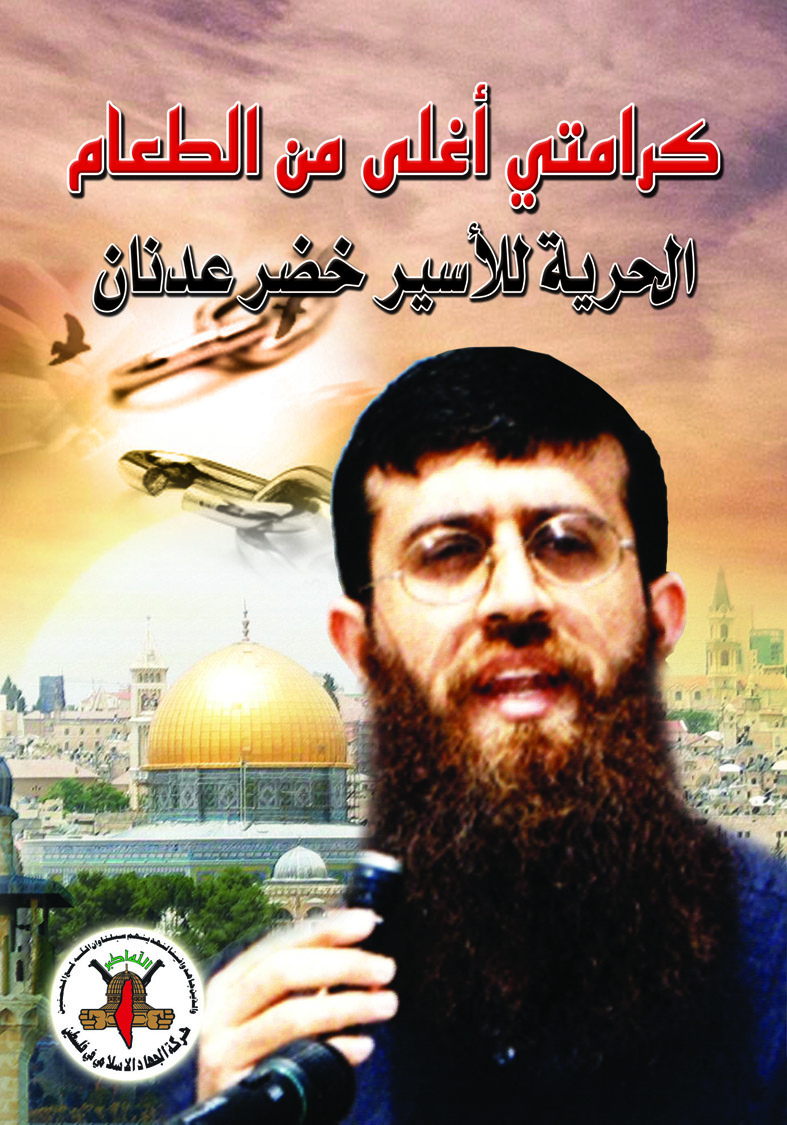
Khader Adnan's photo under this slogan "My dignity is more precious than food"
If you have the power, you can abuse it and no one will say a word in protest. At least this is the case for Israel, which openly violates international law and human rights feeling secure that one will stop it.
But Khader Adnan, a detainee from Jenin, has decided not to stay silent and accept injustices against him and his fellow prisoners. He is battling armed jailers with his only weapon: his empty stomach. Khader started hunger striking the day of his arrest, December 18, to protest the unjust administrative detention he is serving and the indescribable cruelty he has experienced since then.
My father’s experience of being an administrative detainee
It’s worth mentioning that administrative detention is a procedure the Israeli military uses to hold detainees indefinitely on secret evidence without charging them or allowing them to stand trial. Over 300 Palestinian political prisoners are serving this term now, and tens of thousands of Palestinians have experienced administrative detention since 1967.
My father served this term three times. Previously, he had been sentenced to seven lifetimes plus ten years, but released in the 1985 prisoner exchange after serving thirteen. As I read about Khader’s story in a report by Addameer Prisoner Support and Human Rights Association, stories about Dad’s experiences in Israeli prisons came back to me.
The last time it happened, a month after I was born in 1991, was the hardest. My mother told me how I came into this life where safety, peace, and justice are not guaranteed. ”In the middle of the night, a huge force of armed Israeli soldiers suddenly broke into our home, damaging everything before them. They attacked your father, bound him with chains, and dragged him to the prison, beating him the whole way.” The happiness of a new baby – me – didn’t continue for the whole family. My traumatized mother was able to breastfeed me for a month, but then she couldn’t anymore; her sorrow ended her lactation.
Every Palestinian is convicted to a life of uncertainty without having to commit a crime. Being a Palestinian is our only offense. For Khader, this detention is not his first time in Israeli prisons. It’s actually his eighth, for a total of six years of imprisonment, all under administrative detention. Each one had a different taste, ranging from bitter to bitterer.
Story of Khader’s Adnan’s arrest
This time, the Israeli Occupation Forces (IOF) raided Khader’s house at 3:00 am using a human shield, Mohammad Mustafa. Mohammad is a taxi driver who always takes Khader’s father to the vegetable market. He was kidnapped by the IOF and forced to knock on Khader’s door while blindfolded. Then the IOF raided Khader’s house, trashing it as they did. Shouting, they aggressively grabbed his father, with no consideration for Khader’s two little daughters, his wife, who could have miscarried her five-month fetus, or his sick mother. But when did IOF have any respect for human values?
Khader was immediately blindfolded, and his hands were tied behind his back with plastic shackles. Afterwards, the soldiers pushed him into a military jeep with non-stop physical torment that continued for the ten-minute drive it took for the jeep to reach Dutan settlement. You can imagine how a short period seemed like forever to Khader, who was unable to move or see while every part of his body was continuously and brutally beaten. To make things even worse, Khader’s face was injured when he smashed in a wall he couldn’t see due to the blindfold wrapping his eyes after he was pushed out of the jeep.
Addamear reported that after Khader’s arrest, he was transferred to different interrogation centers and ended up in Al-jalameh. Upon arriving there, Khader was given a medical exam, where he informed prison doctors of his injuries and told them that he suffered from a gastric illness and disc problems in his back. However, instead of being treated, he was taken to interrogation immediately.
Silence and hunger strike in response to interrogators’ humiliation
The interrogation period, which lasted for ten days, took the form of psychological torture with continuous humiliation using very abusive language about his wife, sister, children, and mother. Throughout the interrogation sessions, his hands were tied behind him on a crooked chair, causing extreme pain to his back. Believing in the power of silence, Khader’s only response was to object to the interrogator’s use of increasingly insulting speech.
Because of Khader’s hunger strike against violations of his rights and the terrible treatment used against him, Addameer reported that he was sentenced to a week in isolation by the Israeli Prison Service (IPS) on the fourth day of interrogation. Moreover, in order to further punish him without being required to go to court, the IPS also banned him from family visits for three months.
In addition, during the second week of interrogation, Khader experienced further humiliations. One interrogator pulled his beard so hard that it ripped hair out. The same interrogator also took dirt from the bottom of his shoe and rubbed it on Khader’s mustache. But they couldn’t break his dignity, and even after the interrogation ended, Khader continued his hunger strike.
According to Addameer report, on the evening of Friday, 30 December 2011, Khader was transferred to Ramleh prison hospital because of his health deteriorating from the hunger strike. But even there, he lacked medical care. He was placed in isolation in the hospital, where he was subject to cold conditions and cockroaches filled his cell. He refused any medical examinations after 25 December, which was one week after he stopped eating and speaking. The prison director came to speak to Khader, or rather threaten him, commenting that they would “break him” eventually.
I know I mentioned before that there are no trials for Palestinian detainees under administrative detention. But actually, they do get a trial. It’s not for them to challenge the reasons for their detention though. It’s for a military judge to decide the period they are going to serve according to the “secret evidence” that IPS holds against him, none of it shared with the detainee or his lawyer. This is an obvious violation of human rights, leaving Khader and detainees like him with no legitimate means to defend themselves.
On 8 January 2012, at Ofer military court, Khader received a four- month administrative detention order. There, he was threatened by members of the Nahshon, a special intervention unit of the IPS known for particularly brutality in their treatment of prisoners, who told Khader that his head should be exploded.
The need to act
Khader’s health is deteriorating rapidly. He is refusing treatment until he is released, but a prison doctor has threatened to force-feed him if he continues. Cameras in his cell watch him at all times, and if he does not move at night, soldiers knock loudly on his door. This prisoner is at risk, so SUPPORT Addamear campaign to call for his release.
People in Gaza set up a tent in front of the Red Cross last Thursday to join Khader’s protest against his administrative detention and violations of Palestinian detainees’ simplest rights, and demand justice and freedom for them. Something must be done against this unjust system and its conditions of imprisonment. International solidarity is greatly needed. Join Addameer’s campaign to Stop Administrative Detention. ACT NOW!
Read this article in Italian
A new drawing speaks for me
When I’m going through some difficulties, I find it hard to put the right words together to describe how I’m feeling about it. So I made this drawing to speak for me. Every one of you can look at it as you prefer. If I can choose a name for this drawing, it would be “A Complete Mess”.
I believe if we didn’t cry, we wouldn’t know how laughter tastes and if we didn’t feel lonely, we would never appreciate friendship, and if we didn’t lack anything, we would never realize the blessings we have.
Therefore, I’m trying to stay positive and thankful. I hope that these difficulties will end up for the best. If it doesn’t, it will at least help me discover myself more. So I hope that these obstacles will end up creating a better person out of me. I pray for everyone who is feeling like they are living in a mess to find a way to fix it. And I pray that I’ll manage to find the strength inside me to pass through these difficulties and become stronger.

Merry Christmas from Palestine, Gaza
When I was a very young girl, I used to climb the window and stretch my arm out, trying to collect some rain in my small hand, then sip it, believing that it was the purest ever. I remembered this as I was listening to the raindrops hitting my room’s windows, which I made sure were securely closed, to keep the cold wind from blowing inside and disturbing the warmth my body felt under my heavy blankets.
Meanwhile, I could hear mum talking quietly from the room just next door, but couldn’t recognize exactly what she was saying. She suddenly paused and called me to join her and seize the chance to pray, as in Islam it’s said that prayers are more likely to come true while rain is falling. I closed my eyes as tight as I could and listened to her sincere prayers for us to accomplish all that we dream, for all sick and injured people to recover soon, for all dead to reach heaven, and for Palestine, from the sea to the river, to be free. As I could only hear mum’s voice along with the raindrops, a harmonic atmosphere spread around me, and my lips moved in silence, “Amen”.
Being a Muslim, I never celebrated Christmas myself, but having lots of Christian friends inside and outside Palestine has connected me to this day. I’ve always shared it with them one way or another, since I believe that religion shouldn’t stand as a barrier between human beings. Religion is to call for love, compassion, and tolerance. It should unite people, not divide them. Sadly, not all that is said is done. Three years ago, people around the world welcomed Christmas and the New Year happily with lights, colorful balloons and fireworks while Gaza received it with white phosphorous lighting the dark sky and rivers of bloods spilled by the Israeli Occupation Forces.
Even though I am Muslim, I’ve always appreciated the beauty of Christmas trees, lights, gatherings,  meals and religious songs that I see Christians perform in the Christmas movies I watched. On this rainy and windy day, which I knew was Christmas, I wished that Gaza’s sky would snow so that it would be a typical Christmas day like movies made me picture. For an observer like me, snow adds a factor of beauty to Christmas celebrations, even though my Christians friends abroad would sometimes complain about it. I don’t blame them, though, as I have never seen any snow and never experienced its negative side.
I spent this Christmas Eve with Lydia and Joe, two of our Christian friends who came to Gaza in solidarity with Palestine, and in support of Palestinian people who live under the Israeli Occupation. My family and I didn’t hesitate to bring Christmas gifts and share this special day with them, as a form of appreciation for their indescribable humanity as they chose to celebrate it in the besieged Gaza Strip rather than joining their families on such a holy occasion.
Approximately three thousand people among Gaza’s population are Christians. Recently, I made new friends among them, a Christian family that I met through a funny coincidence. A couple of months ago, I was walking with my Greek friend Mack, who came to Gaza as a solidarity activist, and we passed a dress shop named Kopella. The name attracted Mack’s eyes, as it happened to be a Greek word for a young lady. He dragged me inside the shop, which we learned was owned by a Christian family named Alsalfiti. He was very curious to know if they knew what the word means, and it turned that they have a daughter studying in Greece, who chose this name for their shop.
Around a week ago, I visited the Al-Salfiti family with Joe and Lydia, who were interested to know how Christians in Gaza celebrate Christmas. The first thing my eyes glimpsed was a beautifully decorated plastic tree that was placed in the corner of their house to welcome Christmas. “I brought this from Bethlehem five years ago,” Lili, the mother, told me while pointing at the tree after she noticed my surprise.
“We used to get permits from the Israeli Occupation to Bethlehem every Christmas, to celebrate it in the Church of Nativity with our relatives who live there,” Abu Wade’ the father, said. “But that can no longer happen. After Shalit was captured by the resistance, people from 16 to 35 weren’t allowed to go. So my kids haven’t been able to join us in Bethlehem for more than five years. Many people are denied permission for the reasons of security, but no one knows what the security reasons are. For example, my wife and I applied a little while ago. She got permission, but I didn’t.”
Lili interrupted with a frustrated voice, saying, “Only a range of three to five hundred Christians get permission.”
Abu Wade’ raised his voice: “Remember, no Muslim is allowed by the Israeli Occupation to pray in Al Aqsa, either on their religious holidays or any other days.”
While talking about Bethlehem, I recalled precious memories stuck in mind since I was nine y ears old, just before the Second Intifada started. Mum struggled to get permission from the Israeli Occupation to take me and my two elder siblings on a trip to the West Bank. She eventually did, and so we went. I recall the few hours I had inside the Church of Nativity, and how strongly spiritual it felt to be where the Christ was born. I remember how my eyes were captured by the beauty of the place and its architecture that is enriched with history. Once I recalled these memories with Mum, and she laughed at me, remembering how surprised I was to see people crying very hard. When I asked her about it innocently, she replied, “Christians cry while praying out of reverence, just like Muslims do.”
It is very painful to think of how close I am to the West Bank, but how far the Israeli Occupation makes it seem at the same time. If I were to ask Santa Claus for something that would come true, I would wish that I could step on every grain of sand in our historical Palestine, freely visit Jerusalem to pray in Al-Aqsa Mosque and enjoy the smell of its air and its charming, mountainous nature, and visit Bethlehem and the Church of the Nativity. There are many beautiful, breathtaking scenes that I would love to draw as I see them in reality. I have faith that I will someday, once Palestine is free.
Further violence against prisoners as the 2nd stage of the swap deal begins
As the second stage of the prisoner swap deal begins, Israel is escalating its violations of the simplest rights of the 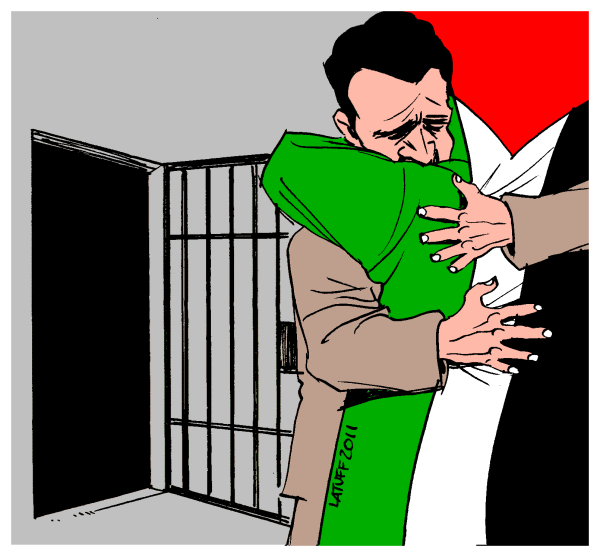 Palestinian political prisoners still behind bars and exercising more violence against them.
A statement I have heard repeatedly from all my friends who are former prisoners, every time I have asked about how Israeli torture affects the prisoners’ spirits, is that “Israeli jailers never keep a sense of stability inside prisons. They expose prisoners to extremely difficult situations tying to depress their spirits. However, they always fail at achieving their inhumane aim. Their cruelty brings more strength and will out of the prisoners. No matter how strong those armed and heartless jailers are, our barehanded prisoners are stronger in spirit.”
On Tuesday, 13 December, a savage group of armed Israeli jailers broke into section 10 of Eichel prison and attacked prisoners aggressively. They sprayed tear gas and pepper powder at the detainees, which resulted in several injuries and cases of suffocation. They summoned additional military units to break into all 13 rooms of the section. Adding more savagery, they confiscated all the detainees’ possessions, dragging away TVs, fans, banning prisoners from the cafeteria, and cutting off electricity and water, leaving Eichel Prison isolated from the outer world.
Rebelling against this aggression, the prisoners reacted by chanting and banging on doors. Our strong-willed detainees have started a short-term hunger strike protesting the unjustified attack, and threatened to take serious protest action, like refusing to stand up for the daily count, in objection to Israeli soldiers’ brutality and arrogance.
As I read this news, reported by the Palestinian Prisoner Club, my mind was preoccupied with my friends Mohammed Brash and his brother Ramzy, who are imprisoned together at Eichel Prison and who witnessed this aggression. I found myself consumed with anger and contacted their family, who live in Al-Am’ary Camp in Ramallah. I called Hamza, their youngest brother, who sounded very worried. “I can’t wait to hear some news about them. I don’t know what to expect from Israeli brutality. My brothers might be among those who were injured, but I can never know. Tomorrow, a lawyer of a detainee imprisoned there that I know is going to visit Eichel Prison, and we expect to hear some news if he is allowed to visit.”
His words added insult to injury. He made me even more frustrated than I was already. Thinking of his mother, I asked him whether she knew about this attack that prisoners, including her two sons, had faced. I hoped that she doesn’t know about the increased repression. He settled my fears that his mother was aware. “If you were me, would you tell her?” he asked me, but when he only heard my silence, he continued “of course, I didn’t tell her. Imagine the reaction of a mother of two detained sons in the merciless Israeli prisons as she hears of this attack against them. She is already worried and laments their names over and over again, just knowing that they are in prison for the tenth year, so what if this old mother hears such terrible news?”
These violations by Israeli jailers are not something unusual to our ears, which are used to hearing about their violence and aggression, and to our eyes, which are used to witnessing their enduring crimes, oppression, and humiliations against all categories of Palestinian people. However, one shouldn’t stay silent. The language of silence means submission to their power, which they think is unbreakable, and allows them to exceed all red lines and openly violate human rights and international law. Only the language of action can work here.
Palestine mourns another real legend, a symbol of motherhood
 My voice is muted but every feature of my face speaks sorrow and anger. There is no need to wonder why. It’s Palestine, the rich land where smiles can turn to tears and laughs can turn to sighs in a second. It’s Palestine, where series of sad stories mixed with strength, will, and glory never end.
Anees and Akram Al-Namoura are brothers who were released in the first stage of the prisoner exchange on October 18 after spending ten years, originally supposed to be two life sentences, in prison. They joined the resistance by the beginning of the second Intifada, answering the call of their occupied lands and oppressed people to defend them, ready to pay any price that their precious homeland, Palestine, would require. While Israel was aggressively and continuously attacking, killing, wounding, and detaining Palestinian citizens, the brothers took to arms against the occupying army hoping for a better future for their family, their neighbors and their community. They planted a bomb beneath an Israeli tank, killing two Israeli soldiers.
I coincidentally met Anees, the elder brother, in his hotel while I was interviewing some other former detainees. After having a short chat, I learned that he was somehow related to my mother’s family. Then he told me that his imprisonment started five months before his brother’s. I commented innocently, “I can’t imagine how hard it is for your mother to have two sons in prison at the same time. But it is a little fortunate that you and Akram met each other there.” He shook his head, smiling at my naïveté, and corrected me. “No. We were in prison at the same time, but separated by the Israeli Prison Administration for the first five years. We tried legal remedies, but no lawyers and no courts could bring us together. So we started an open hunger strike to pressure them, and we were clear that our hunger strike would end only after they had met our demands. We could eventually meet and live as brothers in Armon Prison, in the same cell, for the last five years of our imprisonment. “
Anees and Akram couldn’t enjoy the blessing of kissing and hugging their elderly parents even after they gained their freedom. Israel imposed a separation of a different kind on them as they were exiled from Hebron to the Gaza Strip. But this was only additional pain from a wound that was already existed, as their 80-year-old father, a cancer patient in a wheelchair, and 65-year-old sick mother weren’t allowed to visit their detained sons for more than three years.
When I Googled Anees and Akram’s names, I encountered a video of their parents from a year ago. They were interviewed about how it felt having sons in the Israeli tyrants’ prisons. “How can an old man like me, sick with cancer, threaten Israeli security?” their father wondered with a shaking voice full of sadness. “I collected all papers that explain my health situation, which is getting worse, and tried every possible way to meet my sons again before I die.” After watching the video, I smiled despite my sadness, thinking of how merciful God is: Anees and Akram’s father is still alive and has witnessed his sons attaining freedom.
In the same video, their mother, with expressive wrinkles that evoked long years of suffering, said, “I only wish I could sit on their beds, as I used to when they were young, and play with their hair while their heads lie on my knees.” The father challenged his disability by joining his sick wife and one of his daughters in a trip to the Gaza Strip to meet their sons only six days ago. This trip couldn’t happen earlier, as their permission to leave through Jordan was denied by Israel, and they obviously couldn’t come here through the Erez border for “security reasons.” However, if there is a will, there is a way. They eventually overcame all obstacles and made it here.
Six days ago, I heard Mum speaking cheerfully to Dad about the arrival of Anees and Akram’s parents and sister safely. Today, I saw Mum’s tears for the death of their mother, who had waited long to hug her sons and celebrate their freedom. “Oh Allah, her destiny was to live and not die before she enjoyed seeing and hugging her sons between her arms once again,” Mum said with tearful eyes as she entered our home after the funeral. After ten long years of waiting, with worry, sadness, suffering, and humiliation between checkpoints as she tried to visit her imprisoned sons, she lived six days with them before passing away, leaving us a real legend, a symbol of patience, challenge, and motherhood.
Update on August 7, 2012: After Akram and Anees lost their mother, Anees suffered some medical problems. He had a kidney failure. Doctors thought that this might be caused because of the mass hunger strike he joined which lasted for 24 days and ended following the agreement between Israel and Hamas to release Israeli soldier Gilad Shalit in exchange for 1,027 prisoners, including him and his brother.
Anees’s medical situations was so bad. Doctors said that in order to rescue his life, someone has to donate a kidney for him. Hazem, his 30-year-old brother decided to sacrifice one of his kidneys for Anees. Thankfully, the surgery was successful. I saw Anees after he recovered many times and he looked very well and healthy.
Sadly, when Anees’s medical condition got better, Hazem’s health was under risk. Today, Hazem passed away. Please pray for this symbol of brotherhood to rest in peace. And pray for Anees and Akram to stay strong after their mother’ and their brother’s loss.
“Only one half of me is free…”
 |
| A beautiful halo around Gaza’s full moon |
In a nice restaurant overlooking Gaza’s beach, beneath a full moon with a beautiful halo surrounding it, I sat with my new friends who recently were released from Israeli prisons. Their freedom was restricted by Israel’s inhumane rules, including indefinite deportation from the West Bank, away from their families and friends. However, they all shared one thought: “The problem is not here. Both the West Bank and Gaza are our homeland. The problem is that our freedom will not be complete until our land and people are totally free.”
I listened carefully to their prison stories and memories of their families in other parts of Palestine. One of the most interesting things for me to hear was the warm, strong, and caring friendships they remembered from inside the painful cells. These unbreakable friendships were their only distractions from the wounds that used to hurt them deeply inside.
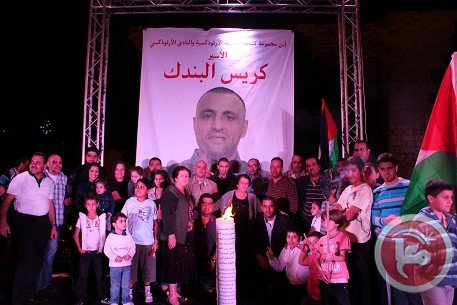 |
| Palestinians in Bethlehem are protesting in solidarity with Chris who is deported to Gaza |
One of my new friends is Chris Al-Bandak, the only Christian of the released detainees, who was freed in the first stage of the swap deal. After I was introduced to him, I congratulated him on regaining his freedom. He faked a smile and replied, “Only one half of me is free, but the other half is still there, locked up behind Israeli bars.”
I didn’t know much about Chris, except for his religion, but many things about him made me want to get to know him more closely. I was quite certain that this impressive 32-year-old man had many interesting stories to tell and learn from.
Chris said that he was one of the people besieged by the Israeli Occupation Forces at the Church of the Nativity in Bethlehem in 2002. That alone made me impatient to hear the rest of his story. “The siege lasted for 40 days. It became more unbearable as time passed, with the food and first aid equipments dwindling. The injured people were under the threat of death, and the others’ lives were endangered as well as the IOF’s pressure increased.”
As Chris spoke, his eyes evoked anger and sorrow as they wandered to his right. He sounded like he was replaying a tape of his most difficult memories. Then he suddenly began stuttering as he said, “My best friend, Hafith Sharay’a, was one of the injured people.” I reminded him that he didn’t have to speak about it if it made him feel bad.
He pulled himself together and kept telling his story. “On the 28th day of the siege, we were on the top floor of the Church of the Nativity, responsible for the lives of the people downstairs and guarding the church, when he was shot in the right side of his stomach. With every drop of blood he lost, my soul burned inside. I couldn’t watch him die and do nothing.”
Impatiently, I interrupted, asking, “Was he killed?” He shook his head and continued. “His injury left me only two choices: let him bleed to death, or send him to the Israeli Army for treatment, while I was certain that he would afterwards receive at least a life sentence.”
Each option was worse than the other. Chris thought that if Hafith died, he would never see him again. If he was treated and then imprisoned, he might meet him, even though the chance was very small.
Hafith and Chris were like soul mates. They didn’t share many things in common. Hafith is older and a Muslim, while Chris is a Christian. However, they prioritized their deep passion for Palestine above everything else. This overcame all their differences, and they share a strong friendship that will last forever.
So Chris chose to put his emotions aside and rescue Hafith from death by delivering him to the Israeli army. “On the 29th day, I somehow managed to sneak out of the church and escape. But ten months later, I was kidnapped by the Israeli entity’s army.”
Chris described in detail the horrible story of his capture. He had gone to visit some of his relatives. Within 20 minutes of his arrival, the Israeli army arrived in great numbers and surrounded the house. He faked a name for himself and answered the police’s questions in a very sarcastic way. He told all his relatives to say his name was Fady if asked, which they did. He refused to admit that he was Chris. After several hours of investigation, pressure, and threats of bombing the house and arresting his mother and brother, one of the children was shedding tears out of fear. Seeing this, a policeman used the child’s innocence and tricked him. After the policeman said that the soldiers would leave if he said the real name of Chris, the child admitted it.
Chris was persistent, and didn’t admit his identity until they were about to bomb the house in front of his eyes. After his confession, he was asked where he had been sleeping at night. He replied, “You bombed my house, so where did you expect me to go? I spent my nights in the cemetery.” The interrogator was very shocked at his reply and asked him, “Weren’t you afraid among all dead bodies in their graves?” He answered, with an angry, challenging look in the Israeli soldiers’ eyes, “One shouldn’t fear the dead. They are dead. But we should be afraid of the living people whose conscience is dead!”
Then they blindfolded him, pushed him inside one of their Gibbs vehicles, and headed to an interrogation center, where he was psychologically and physically tortured for 43 days.
Chris constantly thought of his friend Hafith, and hoped that his imprisonment would allow him to meet his best friend again. This happened in a very narrow cell in Ramla Prison, as he waited to find out which prison he would be jailed in. The detainees were having <em>foura</em>, an hour-long break that detainees take daily outside their jails in a hall, and a very small window, closed with a revealing cover, separated him from the hall. Suddenly he glimpsed his friend Hafith and found himself screaming his name loudly to get his attention. “Our reunion was so emotional, especially behind a fenced barrier,” he said with a broken smile.
Their happiness didn’t last long, as they had to separate once the <em>foura</em> was done. Chris was transferred to Ashqelon Prison, then to Nafha. “I didn’t see Haifith for over a year, but during that time, I never stopped hoping that God would be kind enough to bring us together again.”
Chris was in Nafha when his friend was transferred there, finally uniting them. Then they went through a series of separations keeping them apart for a total of four years. “A prison offers no sense of stability.” Chris said. “When we were imprisoned, we didn’t stop our struggle, but we started another stage of resistance of a different kind, determination and persistence mixed with hope.”
During the period before Chris was released, he shared a prison cell with Hafith. “Other detainees received the news of their freedom with screams of joy and happiness, but I received it with tears. I didn’t even feel one percent happy, as I realized that only I was included in the swap deal. Even now, I feel like my body is outside but my heart is still inside the prison with Hafith and all the other detainees,” Chris said with sadness on his face.
“I am very grateful for having Hafith as a big brother. But I am broken inside because he didn’t get his freedom back. I am sure that he’s such a steadfast man that nothing can depress his spirit,” he said, attempting to console himself.
Their friendship amazed me. It can’t be described in words. I pray that Haifith, along with all the Palestinian political prisoners, will be freed soon. I hope Hafith maintains his strength which used to inspire and strengthen Chris. Chris said that Hafith made him believe in his principle that “the prison’s door must unlock someday. It’s only an obstacle, and is bound to fade away at some point.” I hope it will be unlocked soon to let all prisoners breathe the sweet fragrance of freedom again.
Press here to read this article in French. Thank you Nour Halimi and Claude

"I wish Dad was here celebrating Eid with me."
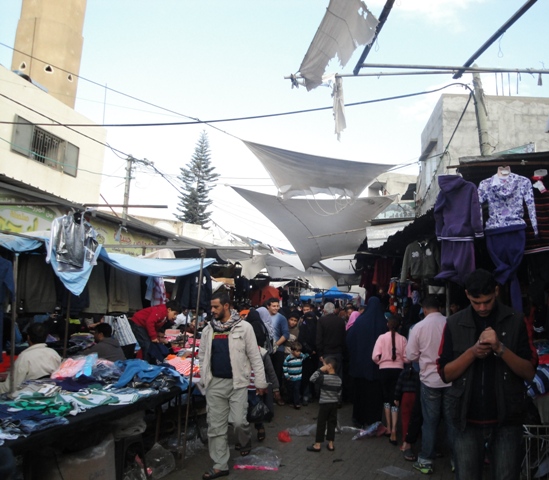 The day before the start of the Eid al-Adha holiday is the day of Arafa. It is said that a believer who fasts on this day expiates the past year’s sins and the sins of the coming year. As it is considered to be a day of forgiveness from sin, many Palestinians fasted on that day. Despite me fasting, I eagerly accepted the offer of my friend, a solidarity activist from Holland, to have a walk in Jabalia Camp. Approximately 108,000 registered refugees live in the camp, which covers an area of only 1.4 square kilometres.
I passed by the Jabalia market, which was so crowded that one has to keep pushing people out of his way in order for him to pass through. With every step forward I could glimpse many faces of different ages, genders and features. I could see children jumping around from one stand of clothes to another, excited to pick their new outfits. At the same time, other children seized the opportunity of this unusually large crowd. They were carrying heavy boxes containing simple goods, trying to earn some money so that they could help their poor families have sort of happy atmosphere, to at least buy some candies.
I could see faces full of anger because of the high prices of goods, which result from the siege which has been illegally imposed since 2007. Parents would spend hours going around to every stand, searching for the cheapest clothing to buy for their children, who still innocently think that Eid means having new clothes. Yesterday, I could see how the inhabitants of Jabalia Camp, who are mostly refugees, face obstacles like low income, shortages of goods, and high prices for the available ones. They are desperate for happiness, even if it’s always missing something: the feeling of freedom, security and independence.
As Gaza welcomed Eid al-Adha, hymns played as the sun dawned. I could hear children and men gathering around the microphone in the mosque right behind our house, singing continuously and happily in one voice, “Allahu Akbar, Allahu Akbar …” I couldn’t help but wake up earlier than I always do, and more energetic than ever, excited for what would come next.
My mother said that the door has been knocked on constantly since the early morning by people with Eid greetings. Some of them could afford to buy sacrificed animals, “Uḍhiyyah,” and hand out a slice of meat.
Eid is a very special religious holiday, as it reconnects people with each other, strengthens social life, and reminds the rich of people who are in need. In Palestine, Eid exceeds its conventional frame. It’s a festival of tolerance, forgiveness, compassion, and thoughts of the people who are missed in prison, in Diaspora, or in the grave. My father and his brothers, for example, visit the families of martyrs and prisoners in the neighborhood.
On the second day of Eid, there was a demonstration in solidarity with our detainees at the Red Cross headquarters to convey that their spirits live among us, and that they are never forgotten. We also meant to show sympathy with the mothers who waited many long years, hoping for their sons’ freedom, who passed away before they could celebrate their release.
It was a day of support for our heroes inside the merciless Israeli bars, encouraging them to stay steadfast, as well as a day of compassion for their families, who have passed through several important holidays with one, or in some cases more than one missing, making their happiness incomplete, to help them stay strong and optimistic.
While celebrating Eid, I felt blessed for having all the people I care about around me. At the same time, I felt like I couldn’t enjoy my happiness at its fullest while thousands of people in Palestine couldn’t feel this blessing.
 I’ve been constantly thinking about Gomana Abu Jazar during Eid. Gomana is a ten-year-old girl whose mother died after she delivered her, and whose father has been imprisoned since she was less than two years old, leaving her uncle to look after her. Once, as she wondered why all children have fathers but her, her uncle said, “I’ll be in your father’s place until he is free. You’re lucky, since you have two fathers instead of one.”So she started calling her uncle “dad” for a whole year, until he was killed by the Israeli Occupation Forces, leaving her with none. As she returned from school one day, she saw a huge funeral in front of her house, and asked, “Whose big funeral is this?” Her neighbors’ children answered, “It’s your uncle’s.” She began screaming, denying it and saying, “Impossible! He accompanied me to school this morning.” Now she lives with her 70-year-old grandmother.I called Gomana to greet her for Eid. After a long chat, I asked her, “What’s your wish for this Eid?” “I wish Dad was here,” she replied in a sad voice. “I wish they would at least allow me to see him once in lifetime. I only know Dad from his photographs. I wish I could see him in reality. Once I thought this dream was very close to coming true, but then I realized that I was prevented from seeing him for security reasons.”
How can Palestinians fully enjoy our happiness while these heartbreaking stories are so very common in their daily lives? I hope next year the happiness of Eid and other occasions will be complete, with the Israeli jails emptied and Palestine independent and free. Insha’Allah, God willing.
To read it in French, press this link (Thanks to the webmaster, Claude)
Another full year of pain in isolation for Ahmad Saadat
The Palestinian political prisoners suffered 22 days of hunger as they decided to fight with their empty stomachs the oppression and the injustice of the Israeli Occupation. They eventually decide to no longer go on with their battle against the violation of their rights as the Israeli Prison Service promised to meet their list of demands which had on the top “ending the solitary confinement policy”. However, that wasn’t but another cruel trick for them to break the hunger strike.
As usual, they’ve never stuck to something they said and their hypocrisy has been one of their traits which characterize them the most. Israel keeps on breaking all the International treaties including Geneva Convention which guaranteed the right of Palestinian prisoners to be treated as War prisoners, and instead, they describe them as “terrorists”.
A friend of mine who had the sit-in tent as a shelter during the hunger strike of our prisoners and who himself joined the hunger strike in solidarity texted me that Ahmad Saadat, the PFLP secretary-general, is bound to serve one mor e full year of pain in isolation. They have ignored the worrying health condition of Saadat as a result of the carelessness of medical care along with his solitary confinement which started since March 16, 2009. Saadat was not allowed any visitations and even denied his right to write or receive letters from his family during his solitary confinement.
Saadat was sent to court ignoring his lawyer, who never received a notice regarding this court session. The Ad-Dameer, one of the human rights organizations, stated that by sentencing Saadat to solitary confinement for an additional year, the court violated promises by the Israeli Prison Administration to receive treatment that is guaranteed by the International law. No justification for this criminal and illegal decision has been provided.
My internal conflict and my worries reached its peak as I remembered when I was sitting with Loai Odeh, one of the released prisoners in Shalit’s swap deal and who participated in the hunger strike, and said that “the mental health of the prisoners who are in isolation should be expected to be in jeopardy after two or three years of isolation and that was the first motif for us to take that step; hunger striking till solitary confinement is no more.”
“It would be difficult for a prisoner in a normal jail to pass through his imprisonment without suffering psychological problems or at least depression, so imagine how difficult it would be for a prisoner in the solitary confinement for long time.” Loai continued. No wonder that is true; the mankind is a sociable creature, and if one is totally isolated from the outer world in a very narrow cell in which light could barely sneak, psychological and mental problems are hardly avoidable.
The brutality of the Israeli entity can never be imagined by someone who has never experienced their inhumane behavior. As Ahmad Saadat’s case occupied my thoughts, I remembered what my father told me about the psychological methods of torment which he endured during his imprisonment and which Israel continue to exercise daily over all the Palestinian prisoners inside the Israeli jails which never follow any of human virtues or the International Humanitarian Law. The more I think about this, the more I fear about Ahmad Saadat’s mental and physical health.
Trying to be positive, I recalled when my father told me “Ahmad Saadat is one of the toughest men I’ve ever know in my life.” It’s true, but that doesn’t mean that Israel should continue breaking its obligations to end its solitary confinement policies, and to implement the demands of the detainees after they conducted a hunger-strike for 22 days. It’s time to take action to fight injustice and to guarantee human rights for all people.
Don’t tell my mother that I have become blind
Mohammad Barash is a disabled political prisoner inside Nafha Prison; one of 85 prisoners who are either physically or mentally disabled. On the 17th of February, 2003, he was arrested after he was badly injured, and despite his disability, which resulted from his injuries, he was given three life sentences plus 35 years. He is still continuing his struggle with pride inside a cell paying a double price; his precious years of prime and the consequences of zionist entity’s crimes.

‘Don’t tell my mother that I can no longer see. She can see me but I can’t see. I fake my smiles when she shows me the photographs of my siblings, friends, and neighbors as she doesn’t know, that I have become blind after illness spread in my eyes till the darkness filled me.
Don’t tell her that I waited for several years to have a surgery to plant a cornea. But the Israeli Prison Service kept on procrastinating and procrastinating providing my eyes all reasons to leave me.
Don’t tell my mother that the shrapnel of bullets and the bombs which managed to hit me is still settling in my body, and that my left leg had been mutilated and replaced by a plastic one. Don’t tell her that the other leg rotted and dried of blood and life.
Don’t tell my mother that the prisoner’s emotions got stripped of the most basic elements of human life as he is sentenced to see only ashes and iron, lightless life and hopelessness.
Tell her that I am alive and safe. Tell her that I can see, walk, run, play, jump, write and read. Don’t tell her that I am shouldering my pains on my walking stick, and I can picture every martyr as a moon souring in the sky and calling me with the power of lightning, thunder and clouds.
Don’t tell her that I suffer from sleepless nights, and that I live under the mercy of the pain killers till it drugs my body. Don’t tell her that I keep twiddling my stuff till I barge into the iron beds or another prisoner sleeping close to me, to wake him up to help me reach the bathroom. Don’t tell her that wakefulness always hurts me and sleep never visits me.
Don’t tell her that a piece of lead entered my eye in that bloody day in the camp streets. They aggressively shot me until my leg was cut off, and my eye was gone. And before I fainted I saw a little kid running toward me waving the Palestinian flag while screaming: a martyr, a martyr.
Tell her that my dream is not enough. My nostalgia for her is too much and her soul never leaves me. I still have from her my language, my purity, my symbols stuck on the wall, all of which heal my pain every time the light disappears around me.
Tell her that I always embrace her holy prayers, to survive from the dark cloud that surrounds me after my body has tortured me. I might get back to her or I might not, but I left the answer to this question open, although I’ve chosen spiritually to be close to her heart, as if I chose my future, of which I have officially no control.
Don’t tell her that Israel, a country in the 21st century, has turned the prisons into places where diseases are planted and bodies are ruined slowly; and slowly, it turned to be fields of trial for living people whose death is inevitable sooner or later.
Don’t tell her that I have become knowledgeable of all names of horrible illnesses and strange medications, along with all types of pain killers, while I’m witnessing my friend Zakariyya diving into a coma, with an ending unknown to me.
Don’t tell my mother about the sick prisoners whose diseases launched an insane war against their bodies: Ahmad Abu Errab, Khaled Ashawish, Ahmad El-Najjar, Mansour Mowqeda, Akram Mansour, Ahmad Samara, Wafaa El-Bis, Reema Daraghma, Tareq Asi, Mo’tasim Radad, Riyad Al-Amour, Yasir Nazzal, Ashraf Abu-Thare’, Jihad Abu-Haniyy. The merciless Israeli prisons slaughter them; illness and carelessness of a country that enjoys slow death sentences and funerals for others.
Tell her that I am still 30 doors away from you and I get closer every time a bird flies and a fire flames up my eye, and barbed wires wound me, carrying me to your arms and to your prayers.’
This was Mohammad’s letter to his mother which unveils the inhumane nature of Israel which claims to be the only democracy in the Middle East while violating the most fundamental human values. I meant to share with you those powerful words he wrote in Arabic to help you picture the torturous conditions that the prisoners endure inside the Israeli cells, especially the disabled.
The core of their shameful crimes which offend any sense of propriety in any heart with any shred of conscience, were done under the banner of maintaining security. However, in this case where those disabled prisoners can hardly threaten their holy safety, how would they justify this?
Conditional Freedom
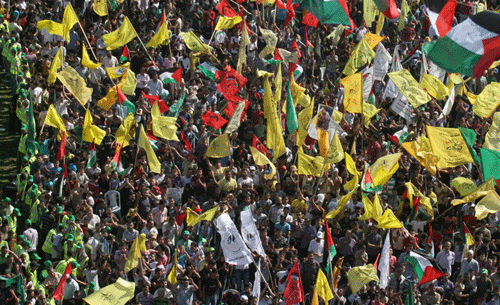 |
| crowds of thousands have greeted 310 former prisoners on Tuesday, 18th of October |
The first stage of the prisoner swap deal has already taken place. As agreed on, 477 Palestinian detainees were set free before an Israeli soldier held in Gaza was delivered by the resistance to the Red Cross to enjoy the full range of freedom.
In Gaza, crowds of thousands have greeted 310 former prisoners — 131 of whom are from Gaza, and another 179 who were deported to Gaza according to Israel’s inhumane stipulations. The release of a total of 1,027 Palestinian prisoners should be completed within two months.
As prisoners have returned to their families, celebrations of freedom have been heard all cross the Gaza Strip, bringing a sense of hope for freedom. However, the road to freedom will remain incomplete even with one Palestinian still suffering inside the Israeli occupation prisons. So what if approximately 6,000 political prisoners are still locked up, including 164 children, in violation of international law?
The deported prisoners
The most painful part of this swap deal is the deported prisoners. They have long waited to be free again to return to their families, but Israel has instead deported them to other places where they have to wait even longer before they can wrap their arms around their loved ones again. The freedom of these deported former prisoners is not true freedom.
My parents recently went to a celebration held in the neighborhood for some released detainees. I was sitting alone when suddenly my phone rang. It was my mother. I could hardly hear her because of celebrations that were going around her. “You should come and see how people are dancing with joy and singing for freedom,” she said. I got so excited that I could no longer stay home and I decided to join them immediately and see for myself the joyous atmosphere there.
I didn’t know the exact address of the festival but I didn’t worry about it as I was certain that the resonance of the songs of freedom would guide my steps. The lights along with the Palestinian flags of all sizes were everywhere, decorating the dark blue sky. The walls were dressed with photos of our heroes who sacrificed precious years for the cause of freedom.
People came from different areas of the Gaza Strip to share with the released detainees the happiness of their freedom. The festival included folk dancing performances, songs of liberation and poetry dedicated to those who were free and to those who are still suffering behind Israeli bars.
 |
| Loai is holding his mother, Rawda, after his release in Gaza City. |
A long-awaited reunion
Near the end of the festival, which lasted for several hours, my father called over me and mom to introduce us to his friends. A woman wearing a beautiful Palestinian traditional dress decorated with threads in the colors of the Palestinian flag — white, red, black and green — was standing beside a bald man.
“Rawda, Yacoub, here is my daughter, Shahd,” my father introduced us. Then the man, Yacoub, stepped forward, kissed my forehead and hugged me and left me surprised and still wondering who he was.
Then Dad continued with a big smile on his face: “This is my friend from Jerusalem who was detained with me in Nafha prison for 15 years, and we were freed together in Ahmad Jibril’s exchange deal. And this is his brother’s wife, Rawda, who was imprisoned for five years as well in the 1970s.”
I then realized that they were here a day ago to see Loai, Rawda’s son, who was freed in the swap deal but deported to Gaza. She was hoping that she would hug her son, Loai, as soon as he was released. She had been waiting for ten years, daydreaming about that day.
Her son was sentenced to 28 years of imprisonment but thanks to the prisoner swap, he only spent ten years behind Israeli bars. However, it was very disappointing for her to find out that he would be deported to Gaza and that he would not return back home.
She did everything she could to tightly hug her son again and for that she traveled with her husband and his brother by bus from Jerusalem to Eilat and then to Egypt and then to Gaza through Rafah crossing. It’s so ironic to know that she had to suffer two days of travelling to enter Gaza when it would take her less than two hours if Israel allowed her to enter though Erez checkpoint.
Shortly after meeting Loai’s mother and uncle, I met him. “Congratulations for your freedom. I’m very glad you’re finally released,” I said, my face expressing happiness and admiration.
After short chat, I discovered that Loai has completed his bachelor degree in sociology. Since the beginning of his imprisonment, he applied for the Israeli Prison Administration to study at Hebrew University. While he must have finished his degree in four years, it took him around 10 years to eventually have it as many times his application to continue his study was rejected for no reason.
After I told him that I am studying English at Al-Azhar University, he replied so enthusiastically, “I’m going to further my studies at Al-Azhar University and you will have to help me and give me so much support as I am new here.” I kept nodding my head, admiring his unbelievable determination and his civility, and replied: “Of course! Any time!”
Exile
We soon had to separate, as it was getting late and everyone needed to go back home and rest after long hours of dancing and chanting. On the way back home, my father was expressing how happy he was to meet his friend, Loai’s uncle, again after more than 24 years of separation, as he is denied access to Jerusalem by Israel.
“Can you imagine that his baldness is because of the torment he endured by the Israeli army?” he asked me with an angry voice.
He added, “The Israeli soldiers used to use a thin stick and knock on the top of his head in sensitive places continuously and slowly for long hours as a way of torturing psychologically and physically at the same time. However, this is maybe the least torturing method. Israeli soldiers are very creative at bringing new methods of torment…”
My father left me speechless and thinking of how much our prisoners have endured in Israel’s cruel jails. It’s true that those former prisoners, including Loai, are now out of Israeli prisons, but still their freedom is conditional and incomplete, as they were forced to accept their fate to live in exile far away from their land and families. It makes me sad to think that this beautiful family is now going to be scattered between their home in Jerusalem and Gaza, where their son is forced to live from now on.
A mother’s story: Umm Fares Baroud
 My drawing for the Palestinian women, especially those who are still waiting for their relatives in Israeli prisons My drawing for the Palestinian women, especially those who are still waiting for their relatives in Israeli prisons |
The prisoners’ families make sure not to miss any day of the weekly protests, so the number of the people inside the Red Cross building is more than usual on Mondays. Therefore, one should expect to see lots of tears and hear lots of tragedies, especially after the names of the soon-to-be released prisoners were declared.
As I entered the Red Cross on Monday last week, an old woman was sitting in a corner, hardly noticeable. She was putting her hand on her cheeks, closing her eyes and saying nothing. The wrinkles on her face, with expressions of sorrow and burdens and the broken glass frame of the picture she was holding, directed my steps toward her.
I tried to talk to her but I didn’t get an immediate answer. She responded only after I started talking very loudly while holding her hands. I realized that she can barely hear anything and her vision is very weak.
“Who’s this man in the picture?” I asked loudly.

Umm Fares Baroud at the Red Cross sit-in tent in solidarity with Palestinian political prisoners.
“This is my son Fares, my darling. He’s not going to be released. I am very sick and about to die. I even spent last night in hospital. Why wasn’t he included to fill my last days of my life which passed for 20 long years without him? I want to enjoy hugging my son before I die,” she said with tears falling so intensively and bitterly.
Calming her was a very difficult task, but one can imagine how deeply her wounds were felt. I was looking around asking who accompanied that lady to the tent, as I found it impossible to imagine that a blind woman came by herself. However, what I thought was impossible, was actually a fact.
A dreamer who never gives up
After questioning people in the Red Cross about her, I met a young woman who seemed to know her. She told me that the old woman, Umm Fares, lives alone in Beach Camp. Her husband passed away years ago and she has nobody to take care of her. It was very hard for me to believe that this very old woman, who can barely walk, see or hear, lives alone. I was very angry and questioned aloud how an old sick woman could be left alone with no one to look after her. But the young woman calmed me down after she declared that Umm Fares was a reason for her to keep coming to the weekly protests. She even arranged a group of girls to help her and show solidarity with her. They have taken turns during the week to visit her as much as they could. Hearing that, I couldn’t help but smiling with relief to know that there are still some caring people, and without her asking me to join her group, I stated that I am already a part of them.
The young woman told me that she once was sitting with Umm Fares in her very simple and narrow house, chatting, attempting to make her feel that she was not alone or forgotten. Suddenly Umm Fares asked her to bring a piece of paper and a pen to write down what she heard her say.
“Dear Fares, when you are free, I’m going to pick for you the most beautiful bride in Palestine. I’m going to build a big house for you to live in with your kids. Stay steadfast my darling and God willing your freedom will be soon,” she said while her weak hands dried the tears that fell on her cheeks. The poor woman didn’t realize that she was only a dreamer, but a dreamer who never gives up.
No one has left a profound impact on me as much as this woman, Umm Fares. I pray that she gets the chance to see her son before she dies and I promise her that she will never be alone. There are many people who will never forget her or her precious tears over her son’s ongoing imprisonment.
Press this link to read it in French (Thank you Claude)
Salama’s wife clings to fading hope
 I had a one-hour break at university on Saturday, so I grabbed the chance to visit the Palestinian detainees’ solidarity tent by the Red Crossbuilding. Every day I go, I see the same people, whom I’ve started to feel are a part of me. When one of them is not there, I miss them, as I recently have spent more time with them than my family.As I arrived at the tent, I felt that there was something strange going on. I asked a friend what had happened earlier. She answered while pointing, “That woman, Najiyya, just fainted when she learned that her husband is not included in the swap deal.” I kept sympathetically following her with my eyes wherever she went. She lifted my spirits up as she walked toward me and sat in an empty chair next to me. She smiled at me, despite her sorrow. I wish she knew how much people like her give me indescribable spiritual power with their incredible strength and steadfastness. Seeing her smile again, while knowing that she was broken inside, brought life to me. I couldn’t help but smile back with a look of admiration and appreciation.
“I waited long enough for him to come back to me; 19 years of forced separation between us. I’ve always fantasized about our unborn child, as the imprisonment of my husband after less than one year of our marriage prevented me from ever having one,” she said after I asked her whether she feels better.
“They broke into our house in October of 1993 and kidnapped him very late at night from inside our home in an excessively violent way,” she continued while tears struggled to fall from her eyes. She looked in a different direction and fell in silence trying to hide that feminine character inside her.
I learned that her husband Salama Mesleh was sentenced for 99 years inside the Israeli prisons. I was amazed at her ability to stay strong and optimistic for a day that would come when she would be united with her husband in a warm house full of love and harmony and bring up their first child.
My sympathy got even deeper for her as I learned that she had been very close to delivering a child. She was 2 months pregnant when the Israeli army attacked her house and turned everything upside down and kidnapped her husband. Her experience was too much to tolerate. The Israeli army didn’t only take her husband away but also killed the fetus growing inside her. If she didn’t go through all these horrific circumstances, maybe this fetus would have turned out to be an 18-year-old man by now who would take care of her while she bravely fights her harsh destiny.
Determined to share pain
My affection for her has been increasing as I knew more of her stories. She is on a hunger strike for the sixth day trying to share with her husband and other Palestinian detainees their battle of empty stomachs. She has refused to break her fast despite all the attempts which people made to persuade her to, especially after she fainted. However, she insisted on going on demonstrating. “Salama, my husband, suffers from more than merely hunger,” she said. “Let me at least feel like I’m living some of his pains even though I know that I’m not even close!”
I suddenly realized that I ran out of time and it was the time to go back to my lecture at university. I had to go there only for the attendance check and be in the class only in body but I knew that my mind would stay with the prisoners and their families. I couldn’t wait till the lecture ended to return to the Red Cross.
I thought that I would go back and see the usual sight of people sitting in the tent chatting while songs for freedom for our detainees are playing. But that wasn’t the case. There was an emergency taking place; people were running inside the Red Cross. An ambulance’s siren was very loud and its red lights were flashing all over the place. My heart skipped a beat as I realized I had missed something during the hour I was at university. My fear of the unknown overcame me.
I was trying to pass through the crowd to discover that the same woman, Najiyya, lost consciousness again. She couldn’t bear the psychological conflict she had inside her — not knowing whether her husband was going to be released or not.
At first, she heard that her spouse was included; and then discovered that he was not. She was swinging between facts and illusions to realize later the fact that her husband will stay jailed inside the dark cells. I learned that she was walking around while talking to herself unconsciously and she suddenly stopped and looked at a big banner that includes the picture of her husband, and then fell down.
I know no matter how strong and how much of a fighter she is, she is a human at the end of the day. The fact that her husband is not going to be free was very hard for her to accept, especially since she was lingering with the hope which the swap deal had brought her.


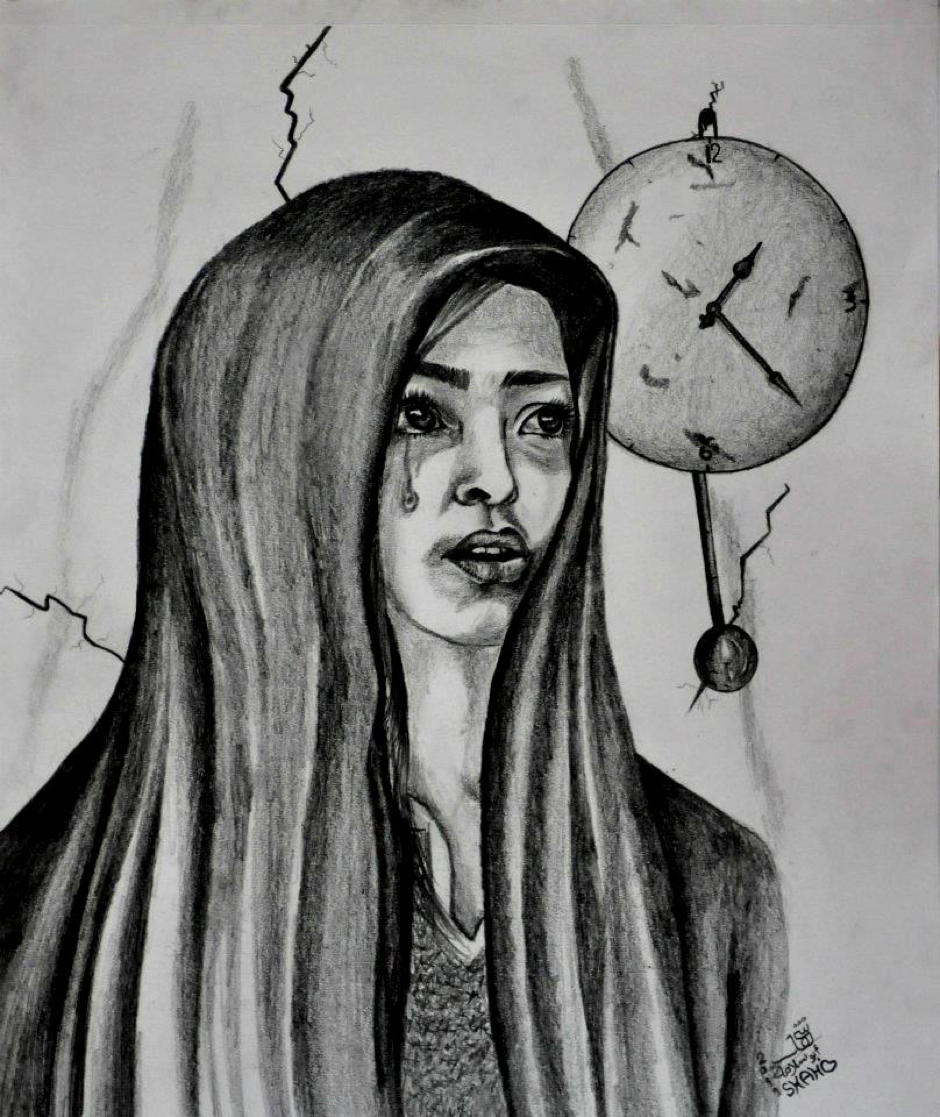


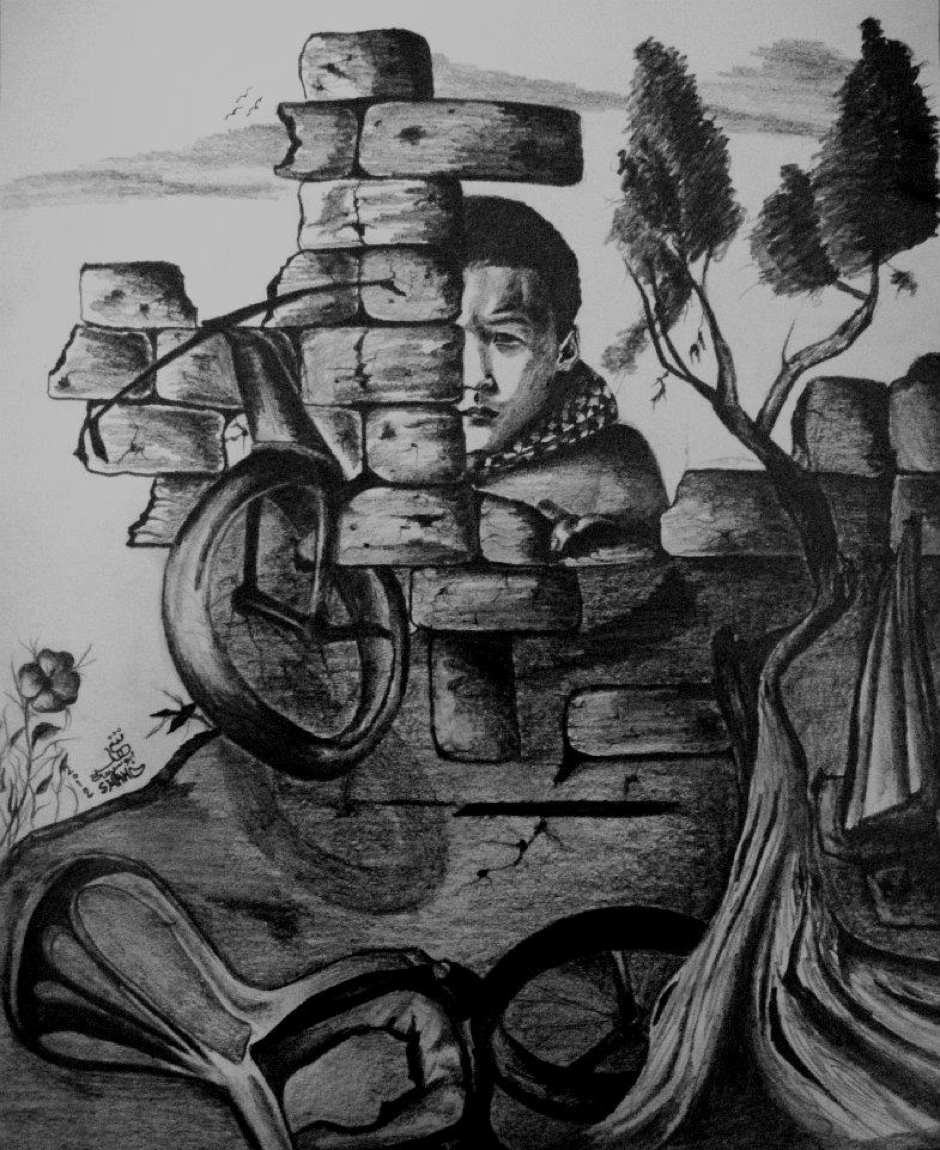
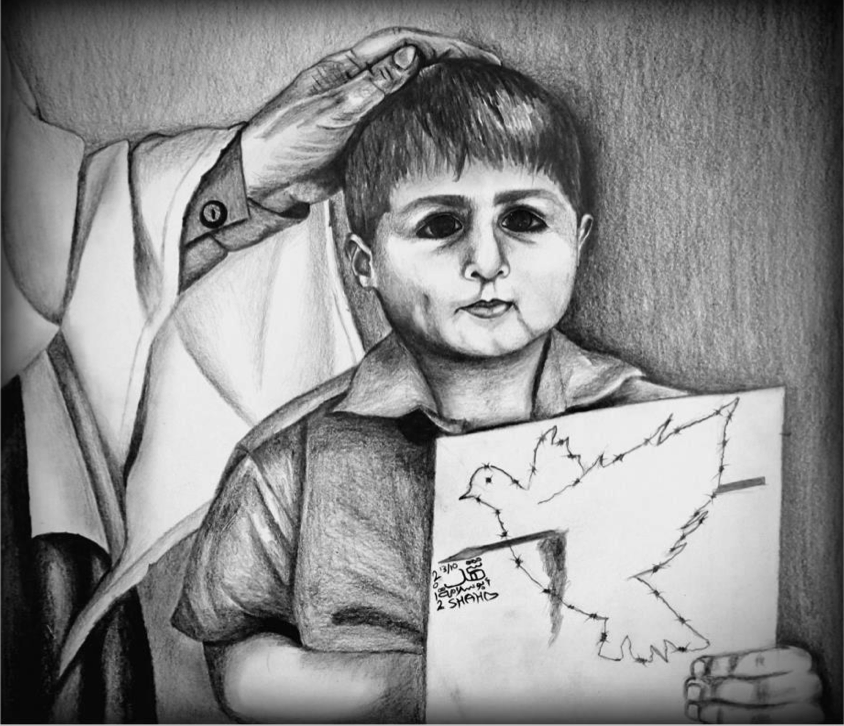
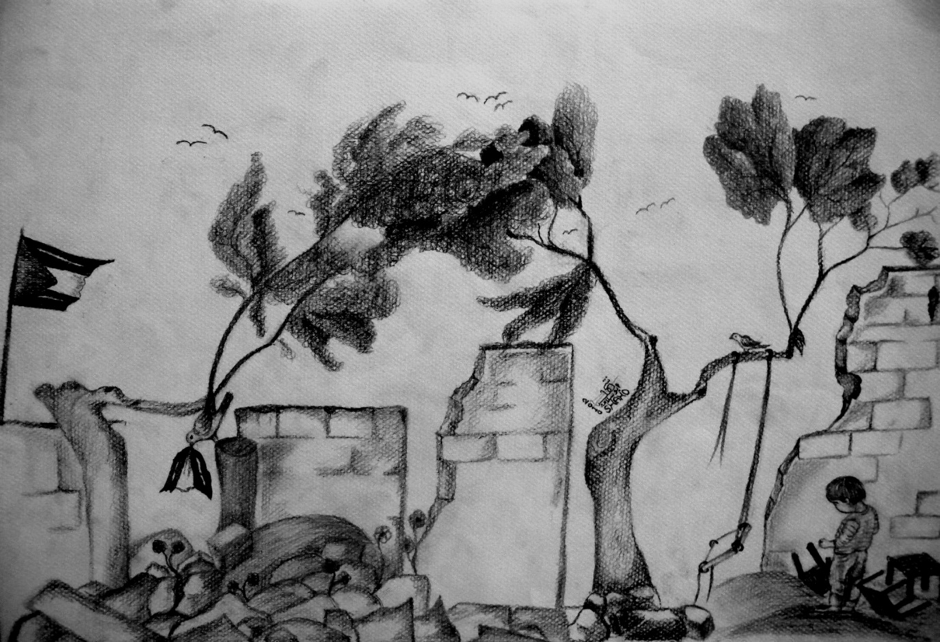

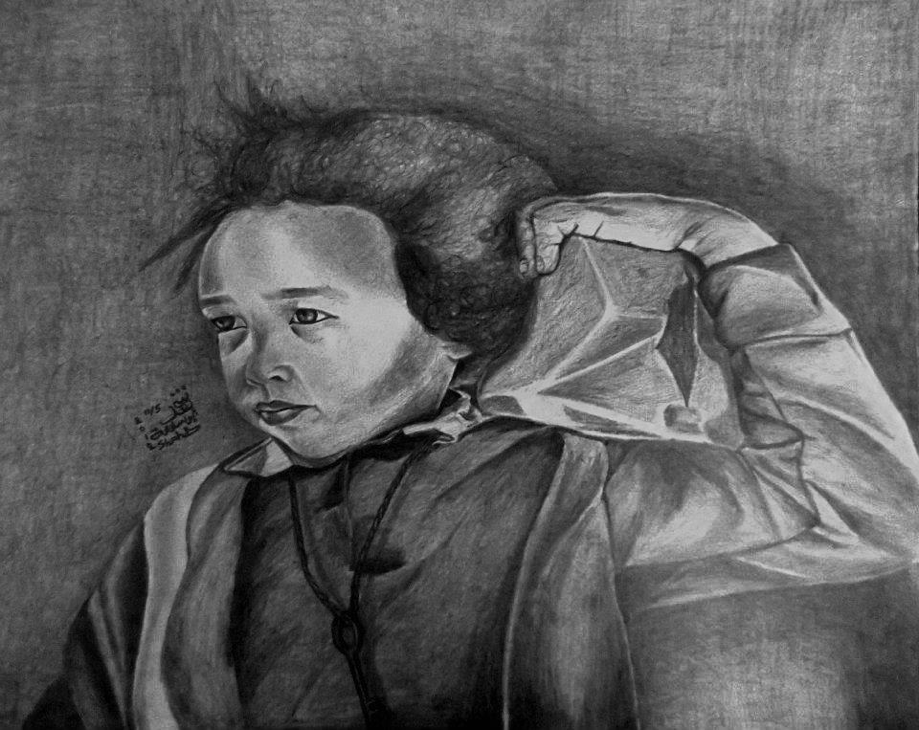


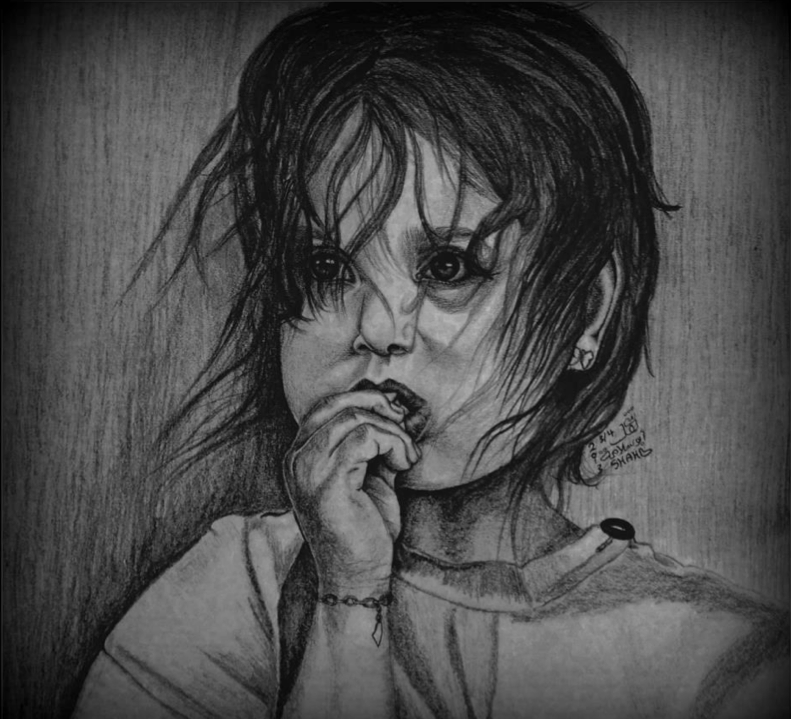
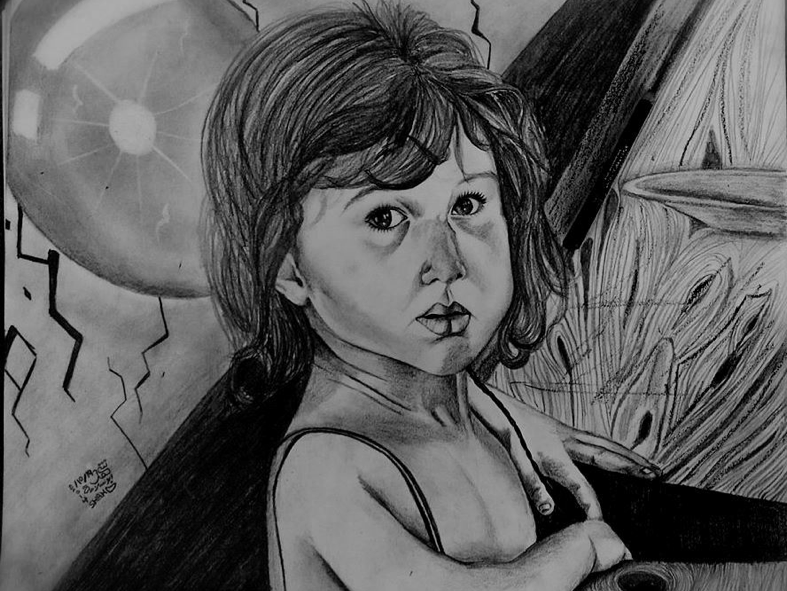
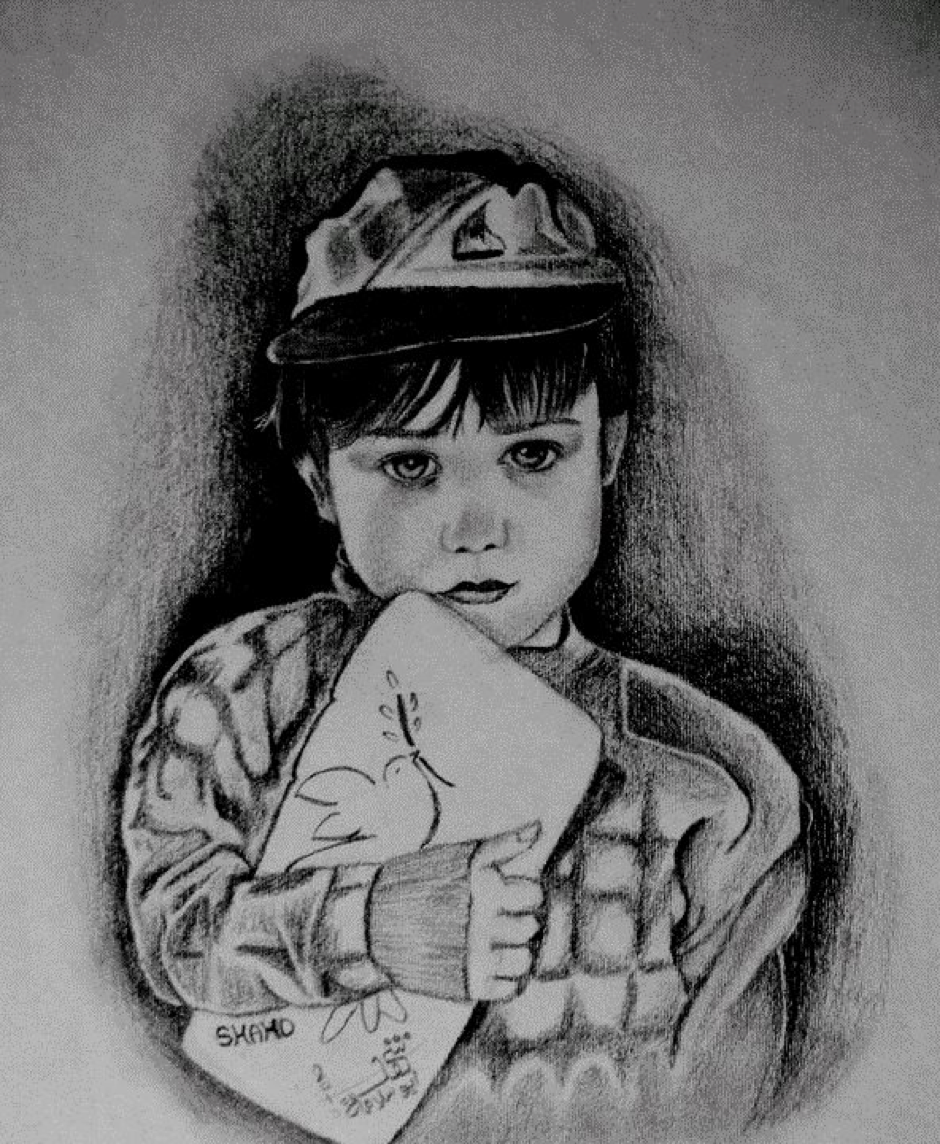


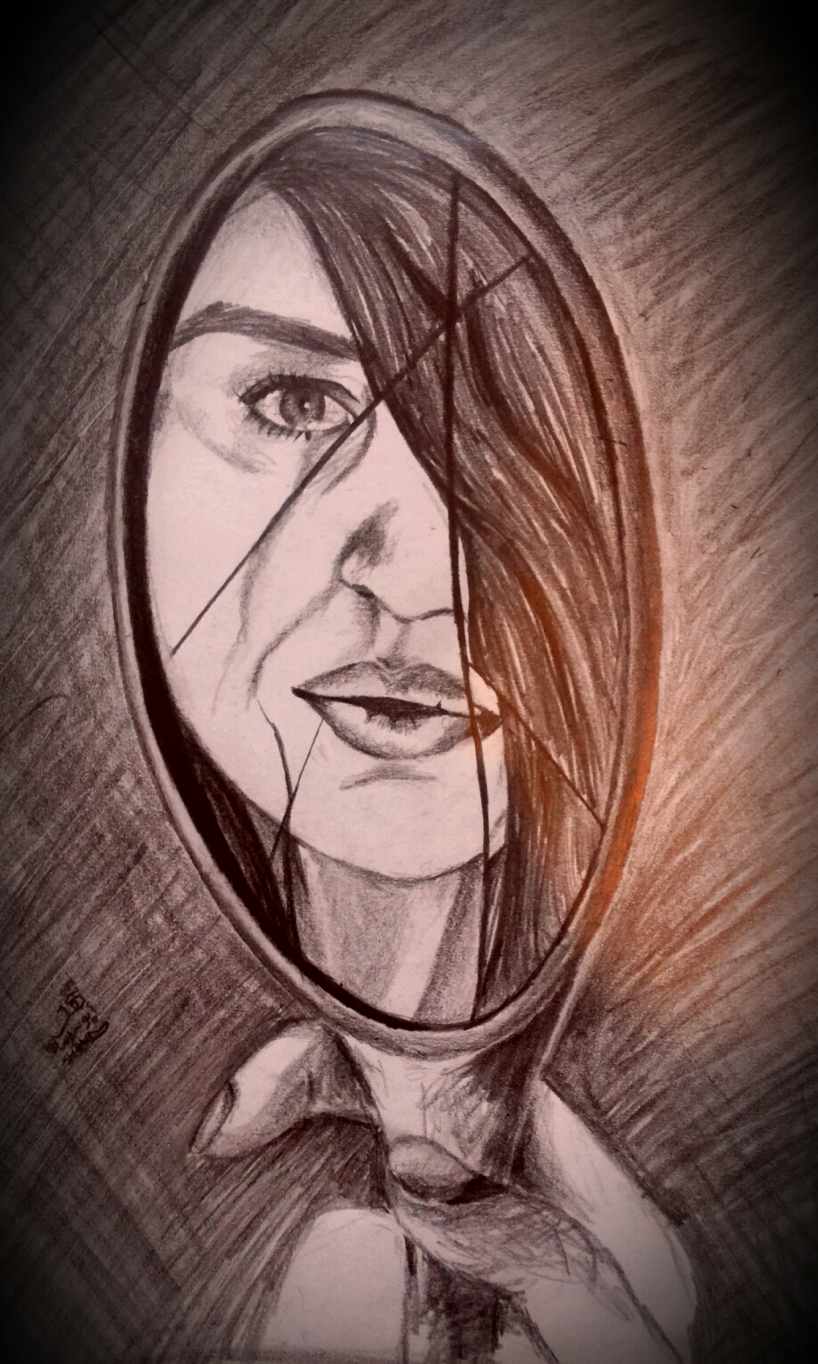
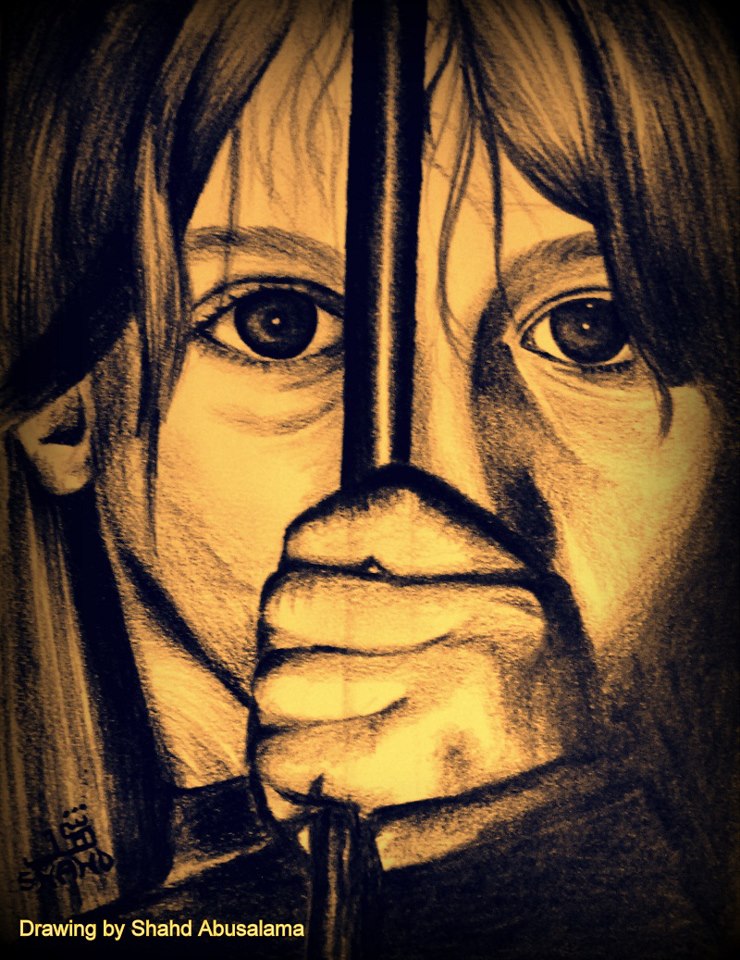


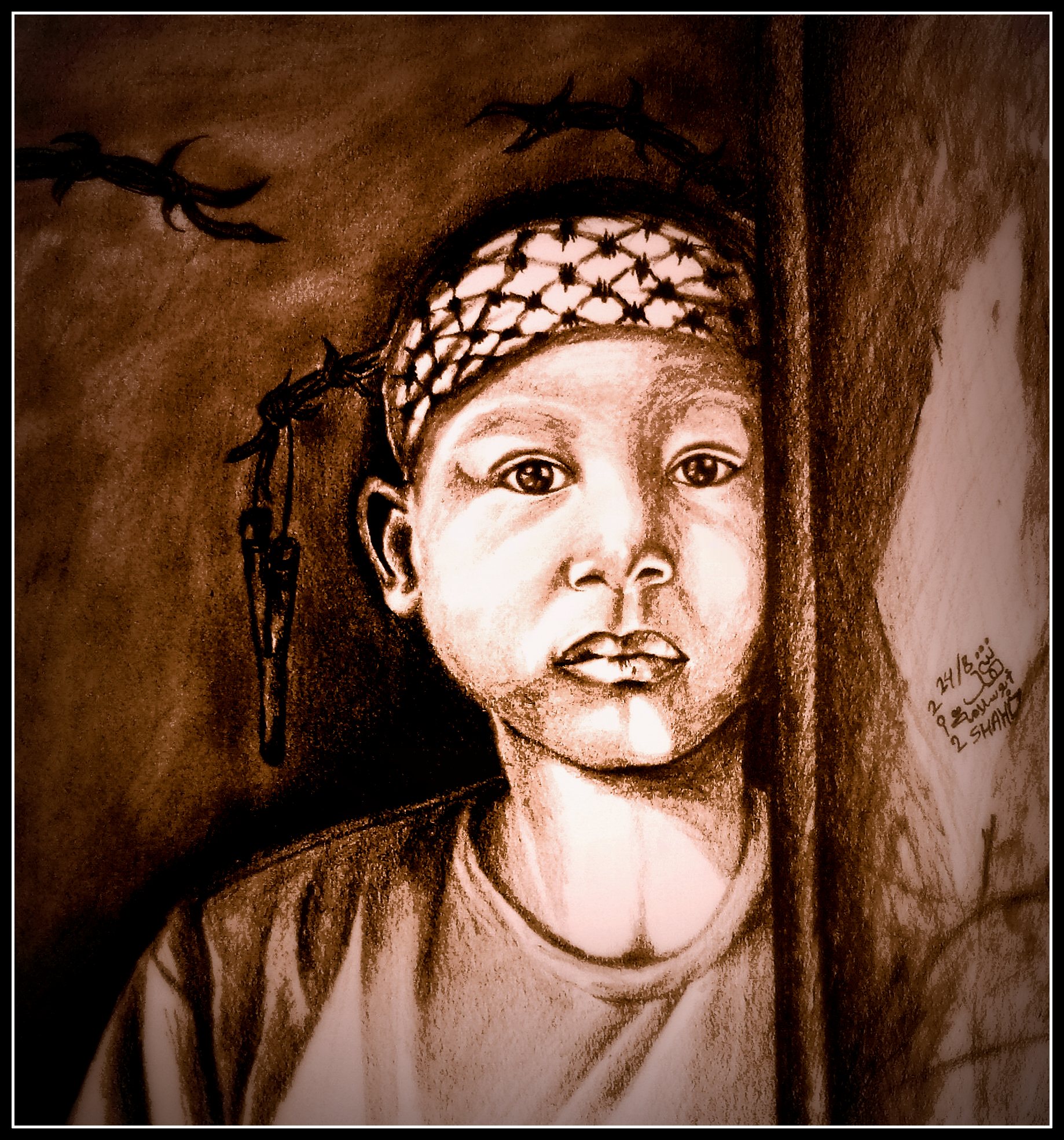
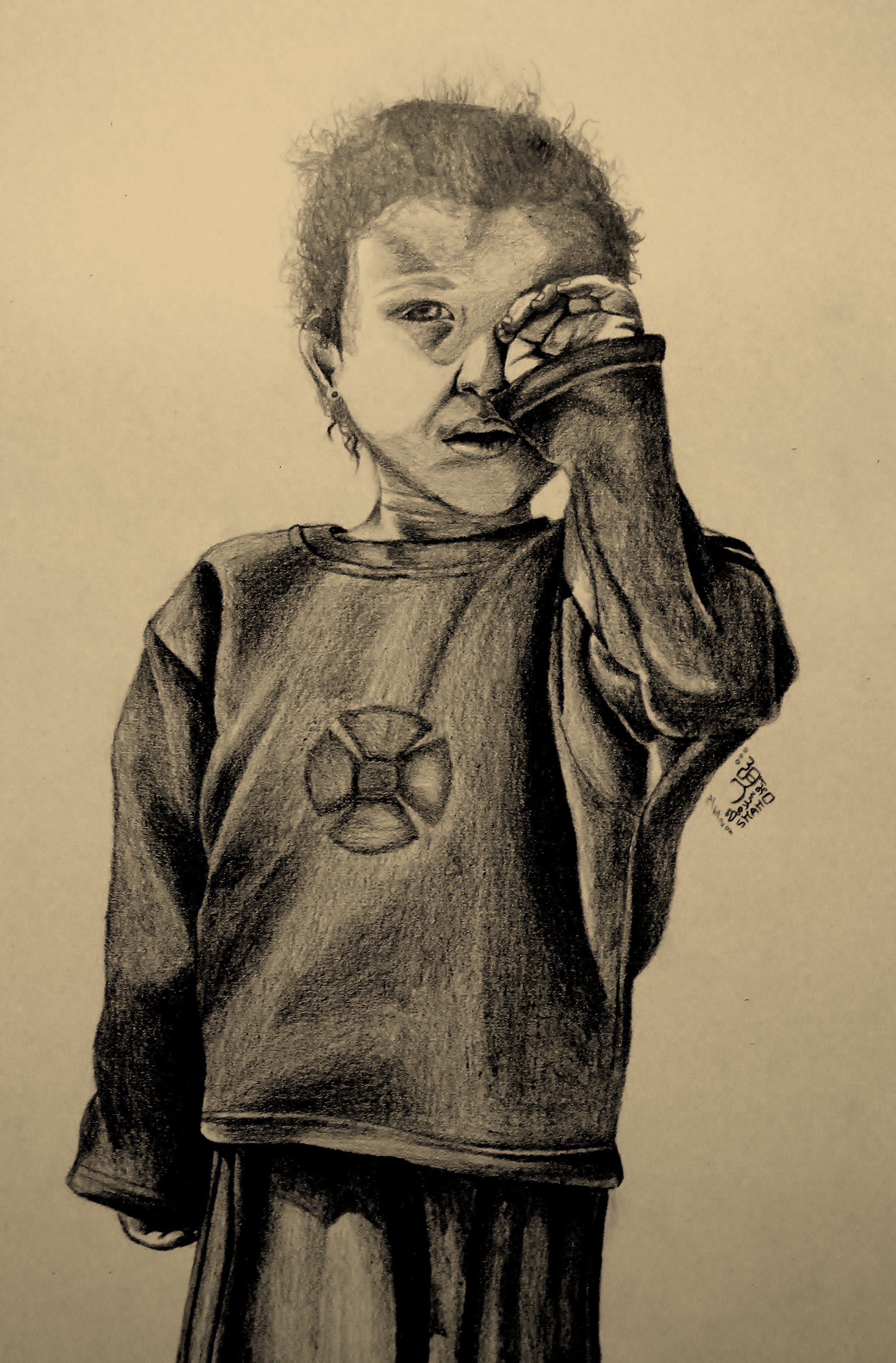


 PALESTINE FROM MY EYES