Generating a fearless and humanising narrative on Palestine!

Latest

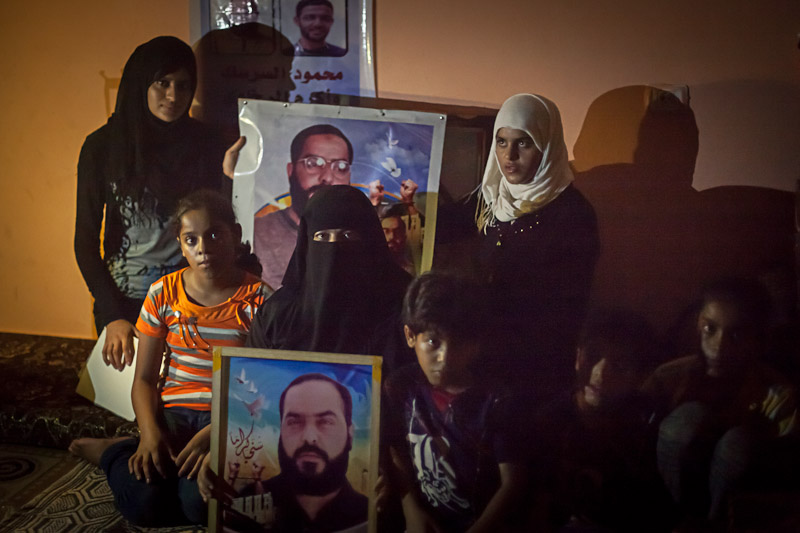
Akram Rikhawi’s family: “Are they waiting for him to return to us in a coffin?”

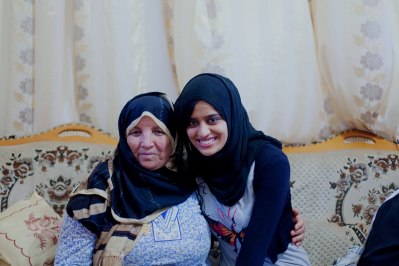
Akram Rikhawi’s family and I at their house in Rafah during the power-cut (by Magne Hagesæter)

The Palestinian football player Mahmoud Sarsak walks freely in Gaza’s streets and alleys, breathing victory among the steadfast people of the Gaza Strip. He acquired his strength to hunger for 96 days from Mahatma Gandhi’s words, “First they ignore you, then they laugh at you, then they fight you, then you win.” Gandhi’s promise came true, and Mahmoud actually won the battle of empty stomachs. Read my account of visiting Mahmoud Sarsak after his release.

Mahmoud was released from the Ramla Hospital Prison on July 10 after he revealed Israel’s crimes against humanity and made it submit to his demands. But his happiness remained incomplete. His thoughts are still in a place he described as “a hospital for torture, not for treatment,” with his comrades he left there, especially Akram Rikhawi, Palestine’s longest hunger striker in history.

About 6:00 pm on Thursday, the 99th day of Akram Rikhawi’s hunger strike, I saw a tweet: “Help us in spreading the truth about Prisoner Akram Rikhawi who might die at any moment #PalHunger”. As I read it, I felt anger at the world’s silence. I called Mahmoud Sarsak to ask for Akram Rikkawi’s home address. He kindly answered, saying, “Come to Rafah and I’ll take you there.”

Excited, I called some friends to join me, quickly got ready, and hurried to Rafah. The one-hour drive to Rafah felt like it took ages. We arrived there around 8:30 to find Mahmoud waiting. “Is it too late already to visit Akram’s family?” I asked him. He shook his head and said, “Their part of Rafah camp is filled with Yibna refugees. They stay up very late, especially Akram’s family. I don’t think they ever sleep!”

Before Mahmoud’s release, the Israeli Prison Service sent him to Akram to pressure him to break his hunger strike. Mahmoud took it as an opportunity to meet Akram for one last time, and to carry messages he wanted to deliver to his family. Akram was very happy for Mahmoud, and had faith that his victory would follow Mahmoud’s sooner or later.

The camp was very dark. I could barely follow Mahmoud’s steps. As we walked through one of the alleys, I recognized our destination from the huge banner of Akram hanging on his house. I could feel his family’s indescribable strength and faith from the way they welcomed us in with hopeful eyes and big smiles. There wasn’t any light in the house, but the smiling faces of Akram’s children filled it with light. Shortly after we arrived, we received word that Friday would be the first day of Ramadan. For Akram’s family, the news held some bitterness, as according to his wife Najah, it is “the eighth Ramadan without Akram.”

We all sat on the rug close to a lantern, the only light in a sitting room filled with photos of Akram. As his wife Najah started speaking, I learned that Akram is the son of a martyr, the brother of another martyr, and has a brother detained in Nafha Prison: a typical Palestinian family’s sacrifices for the sake of freedom and dignity. His father died in the First Intifada, while his brother was killed in the 1990s during a ground invasion by the Israeli Occupation Forces (IOF) in Rafah. His detained brother, Shady, became disabled after he refused food for 22 days during the mass hunger strike in Israeli prisons which began this year on Prisoners’ Day, April 17.

Akram Rikhawi has chosen to shoulder the responsibility for hundreds of disabled and ill political prisoners who grieve daily behind Israel’s bars and suffer its medical neglect. He also decided to rebel against the racist treatment that he received at the hands of some Ramle doctors. That was the main reason for his hunger strike. “After more than 100 days on hunger strike, Akram is in a wheelchair and cannot move either his left hand or leg,” Najah said. “Hunger has perhaps overtaken his body, but can’t easily defeat his will.”

“Before he started refusing food,” she continued, “he wrote a few articles on the suffering of sick prisoners and the medical neglect they endure, describing Israeli Prison Service violations against Palestinian detainees. He hoped they would pay his critical health conditions more attention and care. Instead, they punished him for speaking out by placing him in solitary confinement.”

Akram’s family described the Ramla Hospital Prison as “a slaughterhouse, not a hospital, with jailers wearing doctors’ uniforms,” using Akram’s situation as their best evidence. “He was detained at Ramla from the first day of his detention,” Najah said. “Before his arrest, he suffered only slightly from asthma. His health started to deteriorate when he was given the wrong medication.” She explained how this caused him severe health complications. “He had only one health problem, but medical neglect in Ramle Hospital Prison caused him six, including high blood pressure, diabetes, chronic problems, and osteoporosis, sight problems, and queasiness.”

Physicians for Human Rights-Israel (PHR-IL) previously reported that its doctors had found an “alarming deterioration of Akram’s asthma, which continues to be unstable,” adding that they believed he “has been given very high doses of steroids as treatment, which can cause severe long-term and irreversible damage.”

Najah managed to visit him twice. But since the ban on the family visits for the families of Gazan detainees in 2006, which followed the capture of Gilaad Shalit, they no longer can. “We can neither visit him, nor receive letters or phone calls from him. Our two main sources of information we rely on have been the International Committee of the Red Cross (ICRC) and released prisoners, who coincidentally met him after being sent to Ramla because of health problems they suffered.”

My admiration reached its utmost when I learned that Najah was actually the wife of Akram’s martyred brother. “I was a young widow of five children when my first husband Mo’taz was killed with cold blood by the IOF,” she said. “Akram was still single, and decided to take responsibility for his brother’s orphaned children and widow. So he married me. Allah blessed us with eight more children.”

One of Akram’s youngest twin who were born a little before his arrest and knew their Dad from photos.

Then a young woman interrupted our conversation. “I’m Yasmeen, my mother’s eldest daughter,” she said. “My father died when I was four years old. I can barely remember him. But I recall very clearly how tenderly my father Akram raised me. I never felt like an orphan around him. He always treated his children and his brother’s alike and loved us all the same.”

“He was always like a best friend to me,” Yasmine continued. “I was having my high school exams when he was arrested. During my final exams, he used to stay up with me to study. He never allowed me to prepare anything. He would bring food to my room. He used to wake me up for the Fajer prayer. Allah has made everything up to me when he guided Dad Akram to marry my mother.”

“I was the dearest to his heart, and he sometimes teased me, saying that I was the reason for his detention,” she said. “On June 7, he walked me to school in the morning before my exam. He spent the entire trip reminding me that I should have faith in Allah and not worry. Then he headed to Gaza City. On his way home in the afternoon, the IOF stopped the vehicle at the Abu Ghouli checkpoint between Gaza City and Rafah and demanded to see all the passenger’s IDs. After handing over his ID, Dad Akram was immediately arrested. In his first letters from prison, he wrote that his friends had warned him that the situation was worrying, and that he should remain in Gaza. He refused, saying he needed to check how I did in my exam.” Yasmeen said this with a slight smile on her face. After Akram’s detention, she could barely continue her examinations, and finished them with an overall score of 55.

Then a 17-year-old girl walked in, looking very upset. “This is Akram’s eldest daughter,” Yasmine said as the girl sat silently in the corner. “She’s repeating the same experience I had since Dad’s detention. This morning, the high school results were announced. She is sad that she got 75%, while she has been always one of the brightest students. It was difficult for her to concentrate on her studies while expecting that she might wake up any morning to mourn her father’s death.”

The family’s situation was heartbreaking. I listened carefully to their sad stories and struggled to hold my tears. I felt most moved when his wife pointed at her twin youngest sons and said, “A little while ago, they came to me asking what their father looked like. Was he tall or short, fat or slim? Their age equals the years Akram served in detention. They only know him from photos.”

I could feel the family’s anger and disappointment with popular and international solidarity. “What are the human rights organizations, Hamas, the PA waiting for before they move?” his daughter Yasmine asked severely. “Are they waiting for him to return to us in a coffin? Would they be happy for eight children to become fatherless, and five others to be orphaned for a second time? If Dad dies, we will never forgive anyone who could have done something, but chose to look away.”

Don’t choose to look away. Akram Rikhawi is in desperate need of your urgent actions to save his life. It is late, but it is not over. You can still do something, anything, to contribute to his survival.

Mahmoud Sarsak: “It’s not my victory, it’s yours”

It was 5:00 pm when I decided to escape my home for a place the power-cut hadn’t reached on June 18. Badia, the restaurant closest to the International Committee of the Red Cross (ICRC), is always my first option. Whenever I need to leave the sit-in tent to work on my laptop, I get there after walking less than five minutes. I was drowning in stress from my final exams. I had to double my efforts studying, as I had spent more of the last semester worrying about hunger-striking Palestinian political prisoners than my classes.

Even with stress from being unprepared for any exam, it was difficult to concentrate. My thoughts were filled with the revolution of empty stomachs inside the Israeli jails. June 18 marked the 90th day of the hunger strike Palestinian footballer Mahmoud Sarsak had launched against his unjustified three-year detention under Israel’s Unlawful Combatants Law. His hunger for freedom had pushed his life to the edge of death.

I lost track of time while alternating between news Web sites and literary ones for my class. Dad called me, reminding me to return home early. Just before I closed my laptop, I refreshed my Twitter page to see a Tweet saying, “Israel to Release Mahmoud Sarsak on July 10.” I quickly collected my things and ran toward the ICRC, so excited I even forgot to pay my bill.

Image

Hana’ Shalabi in the sit-in tent for Mahmoud Sarsak

Even the smell of the air seemed different when I stepped outside. Freedom filled the atmosphere. The chants I heard from the ICRC at Badia’s entrance made me run. The first person I recognized at the sit-in tent was the heroine Hana’ Shalabi, the ex-detainee who hunger-struck for 43 days to win her freedom, under the condition of expulsion to the Gaza Strip for three years. I ran to her and she hugged me happily, saying, “Congratulations on Mahmoud’s freedom!” Everyone was raising victory signs and singing for freedom. Then a man with a huge tray of sweets arrived and started distributing them.

I arrived home very late to find Dad waiting in the dark garden, looking upset. I didn’t want anyone to spoil my happiness, so I walked toward him chanting happily, “We defeated the jailers!” I was sure he hadn’t heard about Mahmoud, as our power was still cut. “Mahmoud will be free on July 10,” I said while looking at Dad, whose face turned into a smile. “People are still celebrating at the ICRC. Hana’ Shalabi was even there.” I was smart enough to find a way to negate his anger.

People in Gaza waited eagerly for July 10, a day that will be commemorated in the history of Palestine. All Palestinian television and radio channels reported this magnificent event. Thousands of people welcomed Mahmoud by the Erez crossing, the same place he was arrested around three years ago. As the ambulance arrived at the Gaza Strip side of Erez, Mahmoud appeared in its window, holding a football with one hand and waving with the other to the crowd of people excitedly waiting to see him.

Despite hating long drives, last Friday, I was crazy enough to tolerate a one-hour trip to visit Mahmoud’s house in Rafah, knowing he might not even be home. A group of foreign activists joined me in my adventure. “And what if he isn’t there?” my friend Fidaa, a Palestinian-American human rights activist, asked. “We’ll wait for him to come back!” I answered immediately.

We arrived at Star Square, near where the star Mahmoud lives. Thanks to posters and graffiti spread all over the walls of the Rafah refugee camp’s alleys, it was easy to find his house. “The groom just left for Gaza City,” his neighbors told us, but we were still excited to be at the house where “the groom” grew up and to meet his parents, who raised him to be a revolutionary.

Mahmoud’s parents were very friendly and welcoming. His house was small and simple, yet full of warmth and joy. It was crowded with neighbors, relatives, and strangers who, like us, had travelled the Gaza Strip to meet Mahmoud. Many of us had no relation to him, but following his struggle since the early days of his hunger strike made us feel connected to him. Mahmoud Sarsak, a Palestinian hero, has become a symbol of our resistance.

Image

Mahmoud Sarsak’s mother and I at their house in Rafah (Magne Hagesæter)

“Words can’t describe the happiness I felt when Mahmoud regained his freedom after his unjust detention,” his mother told me. “It felt like my son had escaped the grave! But Mahmoud wasn’t afraid of his. He chose a battle that would lead him to either freedom or martyrdom.”

We asked her how she had gotten news about him during his detention. “Of course, three years passed without a single visit, the same suffering that all Gazan detainees’ families have shared since 2006,” she replied. “So we relied on the ICRC for updates on his situation.”

“We were denied any news for an entire year,” she continued. “After that, we were thankfully able to receive letters from Mahmoud through the ICRC for a short period of time, but I can’t read. Whenever we received a letter, his brother Emad would lock himself in a room and cry for hours. After pulling himself together, he would come out and tell me not to worry, as Mahmoud was doing fine and still playing soccer.”

“During Mahmoud’s strike, I was physically and psychologically exhausted. My sons had to take me to the hospital several times. But I felt like I had returned to life once I heard that Israel had agreed to free him in exchange for an end to his hunger strike. I pray for all detainees’ mothers to experience such relief and celebrate the freedom of their sons.”

The house grew increasingly crowded with visitors. So we left to give others the opportunity to talk with Mahmoud’s wonderful mother.

But I couldn’t give up on meeting Mahmoud himself so easily. We had already travelled from the northernpost point to the southern tip of the Gaza Strip looking for him! So I called his brother Emad, whom I had met frequently in the sit-in tent. When he picked up the phone, I told him I had just visited his family with a group of friends, and that we were very happy to meet his parents. He appreciated our visit, and suggested we meet them in a Gaza restaurant. Excited, we accepted his offer.

We arrived at the restaurant by sunset. My heartbeats grew faster as the time for our meeting drew closer. I could see Emad waiting for us by the entrance. He welcomed our group inside and introduced us to Mahmoud, who nicely asked us to join his table. I felt very nervous sitting directly across from him, but proud that I could look him in the eye while speaking to him. He wore two gold medals and a scarf combining the Palestinian flag and keffiyeh.

Image

That’s when we finally made it and met with Mahmoud Sarsak at a restaurant in Gaza City.

“Thanks to Allah for your release,” I said. “How does it feel to be free again?”

“My happiness is incomplete, as the revolution of empty stomachs is still going,” he answered. “My thoughts are with my comrades Akram Rikhawi, Samer Al-Barq, and Hassan Al-Safadi, who are suffering critical conditions in the Ramla Hospital Prison. I was released from there, and know perfectly the medical neglect detainees suffer there. The Israeli Prison Service doesn’t transfer us there for treatment, but for torture.”

His humbleness added a lot to his charm. He kept repeating that he wouldn’t have achieved his victory without the popular and international solidarity he received. “It’s not my victory, it’s yours. I gained my strength and poise from you.” It was obvious that he had lost a lot of weight, but he was still healthy. Joe Catron, an American activist who has met many freed prisoners, said later that he had never seen a recent hunger striker in such good shape.

Mahmoud’s smile didn’t leave his lips the whole time. He paid us all his attention. When I asked him if Gaza seemed different after three years, he laughed and said, “It looks so different to me. Gaza is a very beautiful city despite its small size. I love its beach, its pure air, and its kind people. I missed everything about Gaza. I just missed being home.”

Fidaa asked Mahmoud if he expected to be arrested three years ago when he went to the Erez crossing. “Not at all!” he said. “I was thrilled to achieve a dream to play football in a national team contest in the West Bank, in the Balata refugee camp. When they ordered me to a security meeting, I wasn’t afraid. I expected they would ask me to collaborate with them. I was confident and prepared myself to reject them. I was shocked when they aggressively shackled me.”

I interrupted, asking, “Why do you think they arrested you if you have never participated in resistance?”

“Resistance isn’t only about armed struggle,” he said. “Resistance can be through pen, brush, voice, and sport. We are all freedom fighters, but each of us has his or her own weapon.” His eloquent, passionate answer impressed us even more than we already were.

“Sport is a form of non-violent resistance,” he continued. “Being a representative of Palestine’s national football team makes me a threat to Israel. I’ve always been passionate about building Palestine’s presence in the sports world. I represented Palestine in several football matches locally and internationally, and had the honor of waving its flag wherever I played.”

The more he spoke, the more I admired him, especially when finally I asked him what had changed in his character after his imprisonment. “My faith in our just cause has become deeper and stronger,” he replied. “My determination to unveil the Zionists’ inhumane and fascist practices, and their violations of our basic human rights, has become my reason to live.”

The time grew late, and we had to end our amazing conversation. Mahmoud Sarsak is one of the most inspiring people I have ever met. I will remember every word he said as long as I live. According to him, we all contributed to his victory. Let’s unite to achieve more victories for Akram Rikhawi, Hassan Al-Safadi, and Sammer Al-Barq. Make them reasons for your life, and fight injustice any way you can.

I Am More Than a Body

Image

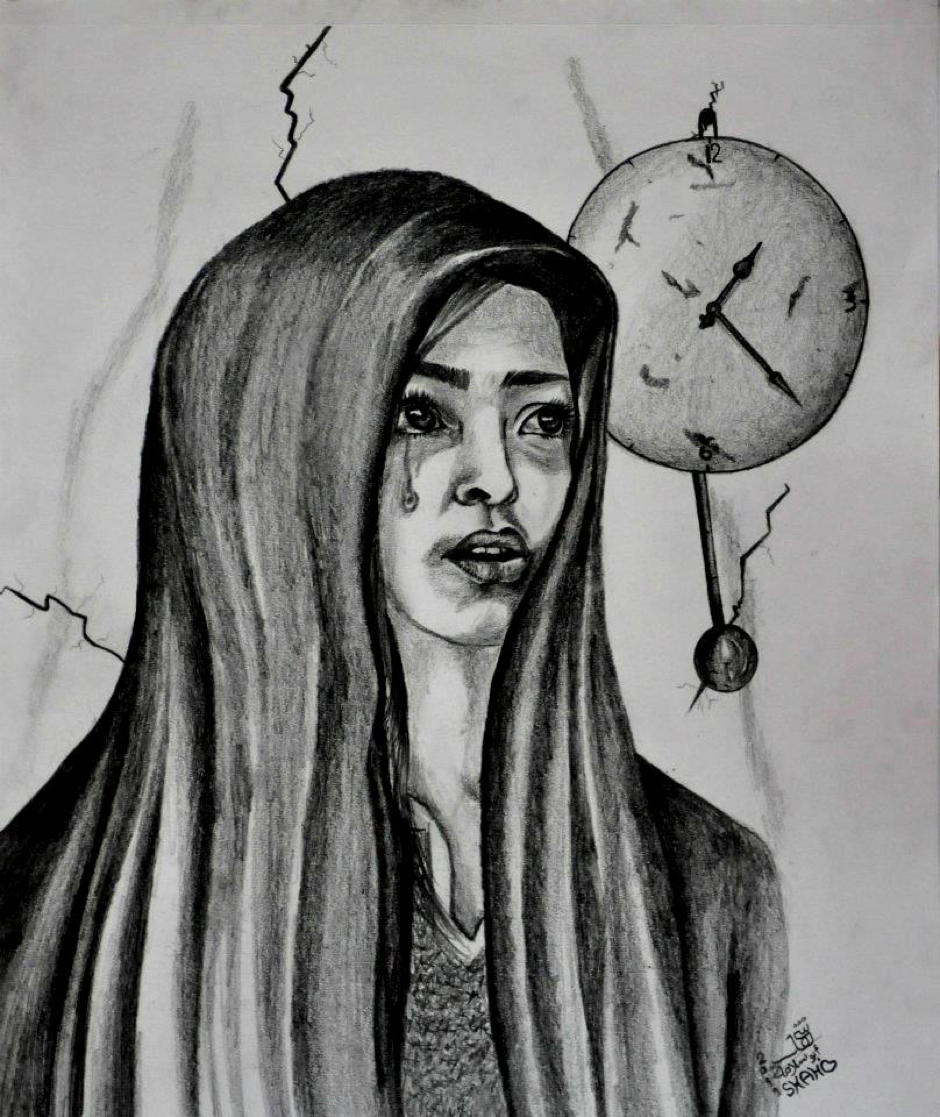
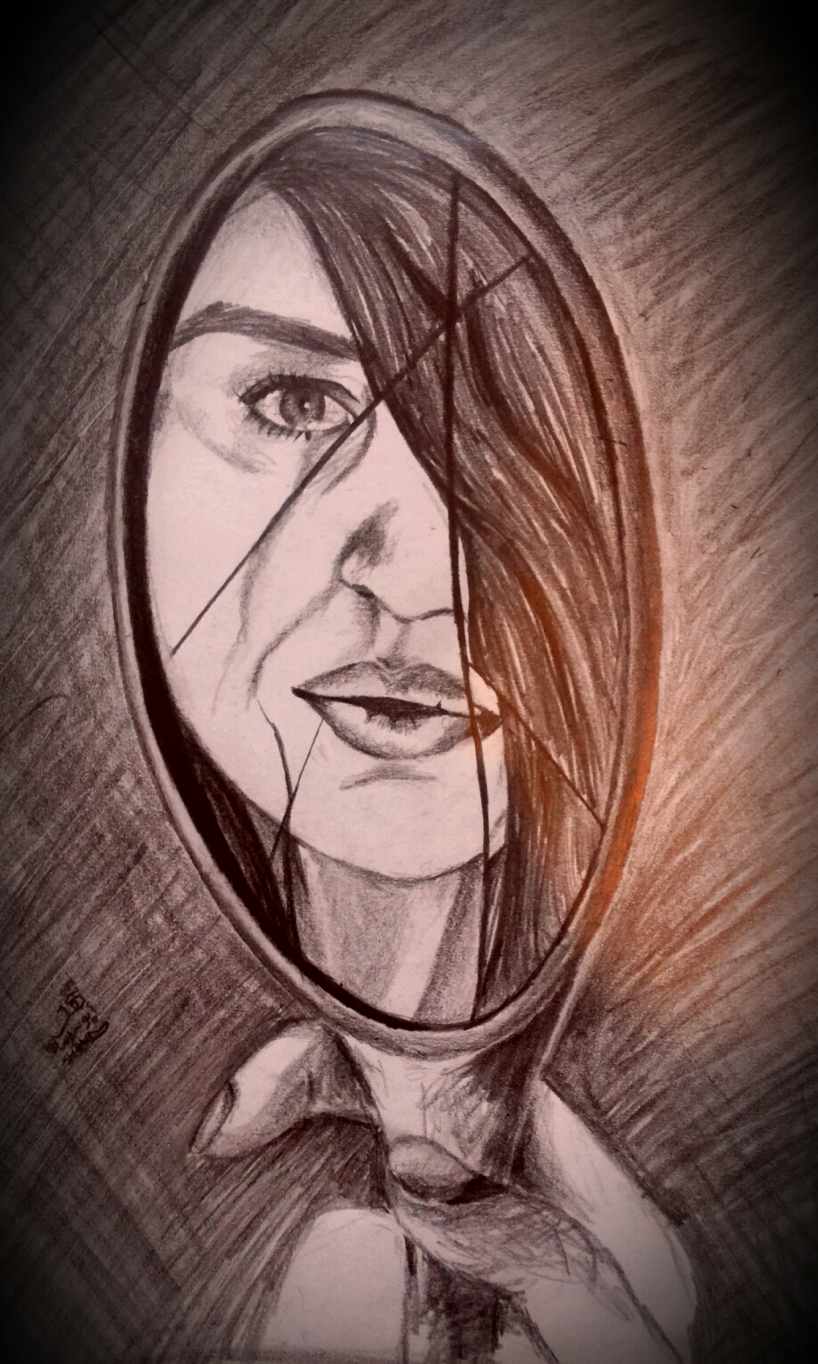
A drawing I did for a campaign against harassment of women that a youth group I am a part of is doing.

“A picture is worth a thousand words.” Inspired by this saying, I did this drawing. This drawing is dedicated to all women around the world. Let’s all revolt against the our societies’ degrading views of us. Let’s revolt against our societies’ conventions that restrict us and stand in the way of our creativity and effectiveness. The girl in the drawing is me and you. I refuse to be seen as merely a body. I refuse to be harassed. I am not a doll. Beyond this body, there is a human. Women are humans, just like men. We have equal rights. No one is superior to another. No one should violate our rights to live the lives we want, not the lives our societies impose on us. We deserve respect. Respect our humanity.

Think of Others: In Gaza’s darkness, Mahmoud Darwish’s words provide inspiration

Its 10 pm, time for the power-cut in our region of Gaza city.  Guess what? This time I didn’t sigh. I laughed thinking of one of my friends who mastered guessing if I have power at home or not, just from hearing my voice’s tune when he calls on the phone. He always teases me by saying, “Is your body connected to an electrical wire? You turn off whenever power cuts off!” Usually, I would just escape from the darkness to sleep.  This night, I’ve decided not to allow my frustration to take over and immediately make use of the charge left in my laptop.

I put my headphones in my ears to listen to Sameeh Shuqair’s song “Think of Others,”trying to cover the horrible noise of generators that already took over the region. Think of Others is originally a poem written by my favorite Palestinian poet and my teacher of life and humanity, Mahmoud Darwish. “You’re such a dreamer.” Many of my friends describe me this way but I am not sure whether it is a good or bad thing. What I know is that Mahmoud Darwish is one of the people who had a deep impact on my life as his words  always took me to my fantasy world that I always dreamed to live in, a pure world that is full of love, peace and people of conscience .

While listening to the beautiful lyrics of Think Of Others, my thoughts were for our political prisoners in the Israeli jails. I translated its lyrics not only for you to share with me the joy of the song, but also to demand you to listen to our detainee’s appeals to think of them.

As you fix your breakfast, think of others. Don’t forget to feed the pigeons.

As you fight in your wars, think of others. Don’t forget those who desperately demand peace.

As you pay your water bill, think of others who drink the clouds’ rain.

As you return home, your home, think of others. Don’t forget those who live in tents.

As  you sleep and count planets, think of others. There are people without any shelter to sleep.

As you express yourself using all metaphorical expressions, think of others who lost their rights to speak.

As you think of others who are distant, think of yourself and say “I wish I was a candle to fade away the darkness.

Image

Me in the sit-in tent when the news of the end of the mass hunger strike was announced in May14 (Ali Jadallah)

The mass hunger strike that was launched by more than two thousand of our political prisoners ended on May 14. Ending the policies of detention without charge or trial, and solitary confinement was on the top list of the strikers’ demands. I was lucky enough to witness that emotional scene of people’s reaction to that victorious news of its end in the sit-in tent in Gaza city. I can recall clearly their happiness that was mixed with tears of pride and joy.

Sweets started being distributed all over, even taxi drivers dropped by to get their share. The songs of victory didn’t stop playing in the background while people were waving Palestine’s flags, chanting, and dancing, celebrating our detainees’ success in forcing the IPS to endorse an agreement that was supposed to be enforced. It was one of the best moments I lived in my life.

Despite that, I learned a very important lesson for life: I shouldn’t get too excited over anything before I see it happening in front my eyes, especially when it comes to promises or agreement that Israel endorses as Israel is the last to stick to any.

Hearing that the isolated detainees will be moved from solitary confinement cells to normal jails fills me with joy. My happiness reached its peak as I heard that Hassan Salameh, who spent 13 years of his detention in a solitary confinement where he ended up having intimate relation with cracks on the walls or the insects, has been moved to Nafha Prison and has eagerly registered at Al-Aqsa University in the Gaza Strip to study history.

But later I got frustrated when I heard of the story of the Gazan engineer Dirar Abu Sisi, the only one left in isolation. After seeking details of Dirar’s case, I became sickened with Israel. Dirar was kidnapped from a train on 18 February 2011 in Ukraine, his wife’s country where he was seeking citizenship. Dirar was handcuffed, blindfolded and placed in a coffin after his kidnapping and once he opened his eyes, he found himself jailed in Israel.

He has been never engaged in resistance or in any political party. Israel has nothing against him but fear of his geniality. Israel has accused him of “conspiring” with Hamas, however even his professors in Ukraine — were he studied — have refutedIsrael’s claims that he studies weapons systems with them.

However, I feel that Israel is trying its best to fabricate any accusation against him. They are very concerned with devastating his mentality. His family has said that Israel fears him because he managed to modify the turbines in Gaza’s sole power plant, so they can run on a cheaper form of diesel that comes from Egypt, rather than on fuel imported from Israel.

He was just “the brain of the power system” who managed to light up Gaza when he repaired the sole power plant in Gaza, which produces 25% of its total electricity needs, after getting destroyed by the Israeli occupation forces during the so called Operation Cast Lead in 2008-09.  Due to that, cowardly Israel fears Dirar Abu Sisi despite his detention and continues to practice its inhumane policies of solitary confinement against him, which exemplifies an open violation of the latest agreement reached with Egypt regarding our prisoners.

Amnesty International says that Israel has renewed at least 30 administrative detention orders and has issued at least three new ones since the deal was signed. Due to these continuing violations, the battle of empty stomachs continues, led by Mahmoud Sarsak, a 25-year-old Palestinian national footballer who’s playing now the hardest match of his life, the match of defending his life’s dignity.

Sarsak has been on hunger strike for 84 days. He was captured at Erez checkpoint when Israel stepped in his way toward achieving a dream he was always longing for: participating in a national team contest in the West Bank, in Balata Camp. This was on 22 July 2009. Since that date, he has been held without trial and without charges and was banned from family visis just like all other detainees whose families are in Gaza.

Even after the release of the Israeli prisoner who was held in Gaza, last October, and the deal that Israel signed after the last mass hunger strike, nothing new has happened regarding coordinating family visitation for the families of detainees from Gaza. Mahmoud Sarsak is in grave condition according to an independent doctor from Phyisicians for Human Rights – Israel who examined him. However, the sporting world and the international community in general are barely paying attention.

I appeal to you to deeply, ponder the words of Mahmoud Darwish’s poem and think of others! Whatever insignificant support you can contribute at easing the life of Dirar Abu Sisi and rescuing the life of Mahmoud Sarsak will help. And remember, their victory won’t be only theirs, but a triumph for humanity!

What was supposed to be a wedding ended up a funeral

Samer and his mother

“Samer will get engaged!” My friend Loai said with a big laugh. “Oh my God! Really? When?” I burst out with an endless list of questions and exclamations in my head.

Samer Abu Seir is an ex-detainee who was released in Shalit’s prisoner exchange and deported from Jerusalem to the Gaza Strip. Getting married should not be surprising for a single man at the age of 46. However, Samer is one of the few released prisoners who was cautiously considering getting married especially after he spent more time in the Israel jails than he spent outside. I remember when I first met him and asked him how long he had been detained and he answered me sarcastically, “Nothing! It was only a matter of 24 years passed like a blink of an eye.”

He always thought that he needed time to keep up with the updates of the outside world that occurred without him noticing. He always felt that he needed to be accustomed to seeing the blue sky, the green trees, the crowded buildings, walking on Gaza’s beach and feeling its breeze smoothly hitting his cheeks, instead of being under that dark-gray ugly ceiling, in a narrow jail, and between the same four surrounding walls where neither sunshine nor air could sneak in.

“What was the reason behind this sudden decision?” I asked. “His 83-year-old mother is in a grave situation,” Loai replied. “He rushed this just to make her happy, so if she dies, she can rest in peace.”

Samer has grown up fatherless. He lost his father when he was a little child when he was away in Jordan. His widow mother had raised him along with his other two brothers and two sisters by herself. He thinks the whole world of her. She is a symbol of motherhood who had raised her children on the noble values of love, dignity, and sacrifice for Palestine. She believed that there is always a price for everything you fight for, and she has instilled these beliefs in her children. Samer and his family have paid the price in many ways. The simplest example of pain that he has always endured was that his family never gathered for a meal. There was always at least a member missing.
Samer had always suffered the ban of family visits for long periods, especially during his detention in solitary confinement for 3 years and a half. These times were the most difficult that Samer lived inside prison as he constantly kept thinking about his mother and fantasizing how her wrinkles beautifully spread in her beautiful loving and peaceful face. The family visits were his only connection with the outside world. Once a family visit ended, he eagerly waited for the next one.

Moreover, Samer had always led unsettled life in prison as he was moved around to every one of Israel’s prisons. Samer’s constant thinking of his mother made it more painful for him to tolerate such inhumane practices of the Israeli Prison Service (IPS). Samer’s mother never let that or any of the humiliating actions she received from strip searches and insults hold her away from having 45-minute meeting with her son through a barrier between them.

Even after Samer was released, she didn’t stop suffering. She handled the pain of Samer’s 24 years of imprisonment without complaining, and then she kept suffering the pain of him being forcibly deported away from her. This is another violation of Article 49 of the Fourth Geneva Convention which prohibits deporting people within or outside the occupied territories.

While thinking about Samer’s motive to get married, I recalled his cute old mother who arrived to Gaza almost a week after the prisoners’ exchange, challenging her age and deteriorating health condition. Last November, I joined my family to a celebration of freedom where almost no one was taking seats, all people were happily performing Dabka, the folk dancing of Palestine, and waving Palestinian flags as revolutionary songs were playing loudly in the background.

Samer’s mother dancing celebrating her son’s freedom

There, my eyes fixed on an elderly woman wearing the Palestinian traditional dress. She could barely walk or stand but her happiness gathered all the strength inside her to dance slowly and erratically. My eyes were following her with joy and wondering who she was. I asked Dad about her. “She is Samer’s mother. Wherever you see her, she is dancing. When she gets out of the car, she dances. when someone visits her at home to congratulate her with her son’s freedom, she dances. Look how happy she is!” Dad answered smilingly. “She reminds me of your grandmother who was just like that when I was set free. All the Gaza Strip would hear of my freedom because of her. She’d be dancing and singing songs of freedom wherever she went.”

Samer was enthusiastically going to officially get engaged today’s evening and let his mother declare his engagement from Jerusalem through Skype. But destiny stood against his intentions of making his mother happy. Sadly, this morning he woke up on hearing the news of his mother’s death and what was to supposed to be a wedding turned out to be a funeral.
I am thankful that at least she lived long enough to celebrate her son’s freedom. This reminds me of another story I wrote last December of a mother of two former prisoners who have been deported from Hebron to Gaza, and who died a week after she arrived to Gaza and wrapped her two sons between her arms once again. Please say a prayer for Samer and his family.

An Essay on Which Matters More in the Shaping of One’s life: Social Class or Gender?

The influential criteria of occupational stratifications differ from one society to another depending on its culture. If we ask two people, one living in America and the other in Palestine, whether their genders or their social classes have a deeper impact on their lives, their answers will conflict. The social class that an individual belongs to unquestionably affects the shaping of her or his life. Social class is associated with economic status. The higher a person’s social class is, the more potentials and education and work opportunities are available for that person, regardless of gender. However, I think in an eastern society like Palestine, gender has a greater influence on one’s life than social class.

In previous centuries, almost all societies were patriarchal ones in which men were the dominant power and women were seen as “insignificant other”. The stereotype was that men were to work outside, while women were to be housewives and work at home. They played almost no role in the labor force. Women suffered from a degrading view everywhere, so that many of them believed they were inferior to men. They had little or no voice in their political, economic, and social issues of their societies. Women had difficulty even expressing their voices. Female writers had to use masculine pen names to express themselves and to have their voices heard, such as Mary Anne Evans, who wrote as George Eliot.

However, times have changed. In World War I, women filled men’s roles in society. The hardships which forced them to depend on themselves to earn incomes for their families made them realize their inner strengths and abilities. In advanced western societies like America, gender matters less than social class does nowadays. Men and women are almost equal in rights. Thanks to the feminist movement, the woman’s status has been upgraded. She has become an affective member of society, not an inferior to the man as previously depicted. But still, even in modern societies, women are found in the upper occupational stratifications much less than men.

Therefore, I personally think the gap between classes in modern societies is greater. There have been more advances made in terms of gender equality than class equality. A poor man faces the same obstacles that a poor woman faces due to the social class that they were born into. When I was in America, I saw female taxi drivers as well as male taxi ones. I saw policewomen just like I saw policemen. But I also saw women in very high positions in the university and the State Department. The only thing that a woman has not become in America is a president of the United States. But when I think about what made one woman a taxi driver and what made the other a minister, I find one reason: their social classes. The female minister must have been raised in a higher social class that could afford to educate her to the highest levels, which contributed to making her qualified enough to be a minister. But the female taxi driver was not as lucky when she was born into a lower social class that suffered economical problems.

It is important to remember that there is still some discrimination against women, even in “advanced” societies like America. There is a lot of social pressure on women to meet an ideal model, that is impossible to meet, in terms of appearance. When it comes to men, they face none of this social pressure. For example, the woman’s appearance is considered as one of her qualifications. The prettier woman has more potential to be considered for a job opportunity than a woman who is less attractive but has more occupational qualifications. Moreover, a man is paid more than a woman in the same job. Apart from that, women’s bodies are used as a commodity and sex object to sell products, ignoring their intelligence.

In eastern societies, women are becoming more aware of their rights and their abilities to be as effective members of society as men. However, in many ways, women are still seen as extensions of men or inferiors due to cultural reasons, not to religious ones as claimed by many people. The rate of working women is notably less than that of working men. Moreover, men usually occupy the highest occupational stratifications. Few women are ministers, managers, or even doctors.

Many Palestinian men think that they are superior and would feel ashamed if their wives were more educated or had higher positions. For this reason, researchers report many cases of oppression and violence committed by men.

In Palestine, women tend to stay at home regardless of the social class to which they belong. In the rich families in Palestine, educated women tend to be dependent on men and enjoy lavish lives without having to work and earn their own incomes. However, in the poor families, women suffer hard conditions with fewer opportunities for education. And if they want to work, they seek crafts like being either hairdressers or seamstresses.

The types of work that is available for women are more limited as well as the places of occupation. When a young women graduates from her high school and decides to attend university, she usually encounters many obstacles. Her father might not allow her to go to university for financial reasons. Even if her father can afford to pay her university expenses, he will influence her decision of what specialization to undertake. My mother studied nursing. But she always describes how society considers nursing as an inappropriate specialization for women to study for cultural reasons. Female secretaries and doctors suffer the same degrading view of the society. It is not as bad as it was couple of decades ago though.

In our societies, in many families where women can continue their university studies, they tend to become only teachers. When my elder sister graduated from school, she wanted to become a journalist. However, my father recommended that she study mathematics. He did not force her, but he insisted, thinking so much of the social acceptance of women as teachers rather than journalists, that she eventually agreed. But she wanted so badly to study journalism. After studying one year of mathematics, she realized that she could not see herself in that position, where she could never be as creative as she wished. Thus she changed her specialization. Thankfully, we have an open-minded father who has respected her wish. What happened with my sister repeats itself thousands of times in our society but fathers who respect their daughters’ decisions are rare.

Many men still think that women have been created to be merely wives. Their understanding of a wife is someone whose responsibility is to satisfy their husbands’ sexual desire, deliver and bring up children, and do the housework. “Your certificate will eventually hang on your kitchen’s wall” is a sentence that I often hear people address to women. Palestinian fathers tend to be more willing to pay for their sons to further their studies, as their sons can eventually work and contribute to making money for their families. Contrastingly, they believe that it is pointless to pay for their daughters to study, as they will eventually marry and leave the house.

Over recent years in Palestine, the way society looks upon working women has differed from the times of economic difficulty to the times of relief. When Palestinians were allowed to work in Israel, it was socially acceptable for women to join the labor force in Israel during times of economic difficulty. My grandmother worked in an Israeli hospital at that time. However, in better economic conditions, the same behavior was considered as “shameful”. My grandmother said that she retired because of social pressure. However, it’s obvious that the status of women in our societies is getting better. More women are pursuing education, and working women have become more respected.

The role that women and men play in each society depends on the social, cultural, political, economical, and religious factors surrounding them. Those factors differ from one society to another and sometimes from one area to another in the same country. Therefore, it is hard to make a generalization about whether social class or gender matters more in the shaping of one’s life. But hopefully, in today’s world, all societies will move towards increasing equality in both spheres.
P.S: This is an assignment I did for my Literary Criticism class at university. That’s why it is very formal.


My father’s memories of his release from Israel’s “graves for the living”

Image

My amazing parents met after Dad’s release, fell in love, and got married. I’m proud I’m their daughter. ( Nathalie Beser)

Twenty-seven years ago, my father’s eyes saw the sun after being in the dark of Israeli prison for 13 years. On 20 May 1985, my father regained his freedom.

“I was sentenced for seven lifetimes plus 10 years and I thought that this prison, Nafha, would be my grave. Thank God I didn’t stay that long there, and I was set free to marry your mother and to bring you to this life,” my father told me, smiling. He considered the 13 years of misery as not that long. Yes, it’s not that long if compared with the life sentence to which he was bound if the deal to exchange Palestinian and Israeli prisoners didn’t happen.

No regret

I can’t recall that Dad ever showing any regret or sorrow for how the precious years of his youth were stolen from him.   His prison experience is instead his song of life. He believes that it is his treasure, the reason behind his rich culture and beliefs, his strong character, his intimate friendships, and the reason why he values life. I’ve always been proud that I am my Dad’s daughter, and I’ll always be. He is a mix of experience and knowledge.

The story of the exchange deal all started when Ahmad Jibril of the Popular Front for the Liberation of Palestine  captured three Israeli soldiers (Yosef Grof, Nissim Salem, Hezi Shai) in revenge for thousands of Palestinian prisoners kidnapped by Israel without any apparent reason. After a long process of negotiations, both sides struck a deal that Israel would release 1,250 prisoners in return for the three Israelis that Jibril held captive. My father was included in the deal, and fortunately, he was set free. Among the prisoners released were the Japanese freedom fighter Kozo Okamoto who had been sentenced to life imprisonment, and Ahmed Yassin, the leader of Hamas who was sentenced to 13 years imprisonment in 1983.

History repeats itself

History repeats itself. On 18 October last year, we experienced a similar historical event with a swap deal involving the Israeli soldier Gilad Shalit, who was arrested by the resistance in Gaza while he was on top of his war machine (an Israeli tank). Just like what happened with Shalit, the capture of three Israelis caused uproar in the Israeli public opinion and international media at that time, but the thousands of Palestinian prisoners behind Israeli bars were not noticed, except for by the resistance fighters that have always forced Israel to meet some demands regarding the Palestinian prisoners.

When I deeply think about these events and the way the international media reacts, I get angry at how unjust this world is. Why did the world make a big deal of Shalit and the three soldiers when they were attested by the “terrorist” Palestinians while thousands of  Palestinian political prisoners are left behind in Israeli jails enduring all forms of violations and torture and the world chooses to look away?

My father told the story with tears struggling to fall. He was staring at a picture stuck on the wall of his room; a painting that my father drew during his imprisonment of flowers blooming among barbed wires. “I cannot forget the moment when the leader of the prison started calling off the names to be released,” he said.

Mixed emotions

Among the prisoners was Omar al-Qassim, a leading member of the Democratic Front for the Liberation of Palestine. Al-Qassim was asked to read the list of the names loudly. He was so excited at the beginning hoping that his freedom would be restored. Every time he said a name, a scream of happiness convulsed the walls of prison. Suddenly, his face’s features started to change. He became reluctant to speak because he noticed that his name wasn’t among the names. This was another incident of psychological torture that the prison’s manager committed against him. But he left him no chance to make fun of him. He withdrew himself silently and went to his prison to continue with his resistance. Sadly, he died in a horrible narrow cell after 22 years of resistance, pride and glory.

The tears of happiness and sadness mixed together. The freed prisoners were happy to regain their freedom but they were upset at leaving the other prisoners in that dirty place where the sun never shines. “We were like a big family sharing everything together. We all handled the same issues that we were united to fight for,” my father said. “Although I am free now, my soul will always be with my friends who are still suffering in there.”

My father has always said that “prisoners are the living martyrs.” He also described Israeli jails as “graves for the living.” Let’s unite and use all the means available to help 4,653 Palestinian political prisoner have fewer years of suffering. We share this responsibility as we can’t leave them as prey for those criminal jailers. Their freedom will be a triumph for humanity.
Note: Read this in Italian here. Many thanks for Emanuele Qalitry for translating it!

On Deported Palestinian’s Day, a deported man describes his life as “never settled”

Image

An old photo of the photo besieged insid the Church of Nativity in 2002

On May 10, 39 Palestinians from Bethlehem completed eleven years of deportation from their precious homes. On the very same day, eleven years ago, they were expelled from the Church of Nativity after a siege by the Israeli Occupation Forces that lasted for 39 days: 26 men went to Gaza, 13 to Europe. Since that tragedy, which marked another form of ethnic cleansing, this day has been called ”Deported Palestinian’s Day”.

Since the last swap deal in October, hundreds of Palestinians have joined this category, as 203 ex-detainees were convicted to indefinite deportation. Moreover, ex-detainee Hana’ Shalabi was recently deported from Jenin to Gaza after hunger striking for 45 days to protest having been re-detained after midnight by a huge, aggressive force of Israeli soldiers, and held under administrative detention on February 16. Israel has intensively deported people from the West Bank to either the Gaza Strip or countries such as Turkey, Syria and Qatar. Israel offered administrative detainees Bilal Diab, Thaer Halahla, and Jafar Ez Al-Din Qadan, all on hunger strike for over two months, deportation to Gaza, but they refused this horrible offer and bravely insisted on continuing their battle of empty stomachs against Israel’s injustices and violations.

Image

Mr. Fahmi Kanan and other Palestinians including deported ones from the church of Nativity marching on Deported Prisoner’s Day calling for ending their exile.

On May 10, hundreds of people from all generations marched to the sit-in tent for Palestinian political prisoners in Gaza to share the continued suffering of the deported Palestinians. The experience of exile, with all its pain, repeats itself hundreds of times in Palestine at the hands of Israel, as it openly violates the same Geneva Convention it ratified in 1951.
One of the people I am very proud to have met through the weekly protest for Palestinian detainees is a deportee from the Church of Nativity, Fahmi Kanan. Fahmi has been a good friend of mine, despite our difference in age: He is 43 years old, while I am only 20. He makes sure to attend every Gaza activity organized in solidarity with the Palestinian detainees and their families.

I remember very well Mr. Fahmi’s touching words when I first met him and asked him about the reason for his dedication to the detainees’ cause. “I have never lived a settled life,” he said. “First, I was born in a land under occupation. Secondly, I lived the hard life of detention inside Israel’s prisons five times, each under administrative detention. I was only a 17-year-old teenager when I was first detained. Thirdly, when I’m not detained, wherever I walk within the Palestinian territories, I’m ‘wanted’ and chased by the Israeli Occupation. Fourthly, I was one of the people besieged inside the Church of Nativity in 2002, then deported to Gaza. Our sufferings take different forms, but all of them result from one thing – Israel.”
Afterward, I learned that Mr. Fahmi is the spokesman for the people deported from the Church of Nativity. Having a shared passion for a just cause, Mr. Fahmi and I get along well. He always brings his kids with him to the protest for detainees. I’ve gotten to know him as a person, not merely as a political activist. I believe that children are reflections of their parents. In Mr. Fahmi’s case, his children are outstanding reflections. I always tell him, “If I ever have a child, I’d like to raise her or him the same way you did.” I see a bright future for Palestine through his kids who are, despite their young ages, very well-educated about Palestinian issues.

On the second day of Eid al-Adha last year, I saw him with all his kids in the weekly protest for detainees outside the International Committee of the Red Cross. When I asked him how his family in Bethlehem was doing, he replied, “I was on the phone with Dad this morning, greeting him for Eid. He is getting older. He fears that his death will be soon as he suffers from some health problems. My heart aches when he tells me that he wishes he could see his grandchildren before he dies.” I asked his 11-year-old son Nasr whether he was enjoying his Eid or not. He replied with a sad look on his face, “I feel like it is the same as any other day. All our relatives are in Bethlehem, and Eid without family is tasteless.” His words touched me very deeply.

Image

Two of Mr. Fahmi’s cute kids, Nasr and Israa, and I in a park in southern Gaza during Al-Adha Eid last November.

When I shared with Mr. Fahmi what his son told me, he answered, “My kids were raised without their grandparents or relatives around. The times I was questioned about them are countless, especially during our traditional and religious feasts. But thankfully, they are smart enough to understand that this is one of the prices that Palestinian people pay for being merely Palestinian. And they are proud!”

Yesterday, Mr. Fahmi made a moving speech that showed the humanitarian aspect of a deported Palestinian’s suffering. “The hardest times in a deported person’s life are the times of need,” he said. “Today, we should remember Abdullah Dahoud, one of the 39 deported from the Church of Nativity. Sadly, he could not be among us today. He died of sorrow over his mother and sister, who passed away without him seeing them for one last time. When he was once asked about his fondest wish, he said, ‘I wish I could read a verse of Qura’n next to my mother’s grave.’”

Palestinians consider the United Nations a partner of the Israeli Occupation because of its silence. Security Council Resolution 607 “[c]alls upon Israel to refrain from deporting any Palestinian civilians from the occupied territories” and “[s]trongly requests Israel, the occupying Power, to abide by its obligation arising from the Convention.” But when it comes to reality, the UN chooses to take no action against Israel’s violations. We, the Palestinian people, don’t want resolutions, we want actions! We want real justice, not just words tossed into the air!

“Only one of my three sons is left and is locked behind Israel’s bars”

Image

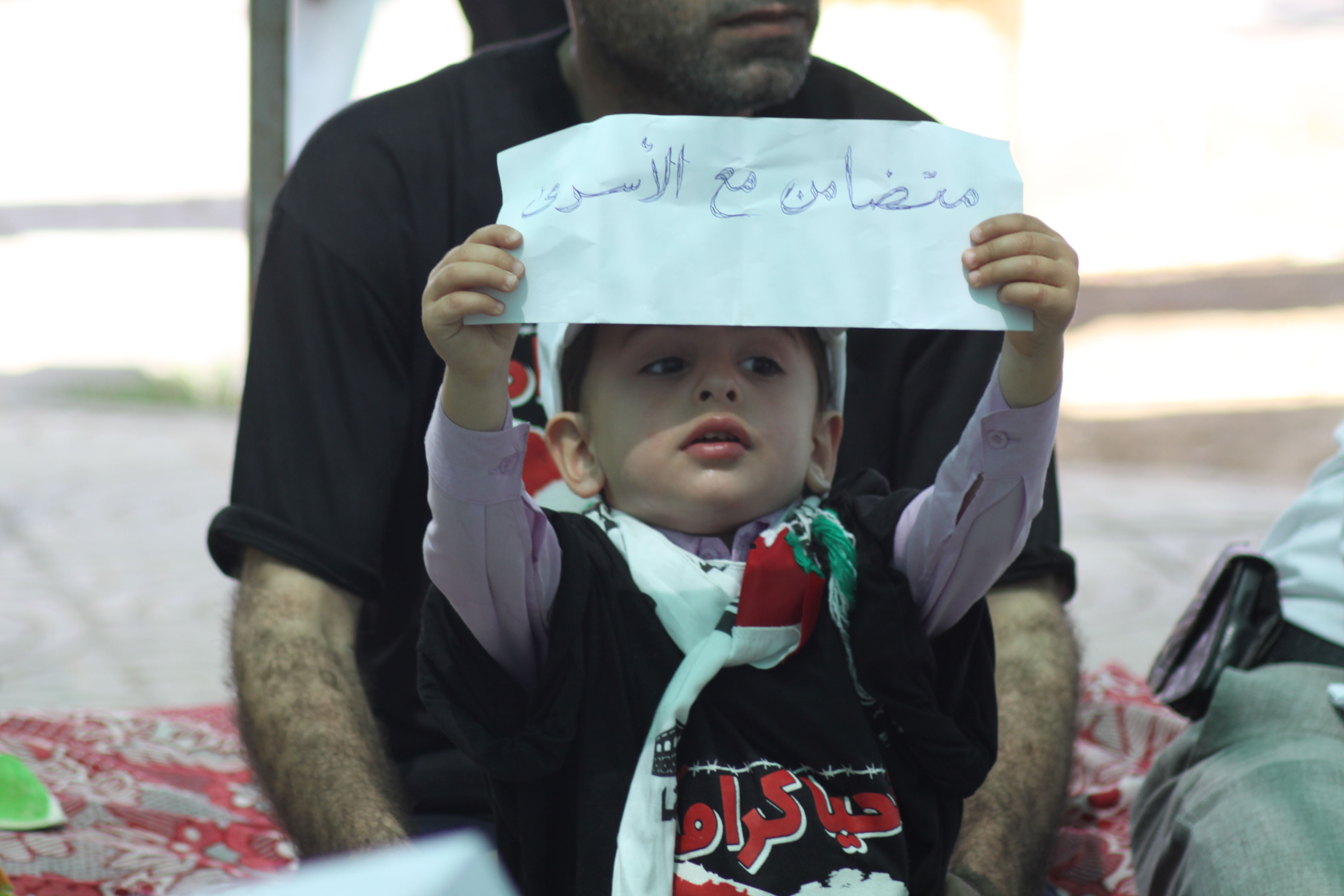
A hunger striker’s son in Gaza’s sit-in tent carrying a sign reading “I am in solidarity with Palestinian detainees”–By Mjd Abusalama

The sit-in tent for Palestinian political prisoners has been moved from the International Committee for the Red Cross to a central park near the statue of the Unknown Soldier in the middle of Gaza City. It is one of the few green places and thus one of the most lively places in Gaza, where people escape from their dark houses and seek fun and relief, or to simply waste their times observing others.  However, the sit-in tent is now used differently, to send messages of solidarity with our Political prisoners who have been on a mass hunger strike since April 17, and to show anger with the Arab and international community and all human rights organizations, which keep calling for human rights, democracy and justice, but when it comes to our prisoners, they do nothing but watch them dying and remaining helpless.

The solidarity is taking many forms, such as lighting candles, making marches, creatively performing plays, songs, poetry and Dabka, joining a symbolic hunger strike.  In Gaza’s sit-in tent, 50 men and 45 women have joined a symbolic hunger strike in solidarity with the detainees since May 2, including prisoner’s wives, parents, sisters and former prisoners. Those people have been protesting day and night. The tent is their shelter as long as the revolution of hunger is going inside Israeli prisons. Having been in the solidarity tent daily, even more than in my house, I’ve witnessed most of the cases among hunger strikers whose health conditions got deteriorating. Several cases were sent to hospital for low or high blood pressure and so many people fainted or emotionally collapsed. Ambulances and doctors never leave the tents anymore as if they have full time job at the tent.

While observing the hunger strikers getting paler as more days pass, I can’t help but think of our heroes, our prisoners behind Israel’s bars and compare. The strikers here have access to water and salt and they also have a small dish of yogurt and soup per day. But our prisoners have nothing but water and salt, ‘in case it’s not confiscated by the Israeli Prison Service (IPS).’  Strikers here can rest or sleep whenever they feel like it, but our prisoners keep being transferred between sections and prisons by the IPS attempting to exhaust them. Loai Odeh, a former prisoner who is also now on a hunger strike in solidarity, emphasizes that the IPS mercilessly prevents the strikers from resting, with these words he wrote recalling his experience of hunger strike during the campaign of disobedience.  “Soldiers burst into strikers’ rooms aggressively as if they were confronting armed fighters on a battleground, not hunger strikers with feeble bodies that can barely stand.  Knowing that strikers are intolerant of noise, soldiers break into their rooms with loud screams and initiate a  hand search in a way that one feels that he’s being beaten rather than searched.”

Image

Loai Odeh and Abu Hosny Al-Srafity in the sit-in tent

While making the daily tour to show support and admiration to the hunger strikers in the tent, I was surprised to see Abu Hosny Al-Srafity wearing the strikers’ t-shirt that distinguishes them from others, and which beautifully designed with the Palestinian flag with “we’ll live dignified” written on it.  Abu Hosny is a 66-year old detainee’s father whom I met since I started going to the weekly protest in the ICRC for political prisoners. Whenever we meet, we greet each other and have a short and informal conversation, but never had a real one that would make me feel like knowing him intimately. Finally, I had this conversation with him after I said “You, too?” out of surprise reacting to seeing that t-shirt.

“Absolutely!” He powerfully confirmed. “We took this step because we consider ourselves as partners in this battle of dignity but our hunger strike remains symbolic at the end of the day. It equals nothing of our detainees’ enormous suffering under the Israeli oppressive regime. They aren’t only hungry for food, they are hungry for dignity, justice, and freedom.”

He refused to let his age be a barrier in front of standing with his son Ali who was detained for 10 years and still has six to go. Doctors keep pressuring him to break his hunger strike but he refuses saying that “my life isn’t any more precious than that of my son.”

Our conversation was still in the beginning.  What came next was heartbreaking. I was amazed at his high spirit and his determination but this profound chat we had clarified to me where he got that strength from.

“Ali is the only son left.” He said. “Left?” I interrupted. Then he moved his below to take a photo he kept below and started explaining. “I had three sons. My oldest son Hosny and my youngest Mohammed were killed and the one in the middle is behind Israel’s bars.” I felt raged and asked how. “In 2004, I was sitting with my wife chatting alone about the terrifying sounds of warplanes that occupied Gaza’s sky. We knew an attack was coming. Then a loud expulsion was heard and shook the land below us. We were in indescribable panic.  My wife prayed, “May Allah stand with the mothers of the targeted people.”  Then she answered the phone that informed her about the assassination of her oldest son, having no idea she was praying for herself.”

It was very hard to keep control of my emotions after hearing that tragedy. I continued looking directly at his eyes that were full of sorrow and listened silently. “Wait. The next story is even more shocking.” He said. “I was on my way home from a family visit with my wife and my seven-year-old son Mohammed in 1994. We were close to the eastern line, near Naheloz settlement. While standing in the street and waving for cars to take us back home, we suddenly glanced an Israeli car and a jeep driving too fast toward us. We got confused and scared. They intentionally smashed my son under their wheels, hit my wife and badly injured her and kept driving fast toward the settlement. It was horrible. It all happened so quickly that I couldn’t rescue my son who froze out of fear in front of that heartless driver who killed him and didn’t bother to even look back.”

Abu Hosny stopped talking to see my reaction but I was too shocked to utter any word after hearing that horrible incidents. His voice narrating the stories of the murder of his two sons kept replaying in my ears, and my tears kept flowing and the features of shock didn’t leave my face.  He saw me in that condition and softly tapped on my hand and said, “Don’t be sad, my daughter. As long as we’re living on these holy lands of Palestine, we’ll never get fed up giving any sacrifice. These unjust and unsecure lives we’re leading are the source of our inner strength and determination. If that wasn’t the case, you wouldn’t see me now hunger striking in solidarity with my son, the living martyr, with hope to celebrate his freedom soon.”

Let’s pray to all detainees’ families to celebrate the victory of their detained sons in their battle of empty stomachs against the armed merciless jailers and pray that this victory will result in allowing them to visit their sons after over 6 years of family visits’ ban. Let’s support our prayers with  taking serious actions.

A morning in Gaza’s sit-in tent for Palestinian political prisoners

Image

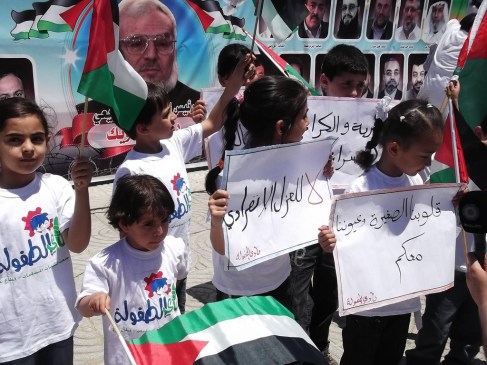
Kindergarten kids carry signs reading, “No to solitary confinement”, “Freedom and dignity for Palestinian political prisoners”, “Our little heart and minds are with you”– by Joe Catron

This morning was very eventful one in the Gaza sit-in tent. As I arrived around 10:00 am, more than a hundred kids, each about four years old, entered the tent. They looked very beautiful and innocent. They came from Gassan Kanafani’s kindergarten carrying signs like “I want to hug Dad,” “I want Dad to be free,” or “Freedom for Palestinian political prisoners.”

They didn’t fully understand why they were there, but their participation put smiles on the faces of the hunger strikers and the detainees’ families, who joined their soft voices while chanting along with them: “Free, free Palestine!” All generations united their voices to call for the victory of our political prisoners’ battle of dignity, which continues for the 23rd day.

Image

Hassan Salama’s mother in Gaza’s sit-in tent

Soon after that, a 75-year-old woman entered the sit-in tent in a wheelchair, surrounded by a crowd of photographers and other people. I wondered who she was, then discovered that she was Hassan Salama’s mother. Despite her age and her medical condition, she insisted on visiting the tent to show solidarity with her son, who has been in solitary confinement for 13 years. She gave a revolutionary, emotional speech that inspired many listeners and made them cry, especially when she said, “My son is my sacrifice to Palestine.” She and all detainees’ mothers are symbols of the resistance.

We consider solitary confinement one of the most horrible crimes and among the most difficult punishments inflicted on our brave detainees by the Israeli Prison Service. Its main goal is to destroy the prisoner’s mind and devastate his psychological and physical health as quickly as possible. Ending this unjust policy is one of the most important demands our prisoners aim to achieve from this strike, as it constitutes a grave violation of their rights to personal liberty, bodily integrity, and dignity.

After that, hundreds of Palestinians marched in solidarity with the2002 deportees from the Church of Nativity in Bethlehem. May 10 marks the eleventh anniversary of their exile. They were promised that they would be allowed to return after two or three years of deportation, after 11 years, they’re still refugees in the Gaza Strip. Deportation is a terrible violation of Geneva Convention IV and a form of ethnic cleansing that Israel continues to use against Palestinian people. Recently, administrative detainee Hana’ Shalabi was deported to Gaza and promised she could return to Jenin after 3 years of exile, but who knows if she’ll ever be allowed back or forced into exile forever?