Generating a fearless and humanising narrative on Palestine!

Latest

Administrative detainees on hunger strike issue their will as they stand “at the edge of death”

Palestinians in Gaza City have launched a solidarity hunger strike in a sit-in protest outside the Red Cross. (Ahmad Abu Hussein)

Palestinians in Gaza City have launched a solidarity hunger strike in a sit-in protest outside the Red Cross. (Ahmad Abu Hussein)

Our Palestinian detainees have been battling the Israel Prison Service (IPS) with their empty stomachs since 24 April, embarking on the longest-known mass hunger strike in the history of the Palestinian prisoners movement. Hunger is the only remaining weapon they can use against the IPS and its well-armed Israeli occupation soldiers.

They launched this hunger strike to call for an end to their detention with no charge or trial based on secret “evidence” submitted to a military court that is kept from the detainees and their lawyers — an unjust policy that Israel calls administrative detention. One hundred and twenty administrative detainees launched this mass hunger strike which grew to involve nearly three hundred prisoners, according to the rights group Addameer.

Our dignified prisoners are striking in protest of Israel’s violation of an agreement reached with the IPS after the 28-day mass hunger strike that ended on 14 May 2012. According to that deal, the use of administrative detention — the key issue behind the hunger strike – would be restricted and administrative detention orders would not be renewed without fresh evidence being brought before a military judge. However, Israel did not abide by the agreement and has continued its practice of arbitrary administrative detention.

Strikers hospitalized

Administrative detainee Ayman Tbeisheh from Dura village near Hebron in the occupied West Bank has exceeded one hundred days of refusing food in protest of his administration detention orders which have been continuously renewed since his last arrest in May 2013, according to al-Quds al-Arabi newspaper. Tbeisheh has spent a total of eleven years in Israeli jails, including nearly five years under administrative detention.

According to Addameer, Tbeisheh first began to refuse food on 22 May 2013, immediately after his four-month administrative detention order was confirmed in a military court. He suspended his strike after 105 days, when he thought he reached a deal with the IPS. But this was soon broken as his order was again renewed, despite his deteriorated health.

Ayman Tbeisheh told Palestinian lawyer Ibrahim Al-Araj, who managed to visit him during his previous hunger strike, “I will continue this open hunger strike until I put an end to the ghost of administrative detention that keeps chasing me.”

Soon after he regained some of his physical strength, he re-launched his hunger strike on 24 February 2014. Tbeisheh has since been placed in Assaf Harofe Medical Center where he lays shacked to a hospital bed that may become his deathbed at any moment.

Ayman’s condition is no different than the rest of administrative detainees whose hunger for freedom and dignity drove them to launch the mass hunger strike that has been continuing for 51 days. Eighty hunger strikers have been hospitalized as a result of their ongoing hunger strike, but they persevere in this battle for dignity.

Despite their weak bodies that are drained of energy, their hands and feet are shacked to their hospital beds. They are threatened with force-feeding on a daily basis, an inhumane and dangerous practice that Israel’s parliament, the Knesset, is close to setting into law.

Death penalty

My father, who spent a total of fifteen years in Israeli jails, calls force-feeding “a death penalty.” He participated in the Nafha prison mass hunger strike in 1980 which lasted for 33 days. He was subjected to force-feeding and thankfully survived. But his comrades Rasem Halawa from Jabalia refugee camp and Ali al-Jaafary from Dheisheh camp were victims of this murderous practice that aimed to break their hunger strike, and were killed after being subjected to force-feeding.

The Israel Prison Service escalates its oppression of the hunger strikers as their health constantly deteriorates. They put them in windowless isolation cells, keep their hands and legs shackled for tens of hours, deny them family and lawyer visits, and they even deny them an access to salt, which is necessary for their survival.

The strikers are committed to “hunger until either victory or martyrdom,” the same asKhader AdnanHana al-ShalabiMahmoud SarsakSamer Issawi and other ex-detainees who freed themselves after heroic battles of hunger strike against the IPS.

Prisoners’ letter

A smuggled letter from Israeli jails written by the administrative detainees who are on hunger strike.

A smuggled letter from Israeli jails written by the administrative detainees who are on hunger strike.

Below is my translation of a letter our administrative detainees managed to smuggle on 8 June to call upon humanity and people of conscience for popular and international support of their battle for justice. The ex-detainee Allam Kaaby read it during a press conference in front of the sit-in tent erected in front of the International Committee of the Red Cross in Gaza in solidarity with our Palestinian prisoners’ open-ended mass hunger strike:


Despite the chains and the prisons’ bars and walls, this is a will from those who are standing at the edge of death to the guards of our homeland, Palestine.

After leaving the isolation cells which are no longer able to tolerate our pains, illnesses and corroded bodies, from our hospital beds to which we are shackled by chains and guard dogs, from amidst the jailers who keep watching our heart monitors that may announce our death any moment, from the edge of death, we send our call which could be the last for some of us. It might be the time to announce our will before we embrace our people as dignified martyrs. Our call is our voice, our scream, our will. We are the administrative detainees who are heading towards immortality, towards embracing the sun of dignity which might mark at the same time, the end of the battle for dignity. We raise our voice, hoping that it will reach our revolutionary people.

First, we call upon you to intensify your support of the hunger strikers who are not yet martyred; the fighters who fight our fascist enemy with their bodies deserve from you a stand of loyalty that prevents the continuation of our bloodshed which will never stop until the achievement of our just demands.

Second, the pains of hunger damaged some of our organs but some organs must be still in tact. As death is waiting for us, we declare that nothing will stand in the way of our sacrifices, even death. Therefore, we donate our functioning organs to the fighters, poor and oppressed people who are in need. We are waiting a visit from the International Committee of The Red Cross to endorse these donations.

Third, we call on you to stay faithful to our blood and the blood of all martyrs who sacrificed their souls over the course of our Palestinian struggle. Faithfulness is not just through words, but through revolutionary practice that knows no hesitance nor weakness.

Fourth, hold on to our historical and legitimate rights and never give up an inch of Palestine, from the river to the sea. The right to return is the bridge to our historic rights. These rights cannot be restored without resistance, which is the only language that our enemy understands.

Fifth, don’t fail prisoners who remain alive after us, as those who sacrifice their freedom as a price for their people’s freedom deserve freedom rather than death.

To our dignified people in Palestine and diaspora, to the free people and freedom fighters worldwide, we will let our screams be heard despite the darkness of Israeli jails, which are graves for the living. To people of dead conscience worldwide, our Palestinian people will continue the struggle until victory. We bid farewell with smiling faces.

Reading their words which embrace pain and disappointment must make us all ashamed as we watch them die slowly. Changing our profile pictures to a picture that shows solidarity with their battle for dignity cannot do them much help. We have to move beyond superficial solidarity to serious actions that will bring meaningful change to them. Act before we count more martyrs among Palestinian heroes behind Israeli bars. Their death would be our shame.
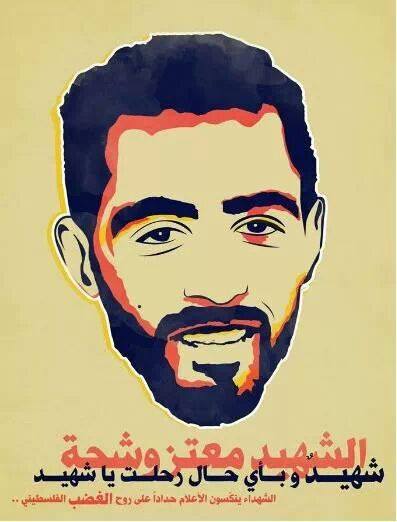
Muataz Washaha: Murdered by Israel as “peace” talks continue

1979563_10201543385455187_1445665841_n-1Words fail me. There are no words that can do justice to the martyrs that fall every day, the pain that intensifies in our hearts, the floods of tears from the oppressed. Words lose their strength for a Palestinian people who face a daily stuggle to survive under a brutal occupation that doesn’t recognize their most basic human rights.

What is more painful and disappointing is that our supposed “leadership” is complicit in these ongoing crimes and shamelessly provides the first line of impunity and defense for the Israeli occupation to continue attacking and terrorizing us. Very aware of how the situation is deteriorating to an intolerable extent, the leadership stays committed to meaningless negotiations that bring no justice to us or to our martyrs. Israel has killed forty Palestinians since the beginning of US-backed negotiations between the Palestinian Authority and Israel.

Before our people go to sleep each night, we always hope for a brighter morning with more security, freedom and justice. But everyday we wake up to witness more darkness, more brutality and more violations of our rights.
Cruel attack

On the morning of 27 February, we woke up to the news of an Israeli military raid on the central West Bank village of Birzeit, near Ramallah. The village lies very close to the Muqataa compound, where the Palestinian Authority lives with a delusion of having authority, guarded by an “army” unable to provide any sense of security to its people.

The Israeli forces besieged a house belongs to Washaha family, forcibly evacuated its residents and those of neighboring houses, destroyed parts of it and set the rest on fire.

Even more cruelly, the military kept its people watching as their belongings and memories burned and as Muataz Washaha, who was active in the Popular Front for the Liberation of Palestine, was attacked.

The Israeli occupation forces had stormed the Washaha family’s house, looking for Muataz. They assaulted members of the Washaha family and detained his brother, Ramiz, as well as his friends Fadi Sedqi and Samir al-Qaisi.

A few months passed since 24-year-old Muataz Washaha was released from an Israeli jail. He knew very well what being imprisoned meant for he refused to surrender to the Israeli military. He prefered to barricade himself in a corner of his house and resist arrest. He chose to die within his home, where he had spent his childhood and youth.

“Do not worry”

“I will be free here. Leave and do not worry about me. I will stay here and not surrender. I will not return to prison.” These were the last words Muataz Washaha uttered to a civil defense worker, who was the last person to have access to him before the house was evacuated of everyone else.

The civil defense man had no choice than to kiss Muataz’s forehead and leave, respecting his wish.

Soon afterwards, the Israeli military located Muataz with its sophisticated technology and started shooting live bullets and shells at him. He was called on to turn himself in but Muataz would not. This unequal confrontation lasted for six hours, which were enough to kill Muataz a thousand times.

After the withdrawal of the Israeli forces,  Muataz’s body was found torn by tens of live bullets. His head had been hit by a rifle-fired Energa shell.

According to the Israeli military, Muataz Washaha was killed because he was “suspected of terror activity.” How ridiculous to read such a statement.

After the countless acts of terror the occupation forces have committed against the Palestinian people, they should be the last ones to speak about terror or define what terror is.

Daily injustices

1656153_644401292336478_467791466_nObserving the daily injustices that our people have to endure makes me frustrated — or, rather enraged — not against the occupation but against the Palestinian Authority. The question that I am wondering about is: what will be the reaction of the Palestinian Authority to the murder of Muataz Washaha?

Isn’t it the time for Mahmoud Abbas to be ashamed of himself for his commitment to the “security” of Israel and his declarations that it is “the utmost important challenge that the Palestinian security forces are dealing with”?

Why is the “peace process” continuing, when it is very obvious that Israel is not interested in peace?

The systematic ethnic cleansing process continues against our people in Jerusalem and settlements continue to expand as more “peace” talks take place. It is time for the PA to turn to the Palestinian people and stop compromising our rights.

The PA has to understand that our fight is about liberation and justice, not about a state and a flag, luxurious embassies all over the world, a few privileges or a travel document. Back in 1993, Edward Said wrote: “We should remind ourselves that much more important than having a state is the kind of state it is.”

Said insisted that “no negotiations are better than endless concessions that simply prolong Israeli occupation.”

Sadly, this is what we see happening on ground. More negotiations lead to more concessions.

“Only God knows” in Gaza, under cruel Israeli-Egyptian siege

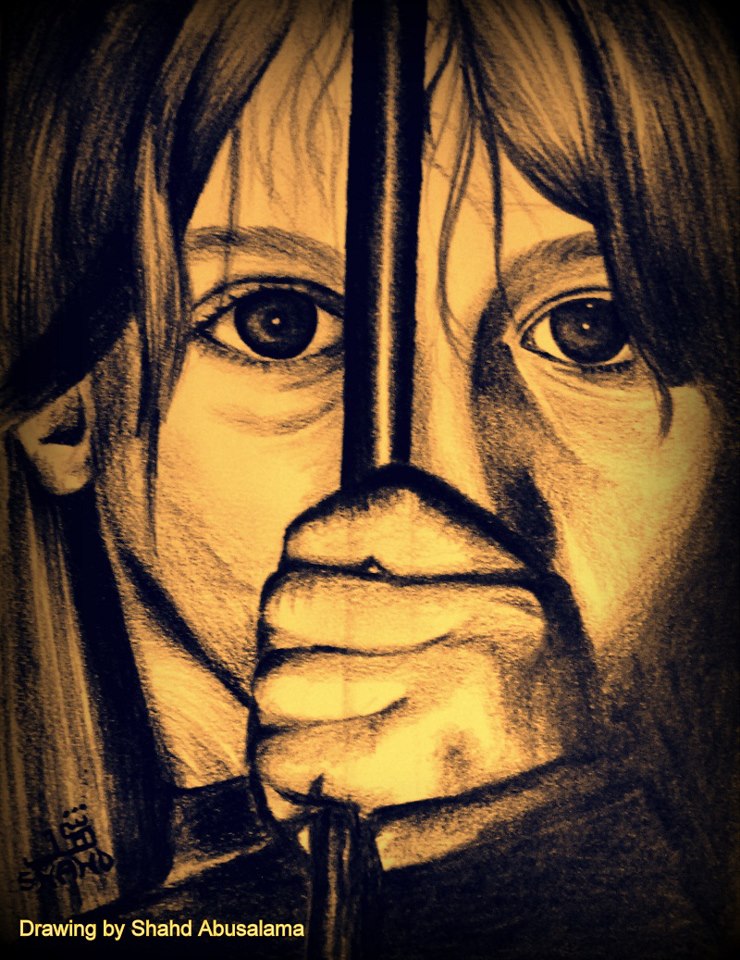
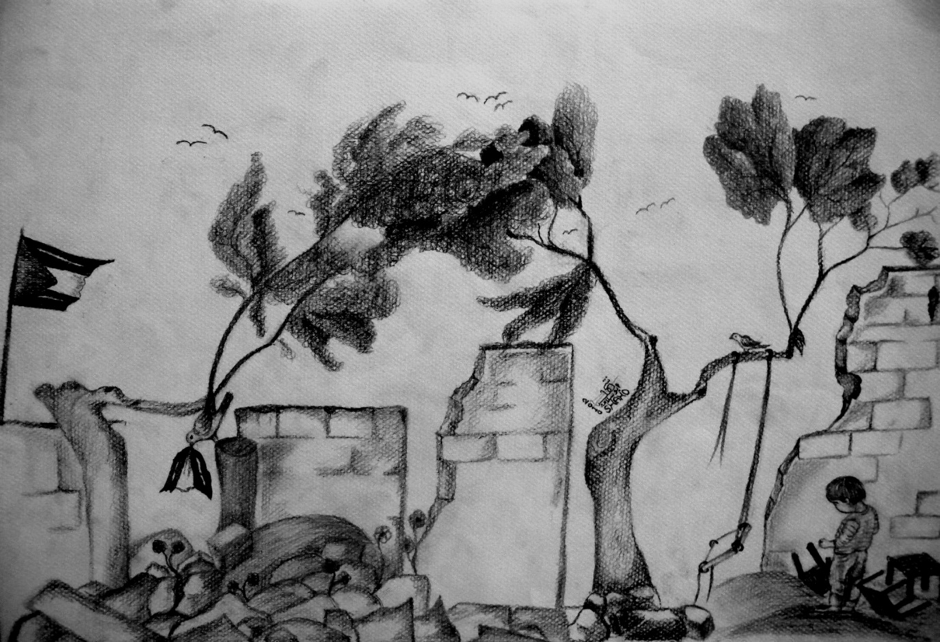
This drawing of mine describes the way I feel: depressed, frustrated and suffocated while waiting for the Rafah border crossing to open.

This drawing of mine describes the way I feel: depressed, frustrated and suffocated while waiting for the Rafah border crossing to open.

I have tried many times to write about my experience at the closed Rafah border crossing with Egypt that has left thousands of people in Gaza stranded. Every time I start, a deep sigh comes over me. Shortly after I feel paralyzed, and finish by tearing apart my draft.  I have never found it this difficult to write about a personal experience. No words can capture all the suffering and pain our people in Gaza deal with collectively under this suffocating, inhumane Israeli-Egyptian siege.

As I write, I am supposed to be somewhere in the sky, among the clouds, flying to Istanbul to begin my graduate studies. But I could not catch my flight, as I am still trapped in the besieged Gaza Strip, sitting in darkness during the power cuts caused by fuel crisis, trying to squeeze out my thoughts during what is left of my laptop’s charge.

As much as I am attached to Gaza City, where I was born and spent all 22 years of my life, each day I spend trapped in it makes me despise living here. Each day that passes makes me more desperate to set myself free outside this big, open-air prison. Each day makes me unable to stand the mounting injustice, torment, brutality and humiliation.

Hardships and happiness

I have never experienced as many extreme ups and downs as I did this month. Despite the hardships throughout September, I also had some immensely happy moments. I think will remember them the rest of my life. This is life in Gaza: highs amid lows, everything in the balance, nothing secure from day to day, no plans, no guarantees.

At the beginning of September, I started the process to secure my visa for Italy. I am supposed to be there on 10 October to celebrate the publication of my first book, the fruits of my work over more than three years of writing. It is the Italian version of my blog, Palestine from My Eyes, which I started in May 2010. My book launched on 22 September. It was impossible for me to attend its release in Italy.

My blog was never about me as an individual. It is rather about a young Palestinian woman who grew up in the alleys of a densely inhabited refugee camp with an imprisoned father. It is about a woman whose awareness of her Palestinian identity was shaped in a besieged city under the brutal Israeli occupation. My blog is about our people, who are routinely dehumanized and whose stories are marginalized and unknown to the majority outside. It was about our Palestinian political prisoners and their families, whose lost and missing loved ones have become statistics, numbers which fail to communicate all the injustices they face under the Israeli Prison Service, which denies them their most basic rights.

The book, inspired by the harsh and complex reality we are forced to endure, makes me feel that my responsibility as a voice for our Palestinian people has doubled. Some amazingly dedicated Italian friends are fixing a busy schedule of events, book fairs, conferences and presentations in many different cities. My presence in Italy is very important, because I am sure few people there have met Palestinians. I am anxiously waiting for the Rafah border to open so I can be there for these events, to help my book spread as widely as possible.

Furious

I read on Reuters last Tuesday: “According to Abbas’s request, Egypt agrees to reopen Rafah border crossing on Wednesday and Thursday for four working hours each.”

My first reaction was laughter. Where was Abbas while the Rafah border was closed to thousands of patients seeking medical care abroad which they cannot access in Gaza, or students whose dreams to pursue their education overseas were crushed?

We are not only paying the price for the unsettled situation in Egypt. We have even become the victims of our own divided Palestinian leadership. It makes me furious to think that the opening of Rafah crossing, a lifeline for our people in Gaza, has come under the influence of the internal division between political parties competing to seek favors from our colonizers. The ruling factions seem to have become participants in the collective punishment we suffer.

The headline infuriated rather than relieved me. Opening the Rafah border for eight hours over two days was not a solution to the crisis caused by the complete closure of Rafah for more than a week.

The same day, in the taxi heading home, I received a call telling me I finally got a visa to Italy. I was so happy I forgot the conservative nature of my society and started screaming out of happiness in the car. The visa process took shorter than I thought. I called my friend Amjad Abu Asab, who lives in Jerusalem and received my passport for me, since Israel prevents Palestinians in Gaza from visiting the city, urging him to find someone coming into Gaza via the northern Erez checkpoint on Wednesday.

This can be my chance to leave Wednesday or Thursday, I thought. My happiness didn’t last. “Erez checkpoint will be completely closed from Wednesday until Sunday, 22 September, because of the Jewish holidays,” Amjad said. “No express mail, and no person, can cross Erez to Gaza during this period.”

“What an absurdity!” I screamed. “When the Rafah border crossing finally reopens, Erez checkpoint closes. We have to deal with Israel from one side and Egypt from the other. How long will we live at the mercy of others? There must be some emergency exit.”

Life of uncertainty

“The definition of uncertainty in the dictionary is Gaza,” my fellow Electronic Intifada writer Ali Abunimah once told me. That describes in short my life at the moment, and the lives of our people generally: a life of uncertainty.

I had no choice but to wait for the Jewish holidays to end for Erez to reopen and to get my passport. But on Wednesday, I insisted on going to Rafah. I refused to sit at home, powerless, unable to do anything but wait. At Rafah border crossing, I saw a gate of humiliation. People crowded on top of each other, roamed the waiting hall, waited impatiently for some news to revive their hopes, and ran after policemen, asking for help and explaining their urgent need to travel.

I met many of my fellow students who were stuck as well. They came with their luggage, hoping they could leave, but ended up dragging it back home.

I stayed until 2:00pm, hoping that I could at least register. I did, I think. I explained my situation to a policeman at the gate. He took my scanned copy of my passport and returned after about five minutes, saying, “Your name is registered.” I am not sure what he meant, but he did not say anything else. I asked him if there was a certain date I could leave. His reply was, “Only God knows.” I wish someone could tell me when I will be able to leave so I can have a break from worrying. But no one knows anything, “only God knows.”

While doing an interview with the Real News Network that morning at the border, an elegant elderly man in a formal black suit and holding a black bag interrupted. “I would like to make an interview,” he said. “I speak English, and if you like, I can do Hebrew.” The old man looked very serious as we awaited his poignant words. “This border, all this area, was mine. They came and stole it.” As he continued, the Real News crew and I realized the interview was descending into farce. “I have bombs in this bag and I can explode the whole place in a second!” the man said. We started laughing and said jokingly, “Go explode, then. We’re standing by you.” Yes, this Rafah gate of humiliation must be wiped away so we, Palestinian people in Gaza, can have some breath of freedom.

A joke

The Rafah border crossing closed again after 800 persons left to Egypt on Wednesday and Thursday. I am sure this closure would be easier to understand if it was a natural disaster. But knowing that other human beings are doing this to me and 1.7 million other civilians living in Gaza, while the rest of the world looks on, is too difficult to believe. It is more painful and shocking to realize that our neighboring Arab country, Egypt, is joining our Zionist jailers and collaborating with them to tighten the siege.

This experience made me believe that human dignity has become a joke. International law is nothing but empty, powerless words printed in books. We are denied our right to freedom of movement, our right to pursue our education, our right to good medical care, and our right to be free or to live in peace and security. But no one in power bothers to act.

I spent September worrying about the border and my dreams which may fade away if Rafah remains closed. This takes a lot of my energy and makes me suffer from lack of focus and sleep, and makes it hard for me to sit and express myself in writing or with a drawing. Our people’s tragedy caused by the ongoing closure of Rafah border continues, and the crisis is deepening. Living in Gaza under these circumstances is like being sentenced to a slow death. Act and set us free. It is time for these injustices we face on a daily basis to end.

Our people in Jerusalem showered shoes at the IOF as “a powerful message of rejection and defiance”

Feeling proud! Feeling high! Our defiant people in Jerusalem lifted my spirit which had been bruised through these last few weeks by the continuous entrapment in the besieged Gaza Strip, unable to leave for my graduation studies. I cannot put into words how proud I feel of our people in Jerusalem.

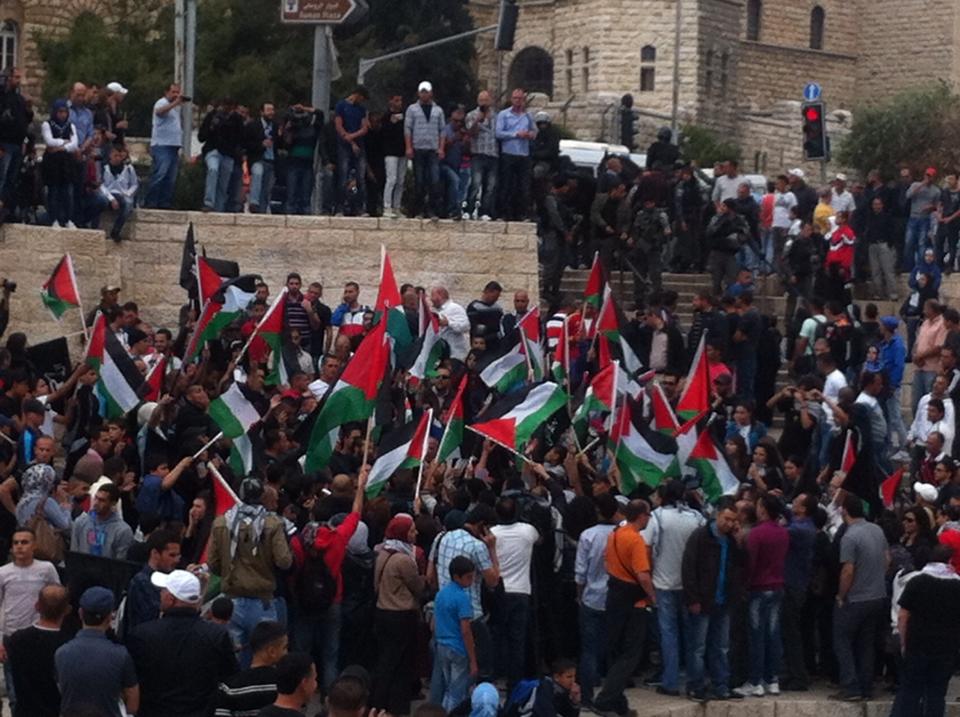
On Wednesday night, I had a long and exciting chat with my friend Amjad Abu Asab in Jerusalem who makes me feel very connected to Jerusalem, as if I am there amidst the bustle and lights of the old city’s streets. He described to me what happened and didn’t miss a single detail. Thanks to him, I could picture my dear city Jerusalem, Al-Amoud gate, the clashes and the demonstrations that happened there, the atmosphere, the anger, the smell, everything.

Amjad was one of the demonstrators who gathered at Al-Amoud gate in the old city. When I called him to ask about the situation in Jerusalem, I expected his voice to be filled with frustration and anger. His positive reply inspired me. “We managed to send a powerful message of rejection and defiance to the Israeli Occupation and the radical Jewish settlers who repeatedly break into Al-Aqsa mosque. The message that Jerusalem is Arab and Palestinian and we won’t be easily defeated.”

It does make me angry to know that our people go through such brutality on a daily basis, and that we can only support them behind the fences and walls as our physical presence is impossible under the Israeli apartheid regime. But it makes me very proud because our people are still determined and defiant.  They pay a huge price for living in Jerusalem which is subjected to systematic ethnic cleansing policies but they pay the price happily because they know that “to love a land is to live and die for it.”

Amjad was one the people who was attacked by the Israeli soldiers. But that couldn’t depress him and he still told me the story with a positive tone. “I was beaten up with batons today,” he said with laughter.

I asked him how all these clashes started. “Many people gathered at Al-Amoud gate to rebel against the repetitive provocative raids of Al-Aqsa. Some radical settlers broke into the demonstration with two Israeli flags and kept waiving them amongst the angry protesters,” he replied. “There was a Palestinian salesman who sells shoes on a little table at Al-Amoud gate. One woman grabbed a shoe and threw it at that radical settler in response to his insulting provocations, and then all of a sudden all the protesters started showering shoes collectively at the soldiers.” The excitement and pride that I could feel in his voice as he narrated the story to me made me burst into laughter.

When our Palestinian people in Jerusalem threw shoes at the faces of the Israeli soldiers and radical settlers, they were attacked with tear gas bombs and batons.  You cannot compare our people’s harmless shoes to the murderous weapons the Israeli forces used to suppress our people. But our people’s faith in our just cause empowers them with strength, poise and determination to stand firm in the face of Israel’s brutality and to keep resisting.

“A tear gas cannister hit my friend’s head and he was sent to hospital. He was rescued miraculously because the bomb hit the wall before it hit his head. Otherwise he could have been martyred,” Amjad said. Amjad’s friend was sent to hospital, but was thankfully released after a few hours. His situation is stable.

About 40 other Palestinians were injured in these clashes including three women, some paramedics and journalists. 15 people were jailed including three children, Ahmad Khanfar 14, Omar Al-Sheilk Ahmad 15 and Omar Abu Sarriya 14. Our Palestinian brethren in Jerusalem were terrorized, wounded and detained in the name of maintaining security and protection for the Zionist colonial settlers.

The Israeli Occupation Forces were savage and aggressive but they failed to make our people surrender. Israel’s brutality inspires our determination to keep up the fight. Every time they tried violently to disperse the crowd, they gathered again in different locations. The Israeli soldiers kept chasing them wherever they went.

Keep an eye on Jerusalem. Our people in Jerusalem face such challenges and risks on a daily basis. These vicious practices by the Israeli Occupation Forces have only one goal: to continue the systematic ethnic cleansing of our people.

At this very moment, passing through Rafah border crossing and travelling abroad for my MA studies in Turkey is no longer what I wish I could do. I don’t wish for anything more than for me to be in Jerusalem! This post is dedicated to my friends and strong people in Jerusalem. I would like them to know that we feel for you. Even if Israel builds a thousand more checkpoints to divide our people, we will stay united and feel for each other’s suffering. Keep your chins up you fighters of Jerusalem! They will not manage to Judaise our Arab Palestinian Jerusalem or our holy Palestinian soil. Free Palestine from the river to the sea!

Gaza’s only exit to the outside world is closed in front of students and patients

Palestinian elderly people dragging their luggage and returning back home after hearing of the closure of Rafah border

Palestinian elderly people dragging their luggage and returning back home after hearing of the closure of Rafah border

I left very early in the morning with my youngest sister Tamam, heading to the Rafah border crossing with her to give her as much moral support as I could.  Having experienced what can only be described as the torture of waiting at the border previously, I know very well how much of a nightmare going there is.

Tamam returned home from Turkey after 9 months of studying Turkish Language there. About a year ago, she earned a scholarship to study for her BA in journalism in Ankara.  After enjoying three weeks of her presence at home, the time had finally come for her to return to Ankara, as her summer vacation is about to end and she has to go through many procedures in order to register for the first semester of her undergraduate studies.

In fact, she was scheduled to leave through Rafah border yesterday. Hearing of the crowds who have been trying to cross in vain for days- if not for weeks, and the restrictions that Egypt imposed on Rafah border, led us to decide to stay at home. A few more hours of sleeping would be worth more to us than the hours we would have wasted if we had gone to the border. Yesterday the Palestinian side allowed five buses in but Egypt allowed only one.

Today we decided to go, hoping that she would be fortunate enough to cross the border. As we were pulling her luggage into the car, we started laughing while mocking the dark situation we have to go through, while knowing deep inside that we will eventually have to return back home.  But we insisted to go and see the situation with our own eyes. It was hard to imagine to what extent the border situation and the travelers’ crisis is getting worse, especially during the difficult times that Egypt is going through.

My sister didn’t realize that a normal decision like returning home for a visit may threaten her to lose her scholarship and keep her locked inside Gaza. She didn’t know that she should have considered such a thought a thousand times before making up her mind. Such a decision is supposed to be normal in a normal situation, but not in our case, which is very far from being normal.

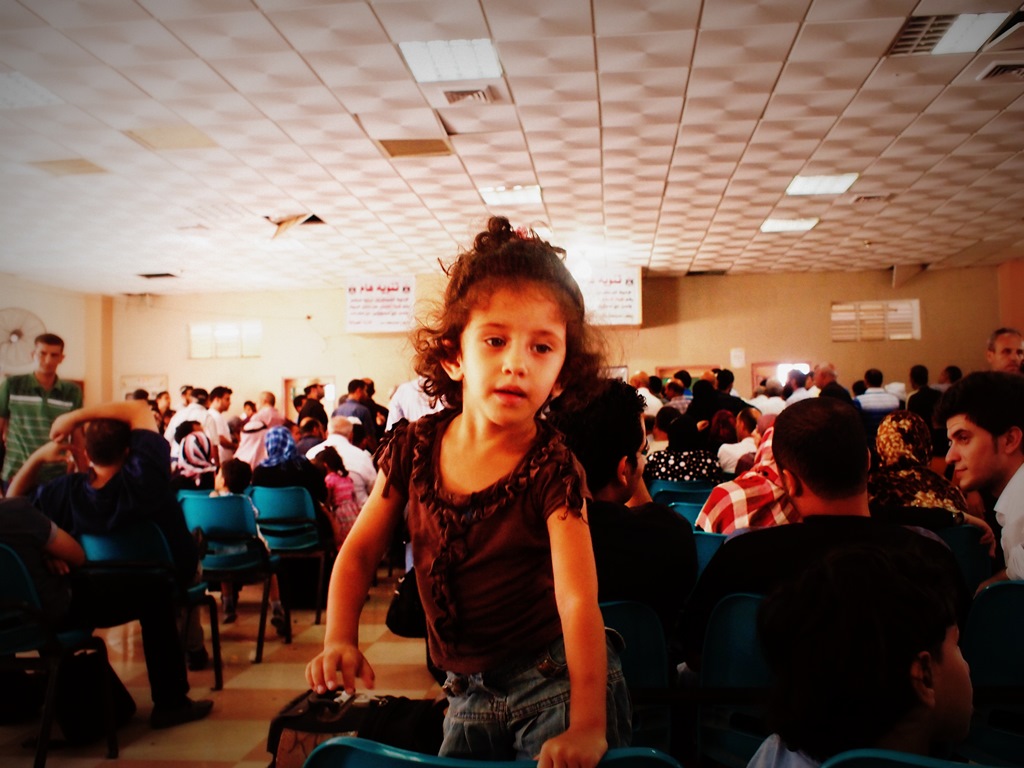
As we arrived at the hall where travelers gather in hope to hear their names called out so they can ride the bus that drives them inside the border, we were shocked to see the numerous people waiting already there. Some people had been waiting since sunrise and had been trying to cross for over a week. Most of them were students traveling for educational purposes or patients leaving for medical reasons.

I shot this photo inside the Rafah hall where the travellers wait to hear their names called out

I shot this photo inside the Rafah hall where the travellers wait to hear their names called out

The scenes of the children who were lying down and sleeping on chairs and those of elderly people who could barely stand on their feet were the most heartbreaking. Elderly people were shouting at the police which was forming a fence in front of the travel coordination offices. They were powerless and had nothing to say or do, but were trying their best to keep people’s anger and frustration in control and to maintain some semblance of discipline.

We were ashamed of complaining about anything, just sitting and watching people huffing and puffing. We met people who have been trying to cross for about two weeks.

At about 1 pm, the police said via speakers, “We ask everyone to return back home. We received a notice that Rafah border is completely closed and not even a single Palestinian will be able to cross due to the killing of 22 Egyptian soldiers in Sinai. We don’t know when the border will re-open. Keep following the Internal Ministry Website for more information.”

I expected people to rebel and break the police fence and turn the hall into chaos. But they just turned their backs, dragged their luggage and went home. I heard many saying, “at least they finally said something. At least we didn’t have to wait until sunset.” For many people this scenario has been happening for many days, so they expected the same to be repeated again and again.

My sister has expressed her experience in few moving words she wrote on her Facebook page. The following is my translation of her words.

“I dragged my luggage very early in the morning to Gaza’s only exit to the outside world, though I was certain that I wouldn’t be able to cross. Dad stood watching me from a distance and finally he stepped closer and uttered one sentence, “May Allah ease your way my dear”. I cried a lot. More accurately, we both cried. I wondered why I cried despite having a strong desire to leave this city after a 3-week visit which was more tiring than joyful, while worrying about Rafah border’s situation. This complicated city is becoming more choking. It makes us weep out of happiness and sorrow. It restricts our freedom. It forces us to learn to adapt to the inadaptable. At this point of frustration and thinking negatively, I can’t think of any reason why we’re so attached to this mysterious city. Nevertheless, one can’t but be always longing to return to Gaza.”

My sister’s flight is scheduled to leave from Cairo to Istanbul on Thursday. It is very likely that she will miss her flight, like many other Palestinians living in Gaza.

Why should Tamam or any other traveler living in Gaza pay the price for anything happening in the neighboring countries? How many dreams are going to be crashed or how many more patients are going to die before we have a permanent and a secure way to travel? Will we ever live a normal life? This situation is utterly insane and inhumane.  Collective punishment policies must end.

Israel’s prisoner release doesn’t legitimize “negotiations”

When I heard that the Palestinian Authority agreed to resume negotiations with the Israeli occupation, I fell into a depression. Here we go again, I thought.

It is a repeat of the what followed the 1993 Oslo accords, time after time.

Yet again, the Israelis are represented by Tzipi Livni, who as a member of the government played a key role during Israel’s 2008–2009 invasion of Gaza.

And opposite her, once again, is Saeb Erekat as Palestinian “chief negotiator.”

How could the blood of the 1,400 victims killed during that massacre be forgotten so quickly? How could Erekat share the same table with her, as he did at a Ramadan iftar at the house of US Secretary of State John Kerry, exchanging smiles in the name of “diplomacy” and “realism”?

Fake “confidence-building measures”

As part of the deal to resume these talks, Israel agreed to release 104 long-term Palestinian prisoners, in phases, as a so-called “confidence-building” measure and to encourage progress. Most of the prisoners have nearly completed their sentences.

The first 26 were freed on 13 August, 11 to the West Bank and 15 to Gaza.

Confidence? Progress? The same buzzwords were used about the Oslo accords two decades ago. Has no lesson been learned?

As Addameer notes, “over 23,000 Palestinians have been released since 1993 as ‘goodwill measures’ during various negotiations and peace talks. However, in that same period, at least 86,000 Palestinians have been arrested, including children, women, disabled persons and university students.”

Currently Israel holds more than 5,000 Palestinian prisoners.

Such “confidence-building measures” are a sham!

In fact, what Israel has been doing all along is accelerating its settlement-building measures. Since 1993, the number of settlers in the occupied West Bank has continued to grow, as Palestinians, impoverished and squeezed, continue to be displaced by Israeli home demolitions and land confiscation.

Since its creation, the Palestinian Authority has served as Israel’s first line of defense against any Palestinian resistance to this colonization.

Because of inaction, and global acceptance of decades-long brutality and land theft – as long as Israel is committing it – the number of illegal Israeli settlers is now more than 600,000.

Of course, just days before the next round of talks were supposed to start, Israel has announced plans to add 1,200 more settler homes.

How could we return to negotiations based on this same framework with the same US mediators?

Nothing left to give

The Palestinian experience of the “peace process” is this: Israel does not want peace. It wants our land and our water. It wants to destroy our heritage, and it wants us to leave our homes, just as it is about to force 40,000 more Palestinian Bedouins out of their homes.

Saeb Erekat, of all people, knows – and this was exposed by the leaked Palestine Papersin 2011 – that when he offered Israel almost all the settlements, and the right of return of our refugees, it wasn’t enough. Israel still demanded more.

“What is in that paper gives them the biggest Yerushalaim in Jewish history, symbolic number of refugees return, demilitarised state … what more can I give?” Erekat told an American official in 2010.

Although he supposedly “resigned” after these revelations, Erekat and all the other discredited people, who should never be representing Palestinians in the first place, are back for more.

Remember that the Palestinian Authority had vowed not to return to negotations until Israel agreed to freeze settlements. They couldn’t even keep that promise. How could they be trusted to protect any Palestinian rights?

The meaning of peace

As much as peace is a dream for the Palestinian people, I sometimes wish I could wipe out the word “peace” from the dictionary.

We do hope to see a just peace, but with those who really want peace, not with such a brutal occupier whose talk of peace while playing the victim serves as an obscene cover for unrelenting crimes against our people.

Prisoners give us hope

The unyielding stance of many former prisoners and the families of detainees towards such compromises has always revived my hope.

Their opposition was not softened by the news of the prisoner release, and they are the ones who know best what it is like to be imprisoned or have a loved one in prison.

They were some of the first people who organized rallies in Gaza protesting the resumption of negotiations describing them as nothing more than “concessions.”

I was delighted to see their anger directed at the Palestinian Authority, which some of them accused of betrayal.

Detainees and released prisoners have an unmovable willingness to remain patient, to make whatever sacrifice is necessary to bring justice to our people, without a flicker of hesitation.

At the same time they affirm that the liberty of any prisoner is a victory that neither Israel nor the Palestinian Authority can spoil.

We must not let the use of our detainees as a political tool dampen the joy that their families and communities feel at seeing them return home.

Israel cannot steal people’s joy

At midnight, on 14 August, the Palestinian people were due to witness the first prisoners come home.

The Israelis deliberately released the prisoners very late, likely to prevent as many people as possible from gathering to celebrate their freedom.

However, thousands of people in Gaza and the West Bank welcomed them home from Israel’s “graves for the living,” with Palestinian flags, fireworks, songs and chants of freedom.

And we know that all of these releases come with no guarantees: whenever Israel decides to take their liberty back, they will be re-arrested.

“At least 12 prisoners who were re-arrested after their release in the October 2011 prisoner exchange are currently facing the possibility of serving the remainder of their previous sentences,” Addameer notes.

But nothing will stop us rejoicing for every mother who fought to live long enough to hold her son in her arms once again, or for children having to live as orphans with only their father’s image in their minds or hanging on the walls, finally seeing their dad in person.

And all Palestinians waiting for justice, or waiting to come home, will be inspired by the patience of the families who overcame decades of absence and suffering as they crossed endless Israeli apartheid checkpoints and endured racist and humiliating treatment to see their beloved for 45 minutes at a time through a glass screen.

Just one prisoner released from Israel’s narrow and dirty cells, unfit for humans, is a victory.

No applause for the PA

But there’ll be never be applause for the Palestinian Authority, which, while giving up our basic rights, trades with Palestinians’ emotions towards their loved ones in Israeli prisons in order to give legitimacy to endless rounds of futile negotiations.

While forgetting its own crimes against us, including the countless ones for which no one has ever been held accountable, Israel always tries to highlight a few cases to paint Palestinians as monsters.

Over the decades, some 750,000 Palestinians have been in Israel’s prisons. They are the ones who willingly took on their shoulders the struggle to bringing back freedom, dignity and a just peace for their oppressed people.

For that they were willing to sacrifice the most precious of things: their freedom. We demand the release of all Palestinian political prisoners in Israeli jails and call for an immediate end to the abominable treatment of Palestinian detainees. Resistance to a brutal military occupation is not a crime, but a duty.

Our people’s sacrifices and ongoing suffering under this merciless occupation will not go in vain.

Freedom for all Palestinian political prisoners!

Exile in Gaza is not the victory we want for our heroic prisoners

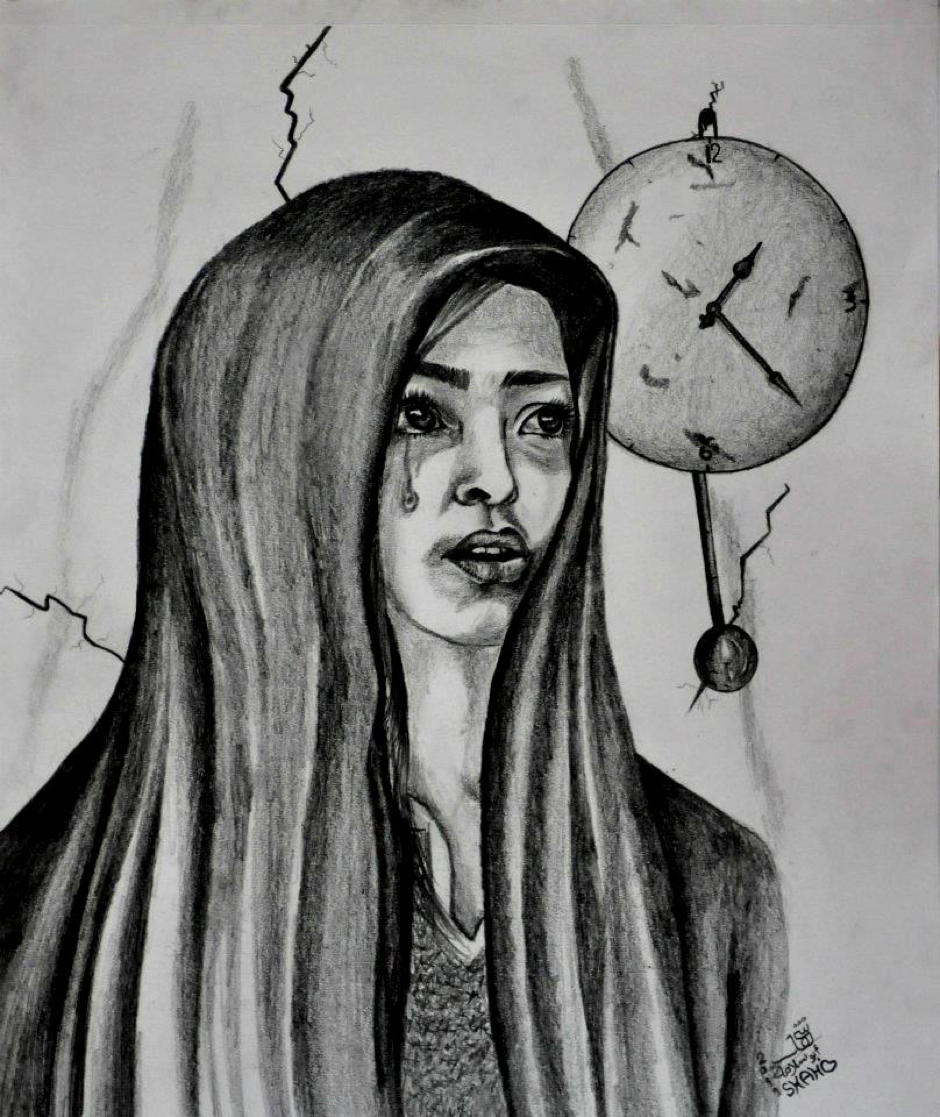
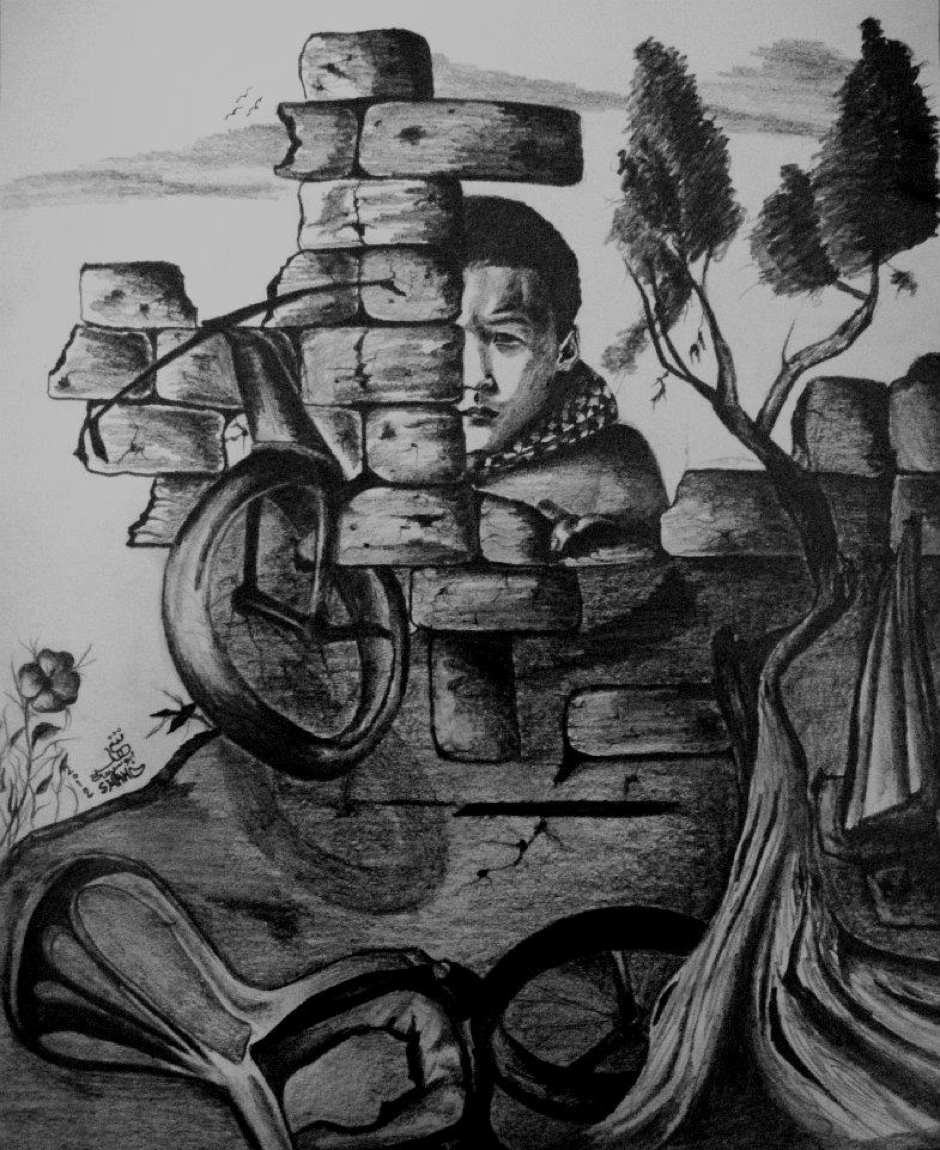
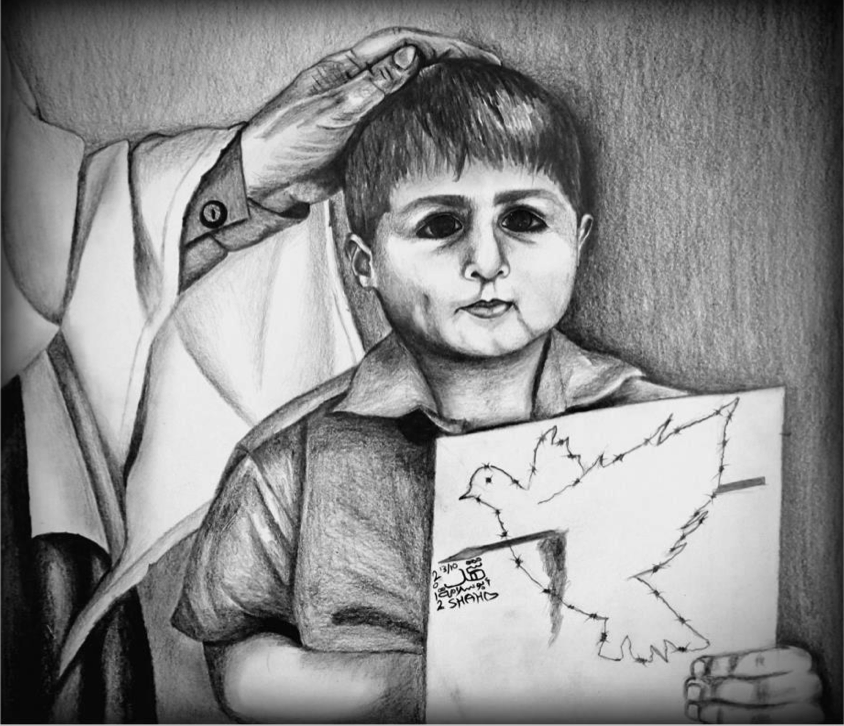
A drawing recently done by the Palestinian artist Doc Jazz

A drawing recently done by the Palestinian artist Doc Jazz

“It doesn’t matter if he goes to Gaza,” said Zahra Sharawna, Ayman Sharawna’s mother. “To be freed is the most important thing.” I understand how these words could come from a mother who fears for her son’s life. She, driven by her motherly emotions, simply wants him to live, even if many Israeli apartheid checkpoints separate her from him. But I must question was that actually the victory that Ayman Sharawna’s hunger strike aimed to accomplish, to get out of prison alive regardless of release conditions? I don’t think so.

A Palestinian’s fight has never been about oneself. It has always been a collective resistance of different forms, for the sake of collective justice for all Palestinian people. Some national principles identify our struggle for freedom. Every Palestinian revolutionary should be armed with them. One is embracing our right to return as the most sacred and ultimate goal.

“One whose hands are in water isn’t like one whose hands are in fire.” This traditional saying always comes to mind when I encounter a complicated situation many people would find it easy to judge superficially. I am not in a position to imagine the kind of inhumane pressure to which Ayman Shrawna was subjected. However, being a daughter of a former prisoner who served 15 years, and having intensively read and heard many ex-detainees’ prison experiences, makes me better able to guess.

The Palestinian Centre for Human Rights condemned Israel’s expulsion of Sharawna to Gaza calling it a “forcible deportation” which is a violation of international law. As such Israel alone is responsible, and we must consider that Sharawna is not acting of his own will.

But still, I was shocked to hear that the man who remained steadfast for nearly eight months of hunger strike, who tolerated all the pain and pressure attached to it, succumbed to such blackmail, to be expelled to Gaza for at least ten years in exchange for his release.  This wasn’t the victory of which I personally expected to hear. I reacted to the news with a shocked face and stony eyes, unable to shed a single tear.

Emotionally, I could celebrate and agree with Ayman that “both are my people, whether in Gaza or Hebron.” But I can’t help listening to my inner worries. I believe that our emotional reactions and stances will only serve the Israeli occupation’s long-term goals: turning the Gaza Strip into a ghetto isolated from Palestine, and expelling as many people as possible from the occupied territories in the West Bank and ‘48 Palestine. My fears that this will open the gate for Israel to intensify its systematic policy of ethnic cleansing against more Palestinian political prisoners left me unable to taste the victory in Ayman Sharawna’s release.

These worries flooded my mind, but Samer Issawi’s statement on deportation lessened my stress and cultivated hope instead.  His opinion was just what I expected, wonderful and strong from a stubborn man of dignity and poise, who continues his hunger strike of nearly seven months and doesn’t give up his principles for the sake of his own physical relief. He is aware of the long-term aims behind the inhumane practices of the Israeli occupation. He believes that his detention, a violation itself, cannot be fixed with a further violation.

According to him, this hunger strike isn’t a personal battle; rather, it’s a collective one. He refuses to be released with the condition of deportation, even within our historic Palestine.

Fawwaz Shloudi, a Palestinian lawyer, managed to visit Samer Issawi after many attempts and asked him whether he will ever agree to be deported to Gaza in exchange for his freedom. Samer answered:

Regarding the Israeli occupation’s offer to deport me to Gaza, I affirm that Gaza is undeniably part of my homeland and its people are my people. However, I will visit Gaza whenever I want or feel like it, as it is within my homeland, Palestine, which I have the right to wander whenever I like, from the very north to the very south. I strongly refuse to be deported to Gaza as this practice will just bring back bitter flashbacks from the expulsion process to which our Palestinian people were subjected during 1948 and 1967.

We are fighting for the sake of the freedom of our land and the return of our refugees in Palestine and the diaspora, not to add more deportees to them. This systematic practice by Israel that aims to empty Palestine of Palestinians and bring strangers in their place is a crime. Therefore, I refuse being deported and I will only agree to be released to Jerusalem, as I know that the Israeli occupation aims to empty Jerusalem of its people and turn Arabs into a minority group of its population. The issue of deportation is no longer a personal decision, it is rather a national principle. If every detainee agrees to be deported outside Jerusalem under pressure, Jerusalem will eventually be emptied of its people.

I would prefer dying on my hospital bed to being deported from Jerusalem. Jerusalem is my soul and my life. If I was uprooted from there, my soul would be uprooted from my body. My life is meaningless away from Jerusalem. No land on earth will be able to embrace me other than Jerusalem. Therefore, my return will be only to Jerusalem and nowhere else. I advice all Palestinians to embrace their land and villages and never succumb to the Israeli occupation’s wishes. I don’t see this issue as a personal cause that is related to Samer Issawi. It is a national issue, a conviction and a principle that every Palestinian who loves his homeland’s sacred soil should hold. Finally, I reaffirm for the thousandth time that I continue my hunger strike until either freedom and return to Jerusalem or martyrdom! (original translation by author)

International law prohibits the expulsion and transfer of people in occupied territories, be it deportation to another country or forced relocation within the occupied territory. Security Council Resolution 607 “calls upon Israel to refrain from deporting any Palestinian civilians from the occupied territories” and “strongly requests Israel, the occupying Power, to abide by its obligation arising from the Convention.” But these words, as history proves to us, are merely words. We have experienced enough empty words and conventions and “international human rights laws” that do NOT apply to us, as if our humanity is in question.

If the United Nations and the all the world’s governments keep of taking this submissive stance on Israel’s crimes and watch, reacting only with silence, we should NOT normalize their violations even if it costs us our lives. People like Samer Issawi teach us how  to stand firm and not compromise our rights. Thank you, Samer, for teaching us how meaningless life is without freedom and dignity.

The 19th Anniversary of The Ibrahimi Mosque Massacre

1208031055360tzeThe Palestinian people have their own calendar in which almost every day of the year goes back to a painful and atrocious massacre that the Israeli Occupation committed against our people. Everyday we have to look back in anger and remember those who fell victim in the course of the our Palestinian history that has been recorded by our people’s blood, sacrifices and suffering under the most brutal and inhumane colonial entity of Zionism.

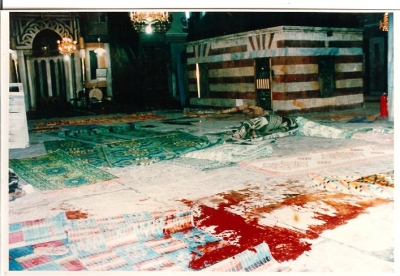
Today marks the 19th anniversary of the Ibrahimi Mosque massacre in Hebron on Feruary 25, 1994, when Baruch Goldstein, an Israeli settler and a member of the far-right Israeli Kach movement, opened his hateful fire on unarmed Palestinian Muslims while they were in Sujoud position inside killing 29 of them and wounding 150 within 48-hour time. If he wasn’t killed by survivors then, the number of victims would have continued to rise.

And guess what the Israeli Occupation did then? They just locked those victims who were left between dead and injured inside and didn’t allow ambulances access to rescue them and forced media blackout. But once the news about this massacre spread out, revolutionary Palestinian charged with anger rioted throughout Hebron and the number of martyrs about Palestinian people reached 50. In the weeks following the massacre, thousands of Israelis traveled to Goldstein’s grave to celebrate Goldstein’s actions. You learn this and then you laugh in bitterness at the absurd that all this is happening to us and then we are the ones accused of hatred and terrorism because we’re just resisting and defending our lands and people’s lives and dignity.

And the world was watching Israel mass killing us inside our worshipping place and did nothing. Israel doesn’t have respect for any place. This was proved again during the 22 successive days of Gaza massacre in 2008-09 when mosques, schools, hospitals and ambulances didn’t survive from Israel’s destructive internationally banned missiles. Will Israel be ever be held accountable? Nobody knows as the impunity of Israel by the world’s silence and their commitment to Israel’s security continues.

Today as we are commemorating the lives of those victims, we renew our loyalty to bling their souls justice so they can rest in peace. Israel will sooner or later confront justice and be punished for all their crimes against inhumanity.

haram images

End the rumors: Samer Issawi’s battle isn’t done yet as he still has to face Ofer military court

12546_407281766026067_694180925_n

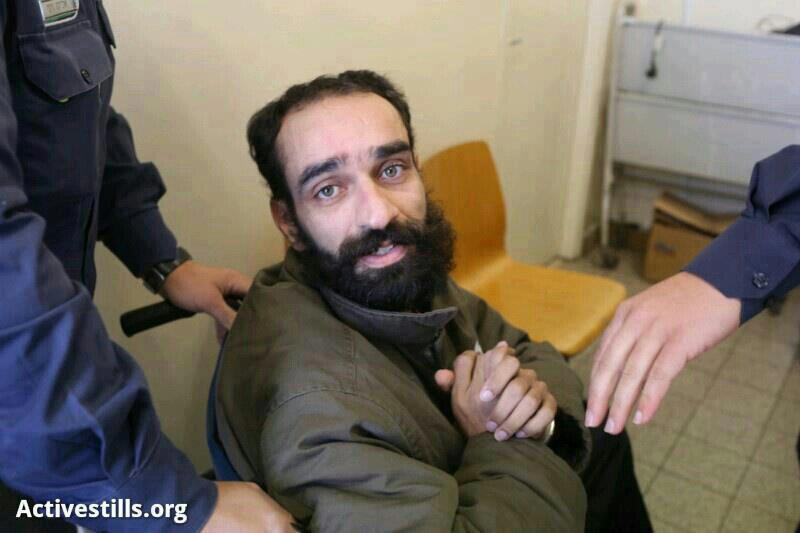
Samer Issawi’s battle isn’t done yet. He is still continuing his hunger strike with great poise for the 115th day till he reaches an absolute agreement that guarantees his release. He knows very well how Israel never holds an agreement and that finding a way around to keep him in custody is always possible.

Today the Israeli Magistrate court issued a release order for Samer on the 6th of March as that court first sentenced him to 8-month imprisonment when he was first arrested. However, this doesn’t guarantee his release. So time for us to celebrate hasn’t come yet. For Samer is a Palestinian, he still has to face another Israeli military court which ordered to hold him captive on the basis of the same accusation; violating his release agreement and entering the West Bank illegally and other charges based on secretive information that no one has the legitimacy to have an access to but their judges.

Remember here that Samer Issawi had been freed after serving 10 years of his 30-year sentence as a part of Shalit’s swap deal that happened between Hamas and Israel on October 18, 2011. He was re-arrested before spending less than 8 months outside jail accusing him of violating his release agreement which is all bullshit and had nothing to do with reality!

Before Samer’s release in Shalit’s swap deal, he was forced to sign a paper that obliges him to never enter the West Bank territories or else he would be re-arrested and continue serving the rest of his 30-year sentence. This is nothing but an inhumane, brutal and humiliating order that comes as an example of the conditional freedom that Samer and all other released prisoners received.

However, even when we think of this unfair charge, no one would be found guilty here but Israel who couldn’t make their mind what the borders of Jerusalem were. Samer was arrested within the municipality of Jerusalem in an area called Kufr Aqab which everyone agrees that it is within Jerusalem. However, they manipulate facts to whatever suits them to prove him guilty.

Currently Ofer military court still insists on this detention order against Samer and that Samer should stay in prison for another two decades to continue what was left from his 30-year sentence! According to Israel’s democracy, there are two approaches in their judicial systems; one serves for the Israeli jews and the other serves for the gentiles, the Palestinian Arabs.

In Israel, if two people, one is a Palestinian and the other is an Israeli Jew, were arrested on some charge, these two go through different judicial procedures. Only in Israel, when a Palestinian convict has to face two types of courts on the same accusation: civil and military court! Does this have any thing to do with justice? This is but an emphasis on that Israel is an apartheid regime. This is injustice and racism.

Samer is done with the Israeli civil court and he still has the military court to face and for that he is still on hunger strike! Our role here is to double our efforts as injustice cannot win!! Free Samer Issawi!

Read Samer Issawi’s letter which he wrote yesterday, February 20, to his supporters whom he thinks that they are not just solidarity activists but “warriors”.

Read more about Samer Issawi’s case here.

Will Samer Issawi be the next victim of medical neglect by the Israeli Prison Service?

6401_10151350325854312_945837052_nReading “With My Own Eyes” by the Israeli lawyer Felicia Langer brought painful scenes to my mind, but my faith in humanity grew deeper. While the Zionists might proclaim “woe to the vanquished,” there were Jewish people in Palestine, such as Langer, who, more profoundly, recognized it was “woe to the victor.” Langer was one who fought bravely against the unjust Israeli system throughout her 23-year career. She defended my father Ismael Abusalama in Israeli courts. He has always spoken about her with admiration and respect for her humanity and firmness.

My father’s story of arrest recorded by Felicia Langer

In her book, she wrote that she met my father on April 6, 1972 in Kafaryouna, an Israeli interrogation center. “Ismael Abusalama, a 19-year-old man who lives in Jabalia Refugee Camp, is a refugee originally from Beit-Jerja.” She mentioned Dad’s cousin who was killed by the Israeli occupation forces after the Six-Day War in 1967. Langer quoted my father’s words, “I saw how children were being brutally shot dead in the Camp’s streets by the Israeli border guards. I witnessed the murder of a little girl who was just leaving her school when an Israeli soldier from the border guards shot her dead. They raid the camp with their thick batons beating up every human. They break into the houses inhabited by women without knocking at their doors. They mix the flour with oil during their aggressive inspections deliberately and without any necessity.”

On page 352, she recorded a painful story of my father’s that she witnessed. While reading it, my heart ached to imagine my father in such brutal conditions. She wrote, “After his arrest in Jabalia Camp on January 1, 1972, they dragged him to the Gaza police center while beating him with batons all the way. They showered him with extremely cold water in winter while soldiers continued to attack him with batons everywhere, and punched him very violently to the extent that he lost his sense of hearing. This continued for 10 days.” She quoted my father saying, “They threatened me with being expelled to Amman and assassinating me there if I didn’t say what they wanted to hear.”

I have no doubt that she tried hard to expose the reality and prove my father and other detainees innocent, but Israel’s unjust judicial system was stronger than her. Her dedicated investigations and defense of the truth didn’t stop Israel from sentencing my father to seven life sentences and 35 years! I appreciate her book, which exposes the injustices of the Israeli occupation and the rotten justice system in Israel. She has always repeated that the aggressor can never win. And I have faith that Israel will never win and Palestine shall be free.

Surprisingly, I only learned this story from her book and haven’t heard it from Dad. When I read that story about him losing his sense of hearing, I asked him about it and he confirmed and continued, “but I was never sent to hospital.”

“Detainees suffer intensively from medical neglect,” he said. “Small health problems can become critical with constant negligence. I thankfully survived, but many others didn’t and were left with permanent disabilities or health problems that led in some cases to their death.”

He stopped for a moment and continued, “Actually, such cases, maybe death isn’t the appropriate word. Murder sounds better.”

Medical neglect is one of the major brutal policies the Israeli Prison Service (IPS) practices intentionally against Palestinian political prisoners which Langer aimed to highlight in her book.

“IPS deliberately aims to harm Palestinian detainees’ physical and mental health in any possible way,” my father repeatedly says and many released prisoners have agreed.  Because of this, access to proper medical care has been always on the top of detainees’ demands whenever they go on mass hunger strikes.

Akram Rickawi’s 102-day hunger strike in protest of medical neglect

Akram Rikhawi, whose 102-day hunger strike ended July 22, 2012 , has chosen to shoulder the responsibility for hundreds of disabled and ill political prisoners who grieve daily behind Israel’s bars and suffer its medical neglect. Since his first day of detention in 2004, he was held in Ramleh prison hospital, described by him and many prisoners as “a slaughterhouse, not a hospital, with jailers wearing doctors’ uniforms.”

Akram ended his hunger strike in exchange for an agreement by Israel for his early release. As part of the agreement, Akram was supposed to be released on January 25, 2013. But it’s been more than a week since that date passed, yet we have heard nothing regarding his release. This is more evidence that Israel never keeps any promises or agreements.

Ramleh stands as a nightmare for many detainees because of the inhumane procedures for them to receive a medical check, such as the long hours of waiting, being shackled from hands to feet, being aggressively treated during transfer from jail to hospital, and being treated as inferior by the racist doctors there. Many former detainees I interviewed repeatedly described this procedure as “torment.” One said, “Only when pain becomes intolerable will many prisoners call the IPS to allow them a visit to Ramleh Hospital Prison. They fear the humiliation and torture once their call is met after a long wait.”

As the Palestinian prisoners’ rights group Addameer recently reported, “Since 1967, over 200 prisoners have died in captivity, fifty-one of them from medical negligence. Alarmingly, there is a recent trend of prisoners who have died shortly after they are released from medical complications that went untreated during their detention.”

On January 22nd,  I came home from my last exam of the semester very happy and relieved that I could finally sleep without worrying about loads of studies. I put myself in bed and decided to check my Facebook before I closed my eyes. I saw a video shared by my friend Loai Odeh that turned my happiness into sadness and my relief into distress. My desire to sleep escaped me.

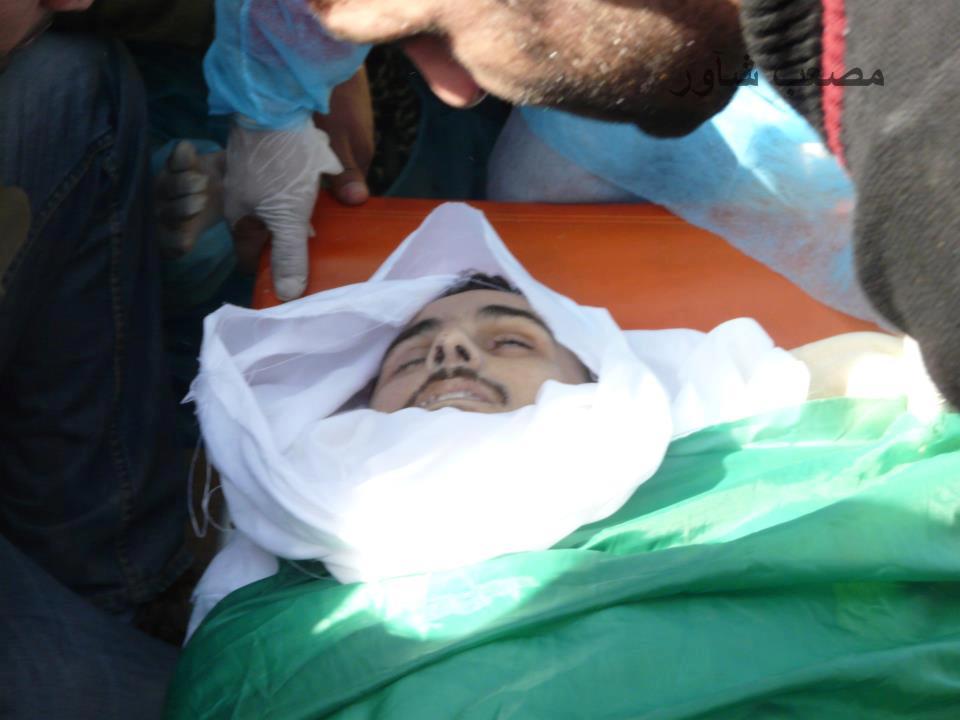
A photo of Ashraf  Abu Dhra' during his funeral (Musab Shawer)

A photo of Ashraf Abu Dhra’ during his funeral (Musab Shawer)

The video’s Arabic title read, “The last words the martyr Ashraf Abu Dhra’ uttered before he fell in a coma.” I had no idea who Ashraf was then. A young man in weak physical shape lay on a hospital bed in the video. While struggling to make his voice as loud and clear as possible, he said, “When I got sick, they only prescribed me paradicamol and released me. When I went to the hospital the medics discovered that I have a severe inflammation. Thank God. My faith eases everything.”

A recently released prisoner fell victim to the IPS’s policy of medical neglect

Then I Googled his name and the ambiguity behind the pronouns he used became no longer ambiguous and learned that Ashraf, a 29-year-old from Hebron, was released recently after a detention of six and a half years in Ramleh prison hospital. Only then did I realize that the pronoun “they” refers to the IPS.

Ashraf was released on November 15, 2012. He spent only ten days outside Ramleh prison hospital at home, surrounded by his beloved family. But those ten days were an extension of the pain he suffered during his imprisonment. Then he fell in a coma until his death on January 21, 2013, which could have been avoided if he had access to better medical care. Israel must be held responsible for the murder of Ashraf.

As Addameer added in their report:

Ashraf had a long history of medical problems that predate his arrest; he suffered from muscular dystrophy and as a result became wheelchair bound in 2008 during his imprisonment. During his detention he contracted several illnesses including lung failure, immunodeficiency and a brain virus that eventually lead to his death.

Due to the frequent denial of medical treatment by the Israeli Prison Service (IPS), Ashraf suffered a slow and painful death that was exasperated by neglect and the prison service’s refusal to provide court-ordered treatment. In 2008, Physicians for Human Rights – Israel (PHR-I) submitted a request to the Israeli district court for Ashraf to receive physical therapy. Although the court granted Ashraf this request, the ruling was ignored by the Ramleh prison hospital, who refused treatment claiming that it was unnecessary. Ashraf was held in captivity despite his failing health for the entirety of his sentence, rarely seeing an independent doctor.

Ashraf’s lack of proper medical treatment in his six and a half years violates several international human rights laws, specifically article 56, 91 and 92 of the Fourth Geneva Convention that obliges the occupying authority to provide “adequate treatment” for each detainee and medical care “not inferior than the care provided to the general population.”

Serious actions must be taken before Samer Issawi become the next victim

12546_407281766026067_694180925_n

Learning about the murder of Ashraf Abu Dhra’ made my worry over Samer Issawi double. Samer’s health is rapidly deteriorating due to his historic and heroic refusal of food which has continued 194 days in protest of his re-arrest for no charge or trial. His hunger is gradually taking over his body, but as he said earlier, “my determination will never weaken.”

He started his battle with a promise that he would only retreat from it as a martyr. Samer has tasted the bitterness of imprisonment for 12 years before. But once he was re-arrested in July 2012, with no charge or trial, he decided to rebel to send a message to his captors that they couldn’t decide his destiny. He doesn’t do this from love for death. He loves life, but in the form he has always longed to have, a life of freedom and dignity.

Serious actions are needed as Samer stands at the edge of death. He suffers from severe pain all over his body, especially in his abdomen and kidney. He has double vision, dizziness, and fractures in his rib cage from a brutal attack by Israeli soldiers while he was handcuffed to his wheelchair at a court hearing. This injury has caused severe and persistent pains that leave him sleepless day and night.

We shouldn’t sit idly and watch Samer slowly die. We don’t want to count more Palestinian detainee as martyrs. If Samer dies, it will be a glory for him, but a shame for us. Our silence allows Israel to cross all red lines. Save Samer from being the next victim of medical neglect after Ashraf Abu Dhra’. Act now to rescue the lives of Samer and all hunger strikers.