UK student union elects Palestine campaigner president

This article was first published at The Electronic Intifada.
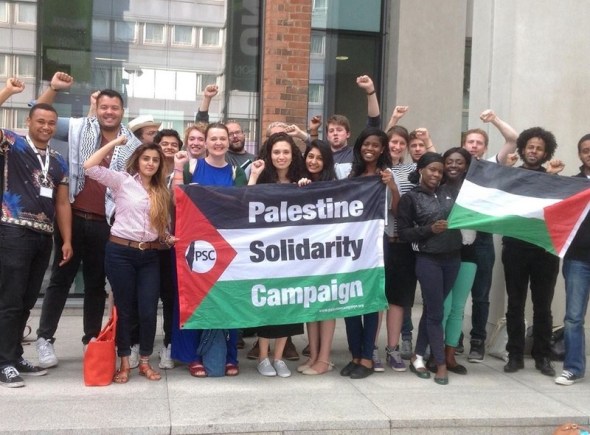
Malia Bouattia (center, holding flag) celebrates passing a 2014 pro-BDS union policy. (NUS NEC)
Anti-racism activist Malia Bouattia was elected president of the UK’s National Union of Students at their conference Wednesday.
Bouattia is well-known for her public stances in support of many causes, including the Palestinian boycott, divestment and sanctions campaign, or BDS. For years she has successfully campaigned in favor of passing BDS resolutions within the NUS.
She has given many speeches encouraging students to back BDS and observe its guidelines within their campuses – especially the boycott of Israeli academic institutions complicit in abuses of Palestinian rights.
After serving as the Black students’ officer, Bouattia will be the first Black Muslim woman elected president in the 94 years of NUS history.
Smears
When the NUS passed its latest BDS motion in June last year, the Israeli prime minister falsely claimed the organization supported Islamic State, the violent extremist group also known as ISIS.
“They boycott Israel but they refuse to boycott ISIS. That tells you everything you want to know about the BDS movement. They condemn Israel and do not condemn ISIS,” Benjamin Netanyahu claimed. He repeated the same allegation on Twitter.
Predictably, right-wing media have recycled this same lie to demonize Bouattia and have also attempted to smear her as anti-Semitic.
But the truth was that the NUS national executive council adopted a resolution at its 3 December 2014 meeting that called for ISIS to be “condemned” as “a reactionary terrorist organization that carries out atrocities” against people of the regions where it operates.
Not only that, but it was Bouattia herself who submitted the motion, speaking in its favor at the meeting where it was adopted with no speakers against it.
The previous September, the executive had rejected a motion on Kurdish solidarity that contained similar language, but its decision had nothing to do with the condemnation of ISIS whatsoever. The resolution was considered flawed because it encouraged students to spy on each other.
The BBC’s website on Wednesday initially claimed that Bouattia had “refused to condemn” ISIS.
After outrage at this false claim was expressed on social media, the BBC appears to have removed that particular lie from the article, but without issuing a correction or apology.
The Tel Aviv newspaper Haaretz reported Bouattia’s victory with the headline, “UK student union’s new president supports Palestinian ‘resistance.’” The article repeats and amplifies the false allegations found in UK media that Bouattia is an ISIS sympathizer.
Smears
Bouattia anticipated these media attacks.
In her winning election speech at the NUS national conference, she said: “I know many of you will have seen my name dragged through the mud by right-wing media. You will have read that I am a terrorist, that my politics are driven by hate.”
“How wrong that is,” she said, given her background of having to flee her home country Algeria and seek refuge in the UK.
As a seven-year-old child, she “saw a country ripped apart by terror” and was “pushed to exile by its doing.”
“I know too well the damage done by racism and persecution. I faced it every day,” she said, promising, “I will continue to fight, in all its forms, whoever its targets, whether it is anti-Semitism, Islamophobia, xenophobia or any other bigoted idea.”
Addressing the prime minister, she said “David Cameron may not like me or our movement, but when we’re strong he’s forced to listen.”
You can watch the rest of her electrifying speech in the video above.
Anti-racist
BDS campaigners, including many Jews, are systemically smeared with the false charge of anti-Semitism by pro-Israel media and campaign groups. So Bouattia is no exception in this regard.
Prior to her victory, several UK Jewish student societies sent her an open letter questioning her “past rhetoric” against Zionism.
She replied in an open letter rejecting the accusations and emphasizing that disagreement over “anti-Zionist politics” is “a political argument, not one of faith.”
Bouattia made sure to draw the distinction between anti-Semitism and anti-Zionism, reaffirming that efforts to conflate them “are dangerous and have become the excuse for many racist and fascist attacks up and down the country and in the world, which I am sure we all want to end.”
Bouattia’s activism is driven by her passion towards fighting racism of all forms.
This has been evident in her campaigning, which has ranged from supporting Holocaust memorial day to efforts to combat Islamophobia.
Zionism is a settler-colonial ideology and practice that led to the establishment of Israel on the ruins of ethnically cleansed Palestinian lands. To this day Israel continues to discriminate against Palestinians based on this ethno-religious ideology, especially by refusing to allow refugees to return to their lands solely on the basis that they are not Jewish.
Islamophobia
Bouattia was one of the main campaigners behind the recent launch of the Students Not Suspects campaign, which aimed at fighting the UK government’s Islamophobic “anti-radicalization” strategy, Prevent.
She appeared in this recent video that aimed to mobilize students and academics to put an end to Prevent on UK campuses.
Prevent “forces colleges and universities to spy on students,” the video explains. It creates “a climate of suspicion around students’ political and religious view,” and promotes “a culture of surveillance and self-censorship,” which is aimed at silencing students and restricting academic freedom.
“Because of the racialized way that counter-terrorism initiatives are formed,” Bouattia says in the video, “it’s black and Muslim students that are most at risk. And so far they’ve been disproportionately targeted.”
The video also mentions two cases previously reported by The Electronic Intifada: the academic conference on Israel at Southampton University which has been banned two years in a row, and the Bath University conference on conflict in the modern world which was subjected to UK and Israeli government monitoring last year.
Bouattia’s election is a sign of changing times in the UK student movement.
Back in 2009, the then president of NUS Wes Streeting not only campaigned against BDS, he went so far as to join an Israeli government anti-BDS working group in Jerusalem which slandered the nonviolent civil society movement as “evil.”
Now a right-wing MP in the Labour party, Streeting Wednesday reacted to the election of the first non-white NUS president in the union’s history by claiming that the “NUS is lost.”
Students protest SOAS director’s meeting with Israeli Ambassador Mark Regev


On Wednesday, Mark Regev tweeted his picture with SOAS director Valerie Amos after what he called “good meeting”.
Students at SOAS, the School of Oriental and African Studies, University of London, protested on Thursday over an unannounced meeting between their institution’s director and Mark Regev, the new Israeli ambassador to the United Kingdom.
Previously the Israeli prime minister’s spokesperson, Regev is a familiar face on television screens where he has often defended military attacks on Palestinians.
He started his new role as ambassador in London on Monday.
On Wednesday, Regev posted on Twitter a photo of himself posing with SOAS director Valerie Amos, after they had had what he termed a “good meeting.”
Dozens of students gathered outside SOAS Thursday chanting: “BDS go! Amos and Regev no!”
Students also protested outside Amos’ office, calling for a free Palestine.
A Facebook page set up by protest organizers stated that “by accepting the ambassador’s visit, Valerie Amos and SOAS as an institution are complicit in … ongoing colonialism.”
Apology demanded
A coalition of student societies issued a statement condemning the meeting, saying they considered it “a flagrant violation of the principles of the boycott, divestment, and sanctions (BDS) movement, which the SOAS Students’ Union overwhelmingly voted to support in the largest student referendum ever held at SOAS last year.”
The groups demanded an explanation, and for Amos “to apologize for meeting with Mark Regev … and to accept our invitation to work together on applying the result of the democratic BDS referendum to the university.”
In an emailed response to the student union, Amos said: “I met the Israeli ambassador to follow up on a letter I had sent him about the detention and treatment of a SOAS research student at Ben Gurion airport.” She added that she saw this “as an important part of my responsibility as director.”
But Zeid Shuaib, a Palestinian student at SOAS told The Electronic Intifada that “this visit has a political message. This is an attempt to undermine BDS, and specifically the SOAS community’s relentless support for BDS.”
An Israeli journalist on a visit to the London embassy recently reported on the “war room”-style map which details “the main campuses, the deployment of pro-Israel activists and the location of the ‘enemy forces.’”
It seems likely SOAS students are considered among such “enemy forces.”
Boycott
In February last year, SOAS students celebrated a huge victory after a referendum to endorse an academic boycott of Israel.
An overwhelming 73 percent voted in favor.
But the coalition of student groups protesting the Regev meeting charged the administration with disregarding the result.
“The student societies that supported the BDS referendum have made effort after effort to engage management to ensure that the governance of the university is kept democratic and have only been met with intimidation and aggression,” the groups said.
Relentless
While Regev was the Israeli prime minister’s chief spokesperson, he relentlessly justified Israel’s wars to the world’s media, including in the UK.
Whether it was the 2006 invasion of Lebanon, or its repeated “mowing the lawn” massacres in Gaza, Regev was there to excuse Israel’s killing of civilians.
SOAS student Roba Salibi said, “we will continue to mobilize and put pressure on the management to turn our BDS referendum result into actions, and ensure that such an offensive and outrageous act does not happen again.”
















 PALESTINE FROM MY EYES